The Household Formation Gap: California’s Hidden Housing Demand Driver
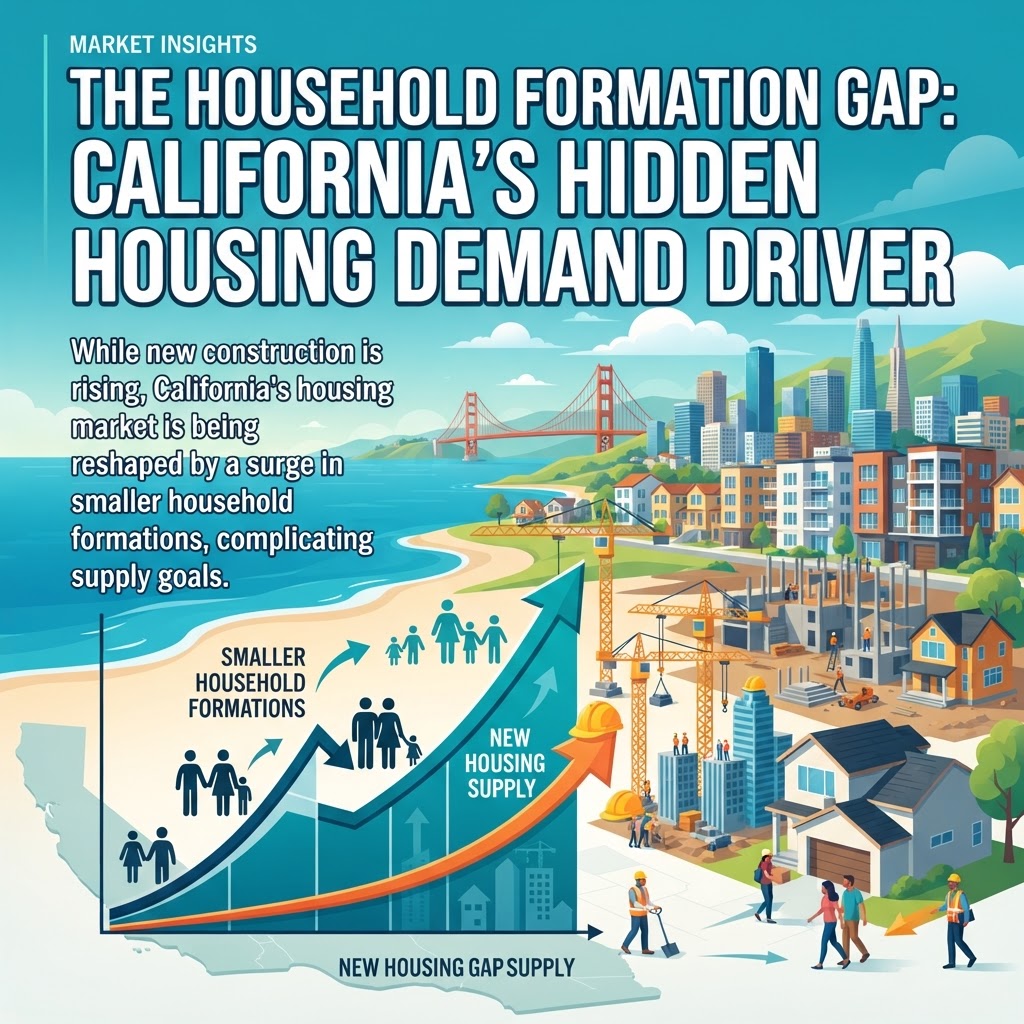
For years, the narrative surrounding California’s housing market has focused on the binary of supply versus demand. However, as we move through the latter half of 2026, a more nuanced trend is emerging: the decoupling of population growth from housing demand. While the state’s total population has remained relatively stagnant, the demand for residential units continues to climb, driven by a fundamental shift in how Californians live.
The Demographic Micro-Shift
The primary engine of current demand is not net migration, but rather the proliferation of smaller households. As demographics shift, more individuals are forming independent living arrangements, effectively increasing the number of units required to house the same number of people. According to recent analysis, this trend is creating a 'hidden' demand that current construction pipelines are struggling to satisfy, even as new permits in major metros like the Bay Area and Los Angeles have seen a 12% year-over-year increase in recent cycles.
Supply vs. The 'Formation' Reality
While builders are making progress, the state remains stuck in a cycle of low transaction volume. As of August 2026, statewide existing single-family median prices have rebounded to $901,420, yet annualized sales remain below the 300,000-unit mark for the 47th consecutive month. This suggests that while new construction is helping to alleviate some pressure, it is not yet sufficient to offset the structural deficit created by these changing household patterns.
Practical Takeaways for Market Participants
- For Investors: Focus on 'missing middle' housing. Properties that cater to smaller, single-person or two-person households—such as ADUs or urban infill townhomes—are increasingly insulated from the volatility of the luxury single-family market.
- For Buyers: Recognize that the 'balanced' market—where homes sell at roughly 100% of list price—is a reflection of low inventory rather than a cooling of demand. In this environment, speed and financing readiness remain the most critical competitive advantages.
- For Sellers: With the median days on market hovering around 53 days, pricing accuracy is paramount. The market is no longer rewarding aggressive over-pricing; properties that align with current appraisal realities are moving, while those that do not are lingering in a 'neutral' zone.
Ultimately, California’s housing market is not merely waiting for interest rates to normalize. It is undergoing a structural recalibration where the definition of 'housing need' is being rewritten by the rise of smaller, more fragmented household units. Understanding this shift is essential for anyone looking to navigate the state's complex real estate landscape through 2028.


