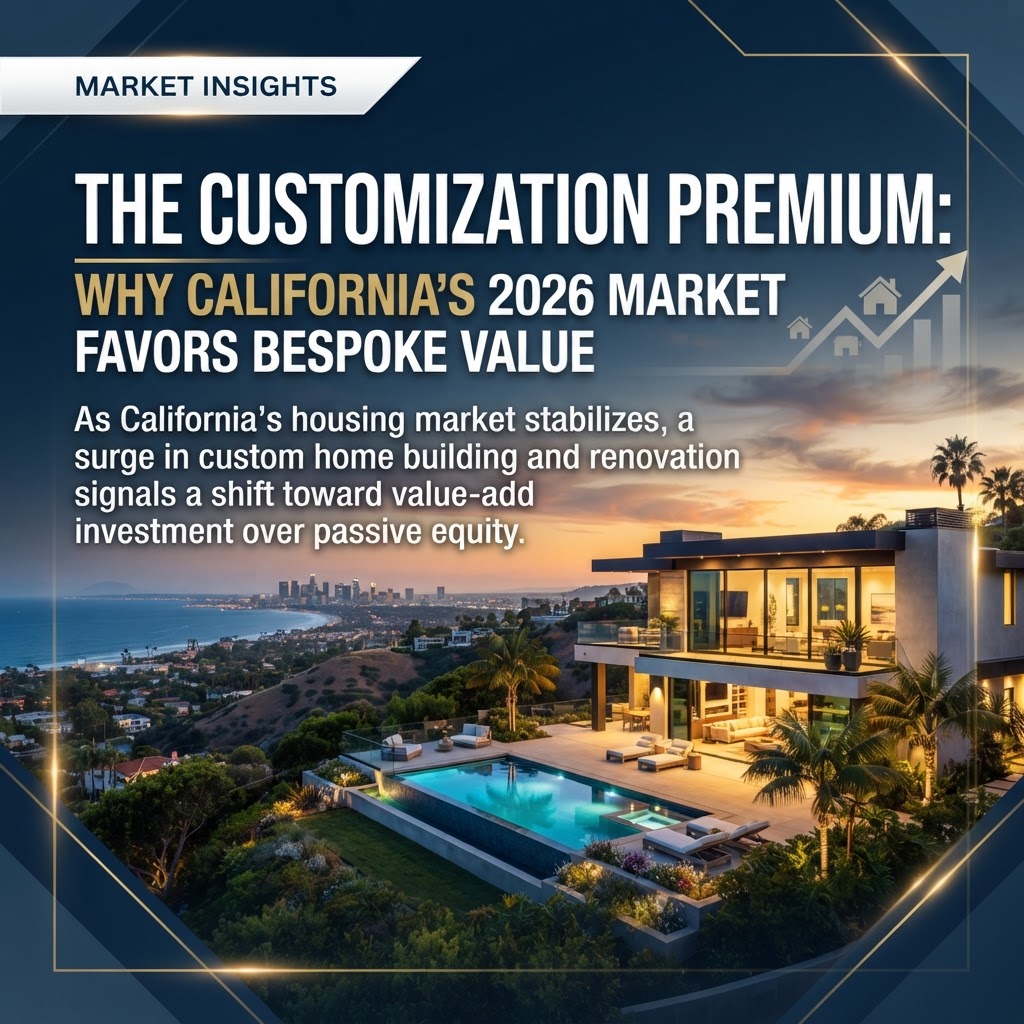
The Customization Premium: Why California’s 2026 Market Favors Bespoke Value
As of October 2026, the California real estate landscape has moved past the volatility of the early decade, settling into a period of measured, albeit expensive, equilibrium. With the statewide median home price hovering near $904,640 as of mid-2026, the market is no longer defined by the frantic, broad-based appreciation of previous years. Instead, a new trend is emerging: the rise of the 'Customization Premium.' Data indicates that while general market turnover remains constrained by inventory, interest in custom home building has surged by over 122% year-over-year, signaling a fundamental shift in how buyers and investors view asset value.
The Shift from Passive Equity to Active Value-Add
For years, California investors relied on passive appreciation to drive returns. However, with mortgage rates stabilizing in the 6.65%–6.75% range, the math for traditional 'buy-and-hold' strategies has tightened. Investors are increasingly pivoting toward properties that offer immediate opportunities for value enhancement. The 122% spike in search volume for custom home builders suggests that the market is rewarding those who can deliver modern, efficient, and personalized living spaces rather than those simply holding aging inventory.
Data-Driven Market Realities
- Inventory Constraints: With active listings down 5.6% year-over-year as of mid-2026, the scarcity of move-in-ready, high-quality housing continues to drive prices upward in desirable enclaves.
- Regional Divergence: While the statewide median price saw a slight cooling from May’s record $930,260, regional performance remains varied. The Far North saw a 23.3% increase in sales activity, while the San Francisco Bay Area maintains a high-barrier-to-entry median of $1.4 million.
- Affordability Gap: With housing affordability stuck at approximately 18%, the market is bifurcating. Entry-level buyers are increasingly looking toward inland regions like the Central Valley, where median prices remain closer to $514,800.
Practical Takeaways for 2026
For Investors: Focus on 'Policy Arbitrage.' Properties that can be easily modified to meet current housing bills or zoning incentives—such as those allowing for increased density or flexible usage—are outperforming standard residential assets. The market is currently favoring those who can navigate local regulatory environments to unlock hidden square footage.
For Sellers: The 'Customization Premium' is real. Properties that have undergone recent, high-quality renovations are commanding a disproportionate share of buyer attention. If you are considering a sale, prioritize cosmetic and functional upgrades that align with modern remote-work needs, as these features are currently driving the highest price-per-square-foot metrics.
For Buyers: In a high-rate environment, look for 'value-gap' properties. Rather than competing for turnkey homes in hyper-competitive urban cores, consider properties in emerging suburban corridors that offer the potential for custom expansion. The cost of renovation, while significant, is often more predictable than the cost of bidding wars in supply-constrained markets.
Conclusion
The California market in late 2026 is not a monolith. It is a collection of micro-markets where the winners are those who treat real estate as an active, value-add enterprise. By focusing on customization and strategic asset improvement, stakeholders can navigate the current inventory drought and capitalize on the enduring demand for high-quality, functional housing in the Golden State.