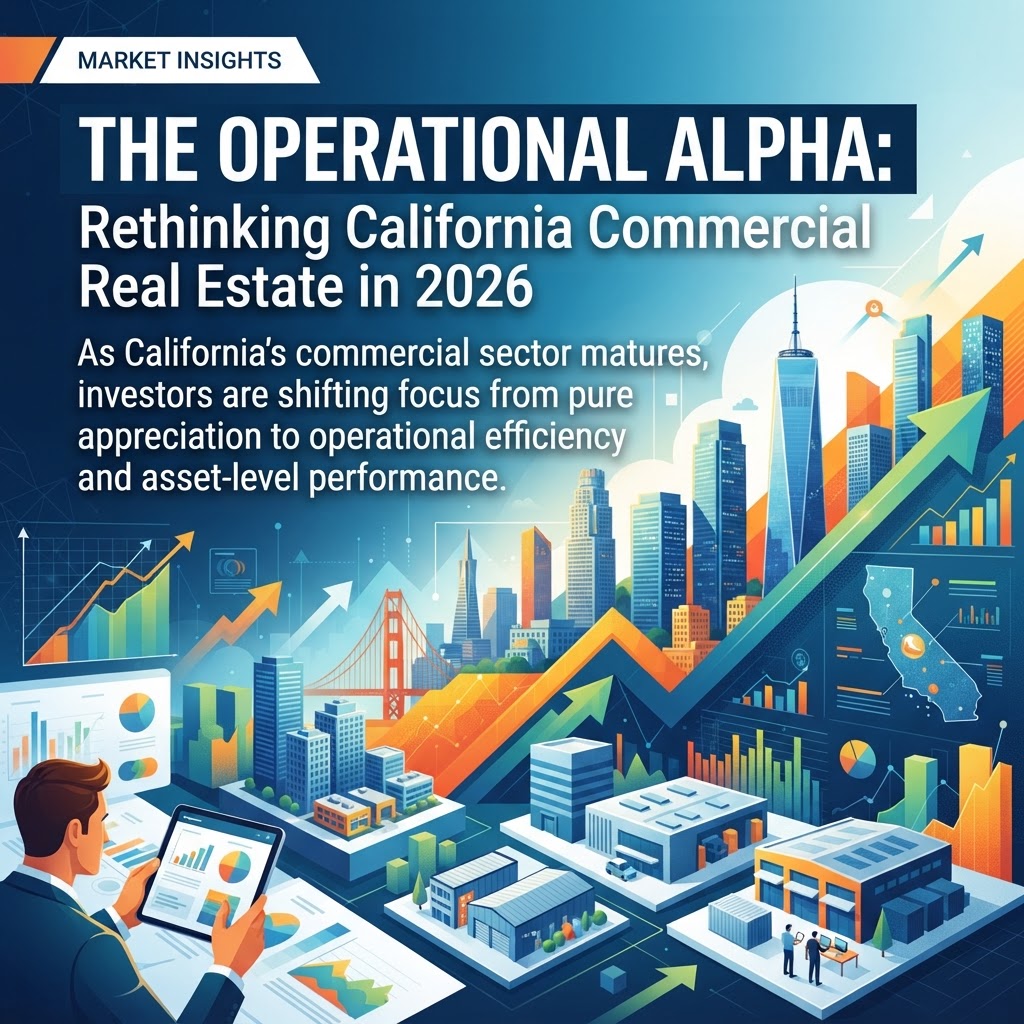
The Operational Alpha: Rethinking California Commercial Real Estate in 2026
The California commercial real estate landscape is undergoing a fundamental transition. As we move through the latter half of 2026, the era of passive, yield-driven investment is being replaced by a focus on 'Operational Alpha'—the ability to generate superior returns through active management, technological integration, and precise asset positioning.
The Shift from Macro to Micro
While national headlines often focus on interest rate volatility, the California market is increasingly defined by micro-trends. Investors are moving away from broad-brush regional strategies and toward hyper-local asset management. According to recent industry analysis, the value proposition for commercial properties is no longer tied solely to location, but to the building's ability to meet modern tenant demands for sustainability and connectivity.
Key Drivers of Asset Performance
- Technological Integration: Properties that lack smart-building infrastructure—such as automated energy management and high-density connectivity—are seeing a widening valuation gap compared to 'future-proofed' assets.
- Adaptive Reuse Potential: With the ongoing evolution of work patterns, assets that offer flexibility in floor plates and mixed-use potential are commanding premium lease rates.
- Sustainability as a Financial Metric: ESG (Environmental, Social, and Governance) criteria are no longer just corporate mandates; they are now critical components of risk assessment and insurance underwriting in California.
Practical Takeaways for Investors
For those navigating the current market, the strategy must shift from acquisition-heavy models to value-add operational models:
- Audit Operational Expenses: In a high-cost environment, small efficiencies in utility management and maintenance can have a disproportionate impact on Net Operating Income (NOI).
- Prioritize Tenant Retention: With supply constraints in specific sub-markets, the cost of tenant turnover is rising. Investing in tenant experience and building amenities is now a defensive necessity.
- Focus on Specialized Properties: Industrial and specialized logistics properties continue to show resilience, but investors should scrutinize local zoning and infrastructure capacity before committing to new developments.
Conclusion
The California market in 2026 is not for the passive investor. Success now requires a granular understanding of building performance and a commitment to operational excellence. By focusing on the 'Operational Alpha'—the tangible improvements made within the four walls of an asset—investors can navigate the current economic headwinds and position themselves for long-term stability.