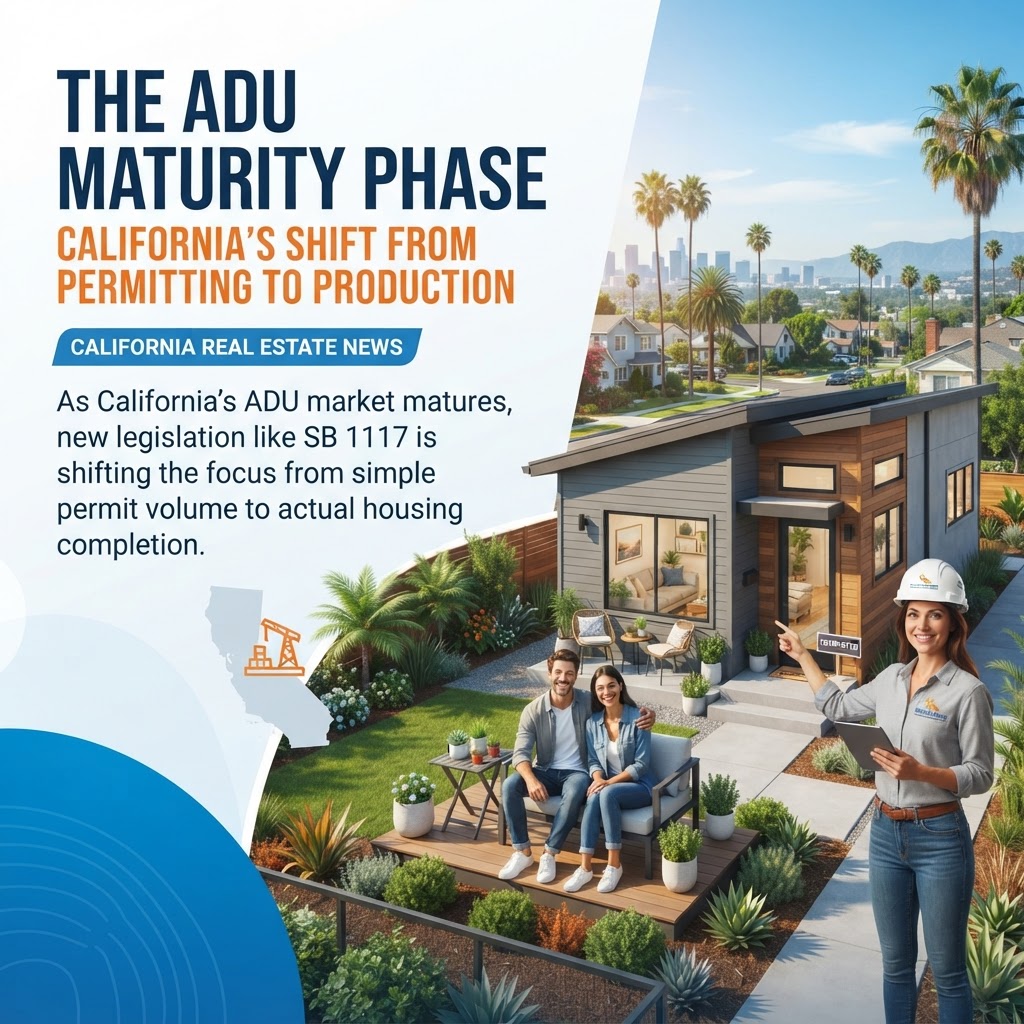
The ADU Maturity Phase: California’s Shift from Permitting to Production
For years, California’s Accessory Dwelling Unit (ADU) strategy was defined by a race for permits. As of September 2026, the narrative has fundamentally shifted. With the state moving past the initial 'gold rush' of approvals, the focus has turned toward the practical realities of construction, cost-efficiency, and the legislative fine-tuning required to turn paper permits into actual housing units.
From Paper to Pavement
Data from regions like San Diego County illustrate this transition. While permit volumes surged—tripling between 2020 and 2024—the current market is defined by a higher ratio of completions to permits. Homeowners are no longer just testing the regulatory waters; they are following through on construction. In unincorporated San Diego, ADUs now account for nearly 45% of all newly permitted housing units, signaling that these structures are no longer a niche addition but a primary engine of residential growth.
Legislative Refinement: The Role of SB 1117
The transition to a production-heavy market has exposed friction points, particularly regarding development impact fees. Recognizing that high costs can stall projects even after permits are secured, the state legislature recently advanced SB 1117. This bill is designed to clarify and strengthen existing ADU laws by specifically targeting the reduction of impact fees, which have historically acted as a barrier to entry for middle-income homeowners.
This legislative push complements the broader 2026 housing package, which includes measures to tighten local review timelines and limit the ability of municipalities to use discretionary loopholes to block density. By reducing entitlement risk, the state is attempting to stabilize the construction pipeline.
Practical Takeaways for Stakeholders
- For Homeowners: With the passage of new fee-reduction measures, the financial feasibility of detached ADUs is improving. However, competition for licensed contractors remains high. Prioritize contractors with a proven track record of navigating the updated 2026 energy and coastal commission guidelines.
- For Investors: The 'ADU-driven' housing production model is now a validated trend in suburban and unincorporated areas. Look for properties with larger lot sizes where detached ADUs are feasible, as these are increasingly becoming the primary mechanism for density in otherwise restricted single-family zones.
- For Developers: The regulatory landscape is shifting toward ministerial approvals. Focus on projects that align with the new height and density standards (up to 100 units per acre in specific transit-adjacent zones) to minimize the risk of local administrative delays.
As California enters the final quarter of 2026, the ADU market is proving that it is no longer just a policy experiment. It has become a structural component of the state’s housing supply, provided that the current momentum in construction completion can keep pace with the legislative efforts to lower costs.