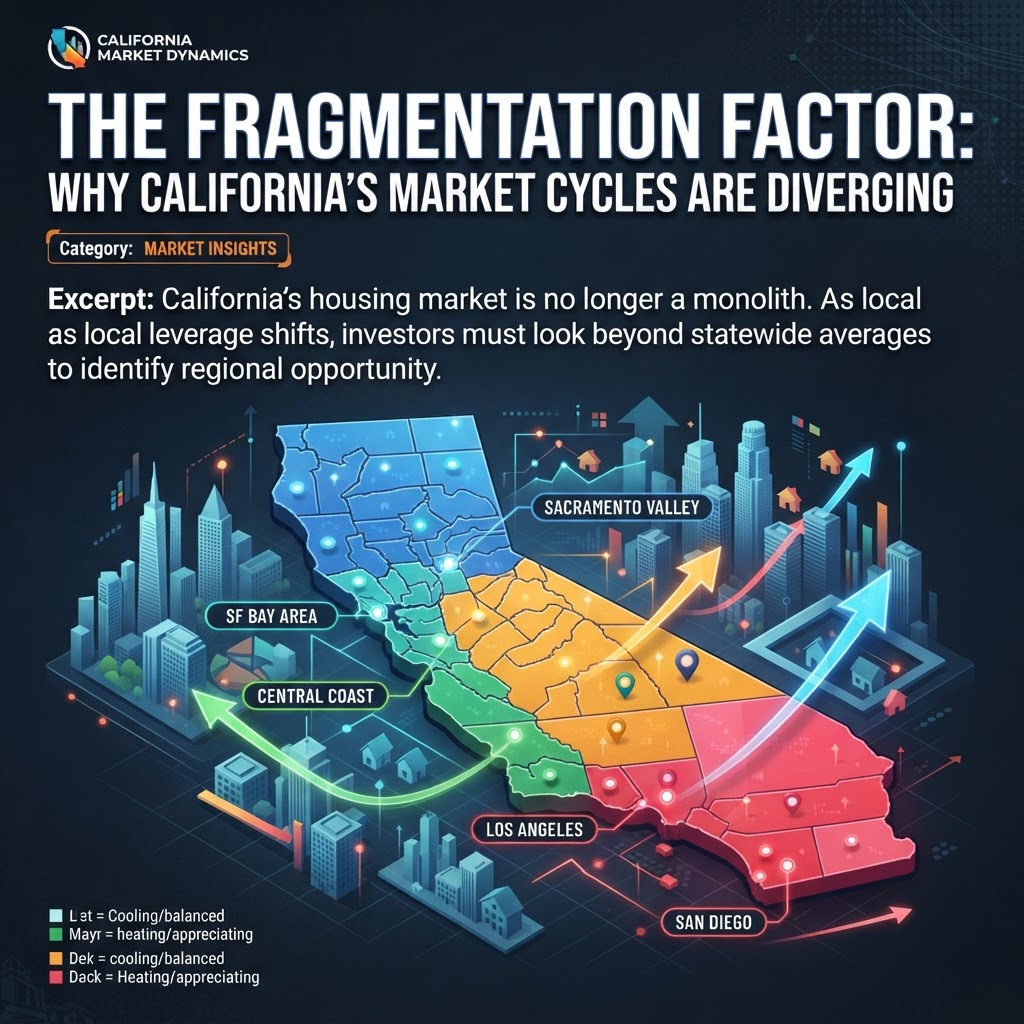
The Fragmentation Factor: Why California’s Market Cycles Are Diverging
For years, California’s real estate narrative was defined by a singular, statewide trend: relentless appreciation driven by chronic undersupply. However, as of late 2026, the state’s housing landscape has entered a period of profound fragmentation. While national headlines often paint a picture of a cooling market, California’s reality is a patchwork of localized cycles that defy broad generalizations.
The End of the Monolithic Market
Recent data from the Realtor.com Market Clock illustrates this divergence clearly. While the state has implemented over 180 housing reforms aimed at streamlining development, these policies have not synchronized the state’s diverse metros. Instead, we see a "fragmented clock" where San Francisco operates as an early seller’s market, while inland regions like Riverside have shifted further toward balanced territory. This suggests that local economic drivers—rather than statewide policy—are now the primary determinants of buyer-seller leverage.
Data-Driven Realities
As of mid-2026, the statewide median home price sits at approximately $914,810, according to recent market reports. While this represents a stabilization from previous peaks, the underlying inventory dynamics are shifting. Active listings have increased by 18% year-over-year, pushing the months of supply to 3.4 months—the highest level since late 2019. Despite this, affordability remains a critical bottleneck, with only 18% of California households currently able to afford a median-priced home.
Investment Perspectives: Moving Beyond the Average
For investors, the "statewide average" is becoming a dangerous metric. The current market environment rewards those who analyze micro-markets rather than macro trends. Key takeaways for stakeholders include:
- Prioritize Localized Demand: Investors should focus on regions where job growth in emerging sectors is outpacing housing starts. The "tech-infrastructure" spillover is creating pockets of demand that are insulated from broader cooling trends.
- Leverage the Balanced Shift: As the market moves toward a more balanced state, buyers have more room for negotiation than they have had in years. Sellers, conversely, must adjust expectations to reflect the increased inventory competition.
- Monitor Regulatory Impact: While land-use reforms are intended to increase supply, their impact is uneven. Focus on municipalities that are actively utilizing these reforms to accelerate permitting, as these areas will likely see the most significant shifts in housing stock over the next 24 months.
Ultimately, the 2026 California market is not experiencing a uniform correction or a crash. It is undergoing a structural recalibration where the "California premium" is being tested by local supply-demand imbalances. Success in this environment requires a granular approach, moving away from state-level assumptions and toward a deep understanding of the specific economic and demographic forces shaping individual zip codes.


