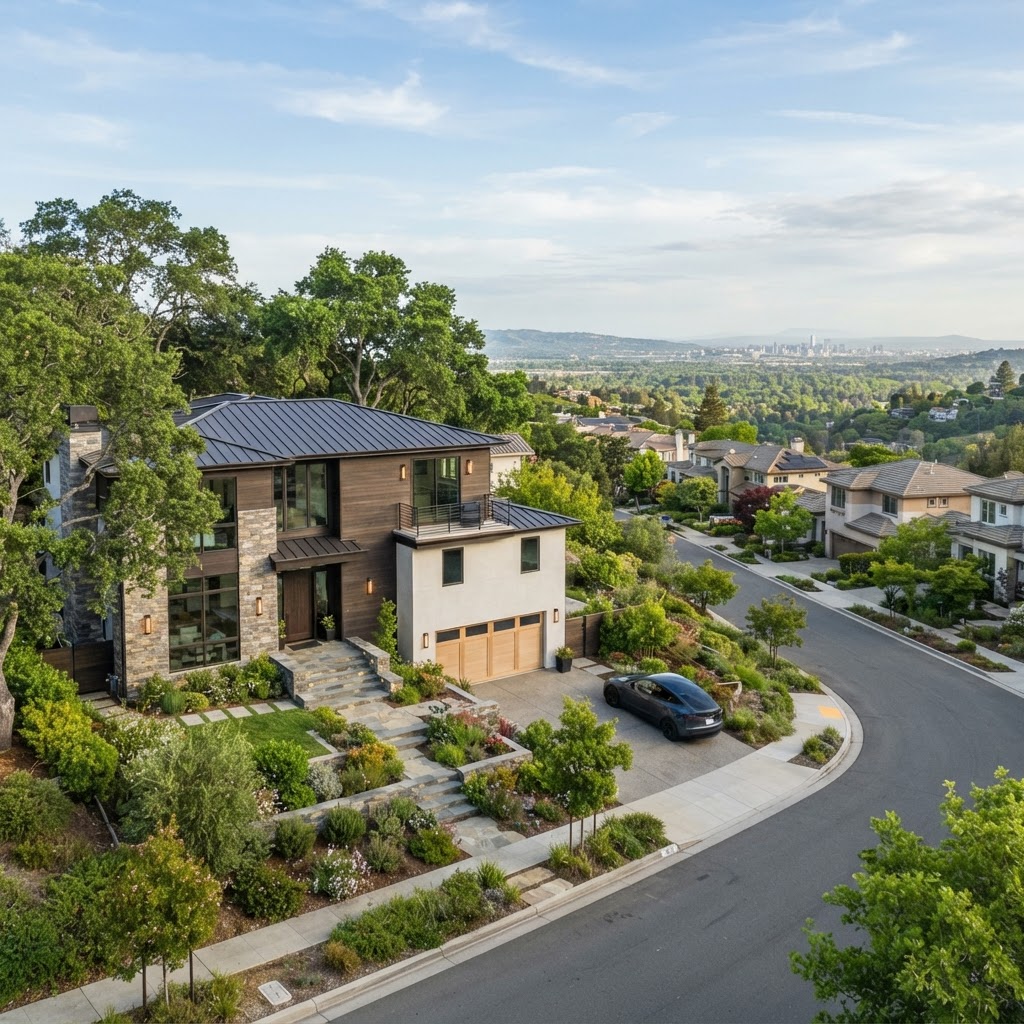
Redwood City’s Farm Hill: The Peninsula’s Strategic Value Play in 2026
For buyers navigating the hyper-competitive Silicon Valley real estate market, the search for value often leads to a compromise between commute times and school quality. In 2026, Redwood City’s Farm Hill neighborhood has emerged as a compelling middle ground, offering a distinct alternative to the premium pricing found in neighboring Palo Alto or Menlo Park.
A Strategic Peninsula Position
Farm Hill is defined by its elevated topography and proximity to the I-280 corridor, providing a critical advantage for commuters. While many Peninsula neighborhoods struggle with the congestion of the El Camino Real or the 101, Farm Hill residents benefit from a more direct route to major tech campuses. As of May 2026, the median single-family home price in Redwood City sat at approximately $2.47 million, representing a roughly 40% discount compared to the ultra-luxury markets just a few miles north [3].
Community Features and Amenities
The neighborhood is characterized by its hilly terrain, which provides many properties with sweeping views of the Bay Area. Unlike the dense, flat urban grids of downtown Redwood City, Farm Hill maintains a suburban, residential feel. The area is anchored by proximity to Emerald Hills, creating a cohesive pocket of quiet, tree-lined streets that appeal to families and professionals seeking a reprieve from the high-intensity pace of the tech industry.
Schools and Infrastructure
Education remains a primary driver for property values in this enclave. The neighborhood feeds into highly regarded local schools, which, combined with the area's relative affordability, makes it a perennial target for young families moving from San Francisco or the inner East Bay. Furthermore, the implementation of California’s SB 79 transit housing law, which took effect July 1, 2026, is beginning to reshape zoning near regional transit hubs, potentially increasing the long-term desirability of Redwood City as a whole by incentivizing more efficient land use near Caltrain stations [3].
Practical Takeaways for Buyers and Investors
- ADU Potential: With California’s updated 2026 ADU laws, homeowners in Farm Hill are finding it faster and more cost-effective to add secondary units. For investors, this provides a dual-income stream; for owner-occupiers, it offers a path to offset mortgage costs [3].
- The Value Gap: Buyers should monitor the price delta between Farm Hill and the northern Peninsula cities. As remote-ready professionals continue to prioritize space and school quality, the relative value of this neighborhood remains a strong hedge against market volatility.
- Transit Planning: Keep a close eye on how the new SB 79 zoning changes impact the downtown Redwood City corridor. Increased density near transit often creates a 'halo effect' on surrounding residential neighborhoods, potentially boosting long-term equity [3].


