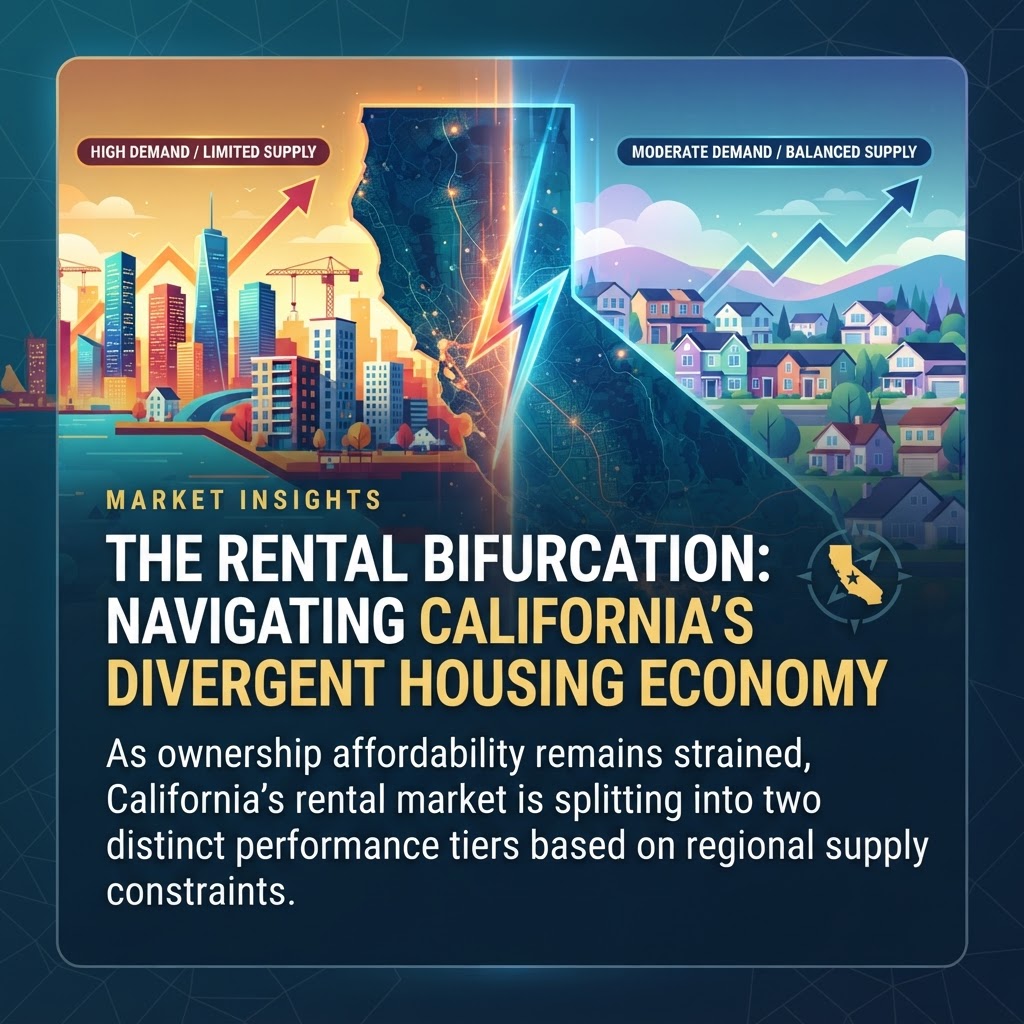
The Rental Bifurcation: Navigating California’s Divergent Housing Economy
In mid-2026, the California real estate landscape is defined by a persistent affordability gap that has fundamentally altered the relationship between homeownership and rental demand. While statewide median home prices hover near $904,640 [8], the market is no longer moving in lockstep. Instead, we are witnessing a distinct bifurcation in rental performance that investors and tenants must navigate.
The Two-Tiered Rental Reality
The state’s rental market is effectively splitting into two segments based on local supply dynamics. In supply-constrained coastal hubs—specifically San Francisco, Silicon Valley, and San Diego—vacancy rates remain below 5% [8]. In these regions, the high barrier to entry for homeownership acts as a permanent floor for rental demand, allowing for consistent rent growth of 4-5% for well-managed assets [8].
Conversely, secondary markets are seeing a different trend. As inventory levels across the state have risen to 3-4 months of supply—the highest level since 2019 [3]—the pressure on rental pricing in less dense areas is beginning to moderate. Investors should note that while statewide active listings have reached approximately 146,000 to 153,000 units [3], this supply is not distributed evenly, creating localized pockets of competition.
Economic Headwinds and Consumer Sentiment
The real estate sector is operating against a backdrop of broader economic caution. Recent surveys indicate that 68% of Californians expect difficult economic times in the coming year [2]. This sentiment is reflected in household spending, with three in ten Californians reporting that they have cut back on food expenses to manage their finances [2]. For landlords and property managers, this suggests that tenant retention is becoming as critical as rent growth; a stable, long-term tenant is increasingly valuable in an environment where household financial stress is rising.
Practical Takeaways for Market Participants
- For Investors: Focus on the "Coastal Premium." Assets in supply-constrained metros continue to offer the best hedge against volatility due to structural housing shortages. Avoid over-leveraging in secondary markets where rising inventory could lead to stagnant rent growth.
- For Tenants: The increase in statewide inventory provides more negotiating power than in previous years [3]. In non-coastal regions, tenants should leverage the higher vacancy rates to negotiate lease terms or amenities.
- For Market Observers: Monitor the divergence between median home prices and rental yields. As home prices stabilize—with some counties like Ventura seeing slight year-over-year price declines [10]—the traditional "buy vs. rent" calculation is shifting, potentially keeping more households in the rental pool for longer durations.


