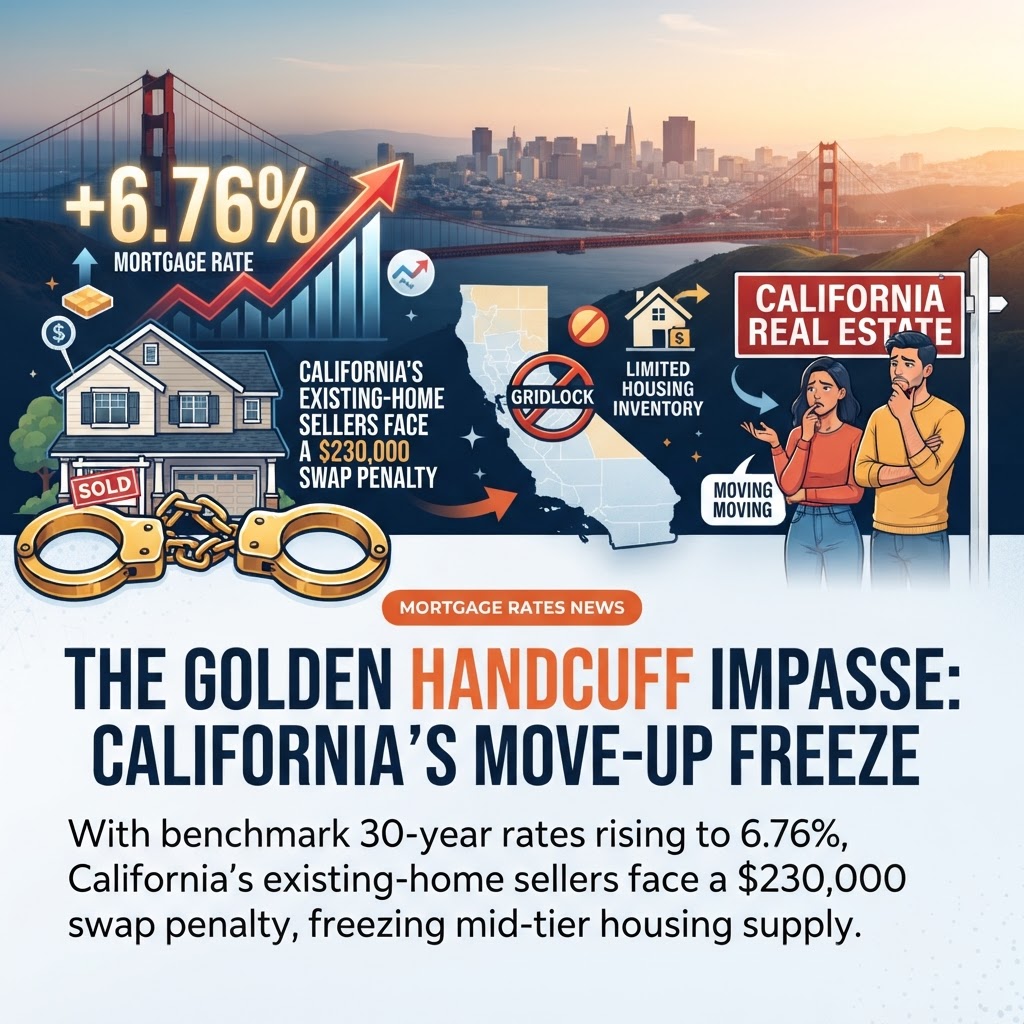
The Escalating Rate Benchmark and the Existing-Home Logjam
National borrowing costs continued their late-summer climb during the second week of September 2026. According to the Freddie Mac Primary Mortgage Market Survey released September 10, the U.S. 30-year fixed-rate mortgage rose to an average of 6.76%, climbing five basis points from 6.71% the prior week and advancing steadily from 6.66% in late August. Shorter-duration 15-year fixed loans similarly climbed to 6.09%, while daily tracking from NerdWallet pegged headline 30-year APRs near 6.98% as of Sunday, September 13.
While rising rates exert downward pressure on borrowing power across the nation, their impact is acutely magnified across the Golden State. Rather than prompting wholesale price drops, persistent rate elevations near 7% have intensified the lock-in effect—often called the "golden handcuff" phenomenon—freezing the traditional move-up cycle that historically fuels California's suburban housing ladder.
The Mathematical Reality of the California Swap Penalty
Data from the California Legislative Analyst’s Office (LAO) highlights the severity of this gridlock. As of 2026, approximately 76% of California homeowners hold an active mortgage with an interest rate below 5%, with a substantial share locked beneath 3.5% from early-decade refinances.
According to the LAO, an existing homeowner exchanging their current property for a similarly priced home at prevailing interest rates incurs an estimated $230,000 in additional interest payments over the life of a standard 30-year loan—raising baseline monthly housing expenditures by roughly 13% for no change in home equity. When combined with the California Association of Realtors (C.A.R.) median home price of $904,640, the friction of trading an existing low-coupon mortgage for new financing at 6.76% creates an insurmountable financial penalty for families seeking to trade their starter homes for mid-tier housing.
As a result, move-up supply has ground to a near standstill. The LAO notes that only 22% of California households currently earn the qualifying income necessary to purchase a mid-tier home, down sharply from 31% in 2019, while statewide housing affordability hovers at a constrained 18%.
Mid-Tier Market Paralysis and Shifting Inventory
Rather than seeing supply swell as purchasing activity cools, the market is characterized by constrained choice. Active listings statewide stood at roughly 108,753 homes according to Redfin tracking via ManageCasa, remaining down 5.6% year-over-year. Move-up homeowners—who traditionally list three-bedroom suburban homes to purchase four-bedroom or multi-generational residences—are simply choosing to remodel or age in place rather than relinquish sub-4% debt.
This behavior is producing a two-speed California housing market:
- Starter and Entry-Tier Inventory: Extremely thin supply, as first-time buyers compete over a limited number of entry-level listings where only 44% of households currently qualify.
- Move-Up and Lateral Markets ($900,000 to $1.4M): A standoff between prospective buyers unwilling to absorb monthly debt payments exceeding $4,500 and move-up sellers who refuse to list because replacing their existing debt structure is prohibitively expensive.
Actionable Strategies for Navigating the Lock-in Gridlock
For buyers, current owners, and real estate investors working through California’s locked housing market, strategic adaptations are necessary to bridge this structural gap:
1. Target Government Assumable Loans (FHA & VA)
Buyers looking at homes purchased between 2020 and 2022 should instruct their brokers to investigate whether the seller has an existing FHA or VA mortgage. These government-backed loans are assumable, meaning qualified buyers can take over the seller’s low rate (often between 3% and 4%). While the buyer must cover the "equity gap"—either in liquid cash or via a subordinated second mortgage or HELOC—assuming a low-rate balance can save hundreds of dollars each month compared to originating a new conventional loan at 6.76%.
2. Existing Homeowners: Prioritize ADU Additions Over Relocating
Rather than paying an extra $230,000 over 30 years to gain an additional bedroom or office space, California homeowners are leveraging state ADU (Accessory Dwelling Unit) mandates. Financing an ADU via a home equity line of credit (HELOC) or fixed-rate home equity loan allows owners to preserve their first-lien low mortgage rate while securing added living space or creating supplemental rental income.
3. Investors: Target Markets with Divergent Price-to-Rent Spreads
With LAO data reporting that California monthly mortgage payments for typical homes exceed local market rents by roughly 66% ($4,600 per month to own versus $2,700 to rent), landlord tenant retention is sitting at multi-year highs. Investors targeting secondary metros in the Inland Empire and Central Valley should underwrite acquisitions assuming longer tenancy lifespans, as would-be first-time buyers remain in the rental pool longer while rates hover near 7%.
The Path Ahead
Until macroeconomic conditions nudge 10-year Treasury yields lower or statewide wage gains systematically outpace home price appreciation, California's existing-home supply will remain heavily governed by the locked-in mortgage rate spread. Participants in the 2026 market must build their strategies around capital conservation, loan assumability, and equity preservation rather than expecting an abrupt flood of move-up inventory.


