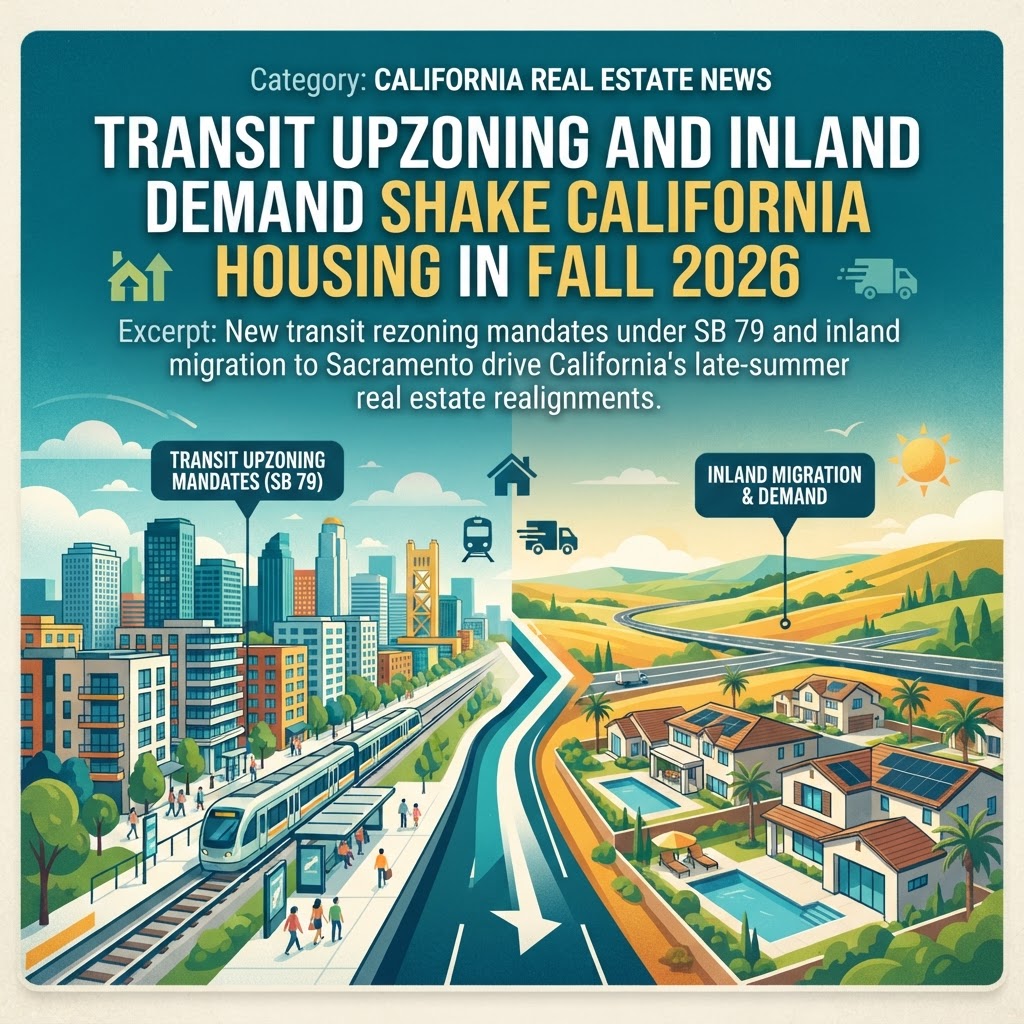
As California enters the post-Labor Day fall market of 2026, the state’s residential landscape is experiencing a sharp structural realignment. While long-term housing supply constraints continue to dictate overall price baselines, a powerful convergence of newly enacted transit-oriented zoning laws and sustained inland migration is actively reshaping transaction volume and development pipelines across major metro corridors.
SB 79 and Infill Zoning Reforms Redefine Development Corridors
The centerpiece of California's latest regulatory wave is Senate Bill 79, which recently went into full effect across high-density counties including Santa Clara, San Mateo, and Alameda. SB 79 fundamentally overrides conventional local municipal zoning limits within defined radii of major transit stations, allowing higher-density residential developments by right, as outlined by legal and land-use analyses from AL Homes Builder and legal insights from Holland & Knight.
Coupled with enforcement measures under SB 786 and procedural streamlining under recent California Environmental Quality Act (CEQA) infill exemptions, developers are aggressively repositioning capital along regional transit hubs. According to recent building permit analytics from Shovels.ai, traditional single-family permitting has stabilized roughly 21% below 2022 peaks, but transit-oriented and infill applications are rising. Permit timelines still present sharp geographic disparities—averaging just 9 days in inland jurisdictions like Chino Hills compared to upwards of 600 days in coastal Bay Area cities like Milpitas—yet SB 79’s mandatory streamlining provisions are beginning to compress approvals for compliant transit-adjacent parcels.
Regional Divergence: Sacramento Surges as Coastal Prices Moderate
The operational reality of high interest rates and median home costs has accelerated a geographical shift away from coastal epicenters toward inland hubs. According to transaction data tracked by the California Association of Realtors (C.A.R.) and regional MLS figures compiled by Ventura County Star:
- Statewide Volume: Existing single-family sales reached an annualized pace of approximately 279,880 transactions, marking a 6% year-over-year increase—the strongest annual sales gain since autumn 2025.
- Median Price Behavior: The statewide median single-family home price stabilized near $904,640 after briefly touching records above $930,000 earlier this summer, reflecting steady activity across entry and mid-market tiers.
- The Inland Migration Magnet: Sacramento posted the state's most aggressive transaction growth, recording a 15% year-over-year increase in sales volume, even as regional home values leveled out around $582,799.
- Bay Area Tech Corridor Resiliency: In Santa Clara County, median home sale prices dipped 4.9% year-over-year to $1.6 million, yet unit transaction volumes rose 13.3%, with typical listings clearing escrow in just 15 days.
Practical Takeaways for Buyers, Sellers, and Investors
For Homebuyers
Buyers priced out of prime coastal cores are finding more inventory liquidity and competitive pricing power in inland regions such as Sacramento and the Central Valley. However, buyers targeting transit corridors in the Bay Area and Southern California should track local SB 79 implementation maps; areas slated for mid-density residential construction may yield increased future inventory over the next 24 to 36 months, moderating bidding wars.
For Homeowners and Sellers
The lock-in effect remains influential, keeping statewide sales beneath the historical 300,000-unit benchmark for the 45th consecutive month. However, entry-level and mid-tier single-family homes priced under $1 million are turning over rapidly. Sellers in secondary and inland metros hold strong leverage, while coastal sellers must increasingly align list pricing to current appraisal values rather than peak speculative comps.
For Real Estate Investors and Developers
The margin for traditional single-family suburban infill remains tight due to elevated labor, material, and Title 24 compliance costs. In contrast, parcels within a half-mile of qualifying transit stops under SB 79 offer clear development upside via density bonuses and minimized parking minimums. Developers should audit charter city compliance and prioritize jurisdictions with digitized, expedited entitlement workflows to reduce capital holding costs.


