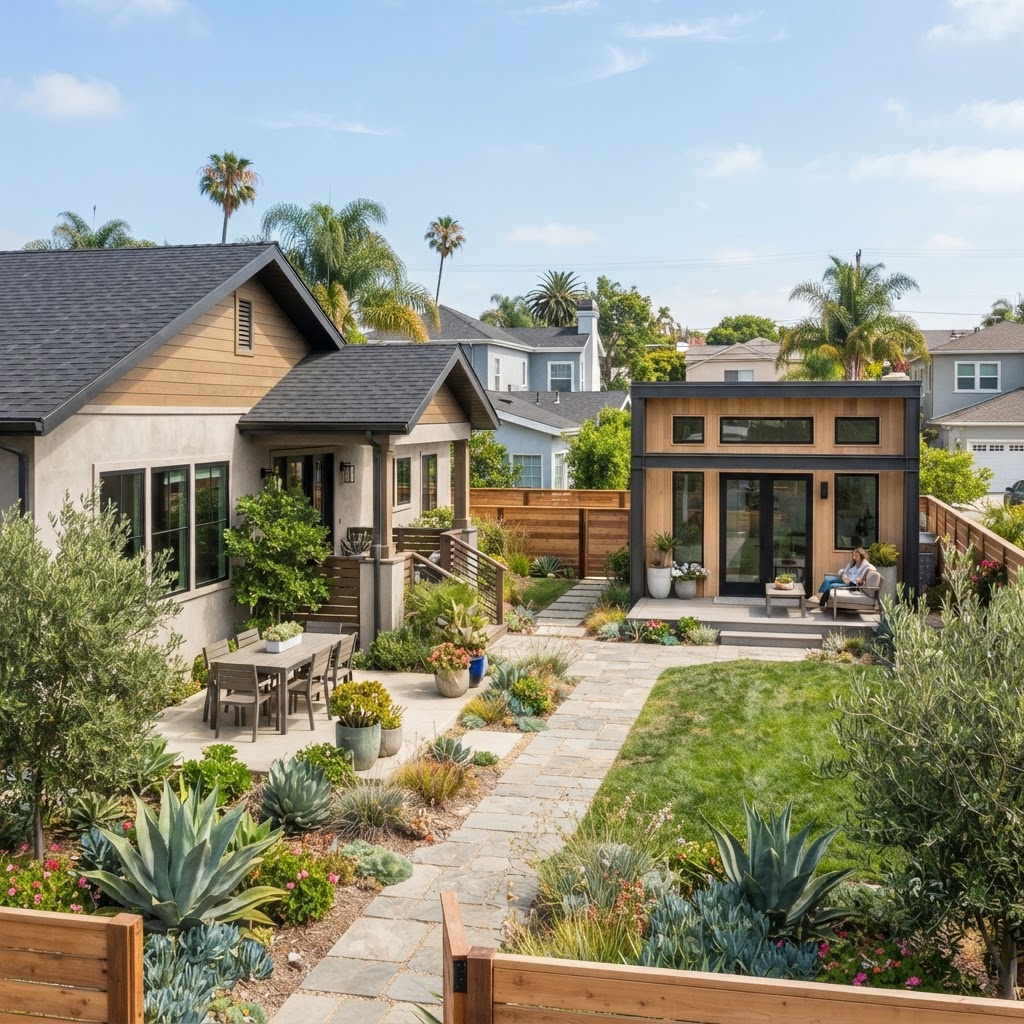
Rethinking California Homeownership: The Density Advantage
Entering the California real estate market in late 2026 remains one of the most demanding financial feats in American homeownership. According to recent market analysis from reAlpha Tech Corp., only about 16% of California households can comfortably afford a median-priced home, with metropolitan hubs across Los Angeles, the Bay Area, and San Diego seeing five-year price appreciation in excess of 30%. With conventional conforming limits reaching $806,500 and urban core listings commanding steep bidding competition, successful buyers in 2026 are shifting their purchasing criteria away from finished square footage alone and toward densification capacity.
Rather than stretching debt-to-income (DTI) ratios to the absolute limit on a turnkey residence, strategic buyers are focusing on single-family properties with immediate accessory dwelling unit (ADU) potential. Recent industry research indicates that adding a permitted ADU can generate between $2,200 and $2,800 in monthly rental income—yielding up to $33,000 annually—while boosting property appraisal values by 20% to 30% (Facebook ADU Investment Analysis). To turn this into a winning acquisition strategy, buyers must understand site evaluation, tax implications, and utility feasibility.
1. The Physical Lot Audit: Sizing Up ADU Feasibility
Not every backyard can easily host a permitted detached or attached dwelling unit. When conducting property tours and during the standard contract review periods, buyers must look beyond cosmetic features to evaluate site configuration:
- Setbacks and Access Pathways: While California state housing laws have standardized side and rear setbacks to 4 feet for detached ADUs, local access paths must comply with fire and safety codes. Ensure there is clear, unencumbered pathway space (typically 3 to 4 feet wide) from the street or alleyway to the proposed build site.
- Utility Lateral Capacity: Older sewer mains and residential electrical panels are frequent bottlenecks. Standard modern detached units generally require an upgraded 200-amp main service panel on the primary residence or an independent secondary meter. Reviewing the panel during initial walkthroughs avoids unexpected five-figure electrical infrastructure upgrades later.
- Topography and Soil Conditions: Expansive clay soils—frequently seen in the Sacramento Valley and coastal foothills—require engineered slab foundations that significantly inflate construction costs. Always verify soil stability before budgeting standard square-foot construction metrics.
2. Proposition 13 and New Construction Tax Realities
One of the most persistent misconceptions among new California buyers is that building an accessory unit will trigger a full property reassessment under Proposition 13. According to guidance from the California State Board of Equalization, this is not the case:
- Blended Reassessment: The base purchase price of the original home and lot remains locked under Prop 13 protections (capped at a maximum base property tax rate of 1% plus voter-approved local indebtedness, with annual assessment increases capped at 2%).
- Incremental Construction Valuation: Only the newly constructed square footage of the ADU is assessed at market value upon completion. For example, if you build an 800-square-foot unit at an assessed improvement value of $180,000, your property tax liability increases solely based on that $180,000 addition, leaving the primary home's original base-year valuation untouched.
3. Underwriting and Financing Options in 2026
Mortgage underwriting guidelines allow buyers to leverage projected and existing secondary unit cash flows more effectively:
- CalHFA and Local Down Payment Programs: First-time buyers seeking down payment assistance can tap into state programs, such as CalHFA and the MyHome Assistance Program, to bridge the entry hurdle while reserving private capital for site improvements.
- Fannie Mae and Freddie Mac ADU Flexibilities: Conforming and FHA guidelines permit lenders to count up to 75% of documented or projected market rent from legal ADUs toward qualifying DTI ratios, provided an appraiser provides comparable rental data (Fannie Mae Form 1007).
- Renovation Mortgages (Fannie Mae HomeStyle / FHA 203k): Rather than acquiring a turnkey home and waiting years to finance a backyard cottage, buyers can utilize single-close construction loans that finance both the acquisition and the ADU build into a single fixed-rate mortgage based on the property’s future completed value.
Actionable Buyer Checklist
- Pull Historic Permit Records: Confirm whether existing unpermitted garage conversions can be legalized under amnesty statutes or if they present active code violation liabilities.
- Verify Sewer and Water Connection Fees: Under state law, ADUs under 750 square feet are exempt from local development impact fees, substantially reducing soft construction expenses.
- Run Dual-Income Pro Formas: Calculate whether short-term flexible living arrangements (e.g., house hacking the primary residence while living in the secondary unit) can reduce initial out-of-pocket housing costs below median rental averages.


