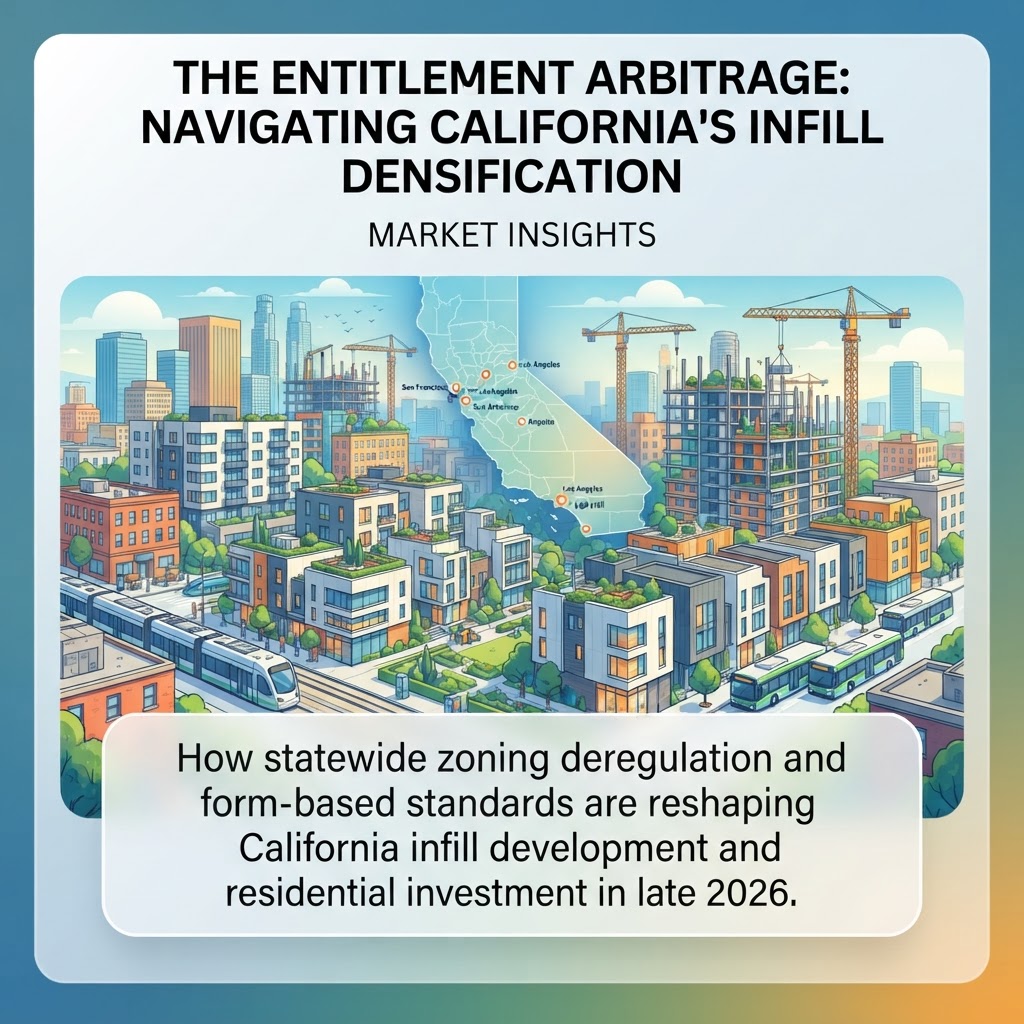
Entering the final stretch of 2026, California’s residential real estate landscape is defined by a subtle yet pivotal structural shift: the rise of entitlement arbitrage. While median statewide home prices hover around $904,640—rebounding modestly toward projected baseline trajectories of $905,000 according to market tracking by ManageCasa and industry analysts—the broader market has moved away from speculative appreciation toward site-level optimization.
The Shifting Land-Use Architecture
For decades, California real estate was governed by rigid, single-family Euclidean zoning. However, the cumulative maturation of statewide density mandates and municipal zoning overhauls has radically lowered entitlement barriers for urban infill. As analyzed in industry reports on zoning reform impacts on developers, planning departments across Southern and Northern California have transitioned toward form-based codes and objective design standards.
Rather than relying on lengthy discretionary conditional-use approvals, developers and small-scale infill builders are leveraging streamlined ministerial approvals. This policy evolution is transforming how single-family parcels, underutilized commercial strips, and transit-proximate lots are evaluated. The underlying value of an asset is no longer pegged strictly to its current square footage, but rather to its ‘as-of-right’ densification capacity.
The Two-Speed Infill Market
While macro data from the Federal Reserve Bank of St. Louis (FRED Active Listing Count) reveals an expanding active inventory baseline, this aggregate supply masks a distinct bifurcation:
- Static Low-Density Assets: Traditional single-family inventory on standard residential parcels faces prolonged days on market as 6.0% financing thresholds continue to cap consumer purchasing power.
- Arbitrage-Ready Infill Parcels: Urban infill sites, transit-oriented corners, and residential properties with favorable lot dimensions for multiplex, accessory, or small-lot subdivision conversions command notable valuation premiums from local builders.
According to regional insights from City Ventures’ Northern California outlook, demand remains resilient where high-density, energy-efficient modern construction intersects with transit corridors and established employment centers. By bypassing multi-year environmental reviews and conditional-use hearings, capital deployment cycles are shortening by 8 to 14 months, buffering developers against holding costs.
Actionable Takeaways for Real Estate Stakeholders
1. For Investors and Infill Developers: Focus on Form Over Broad Density
Municipal zoning updates increasingly deploy form-based standards that dictate building envelope, height, and setbacks rather than pure unit counts. Evaluate acquisition targets based on frontage width, alley access, and infrastructure capacity (such as utility tie-in fees and transformer thresholds) rather than gross lot square footage alone.
2. For Sellers: Package the Development Potential
Homeowners and estate executors selling properties on deep lots or multi-family-zoned land should avoid pricing strictly on residential comps. Commissioning a preliminary zoning feasibility study showing allowable ‘by-right’ unit yields can unlock developer-grade pricing well above standard neighborhood single-family comps.
3. For Buyers: Look for Strategic Under-Utilization
Owner-occupiers can exploit this trend by targeting properties with detached garages, dual-street frontages, or excessive rear setbacks that permit phased densification. Even if development is deferred, securing land with pre-approved by-right expansion potential creates built-in equity appreciation as California's housing deficit persists.
The Bottom Line
California’s housing market in late 2026 is no longer defined merely by macro interest rate movements or single-family supply pinches. The real margin of safety lies in regulatory execution: identifying properties where regulatory liberalization has outpaced current appraisals, transforming obsolete square footage into dense, scalable urban infill.