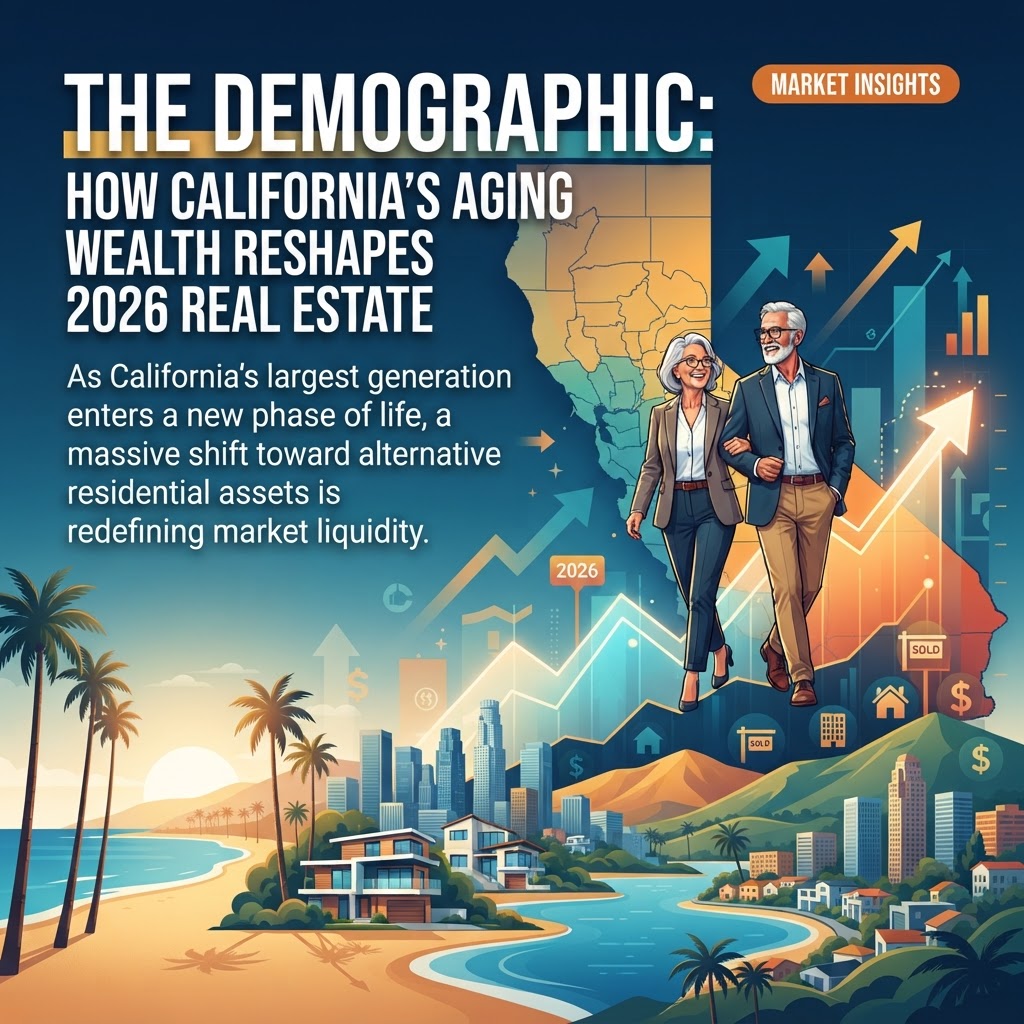
The 2026 Demographic Shift: Beyond the Supply Crisis
As of September 2026, the California real estate market has reached a critical inflection point that transcends the traditional supply-and-demand narrative. While the median home price in California rose to $759,766 in July 2026—a 1.3% year-over-year increase—the underlying driver of market activity is no longer just interest rate fluctuations or inventory shortages. Instead, a massive demographic recomposition is underway.
According to recent PwC and ULI demographic data, a significant threshold is being crossed as the state’s aging population reaches the age of 75. At this stage, homeownership rates historically drop from 75% to significantly lower levels as seniors transition into rentals, multigenerational living, or specialized group settings. In California, where the 'Silver Tsunami' has long been predicted, this transition is finally providing a much-needed release valve for inventory in supply-constrained coastal hubs.
The Rise of 'Alternative Core' Assets
Institutional and retail investors are pivoting away from traditional multifamily and office sectors toward what is now termed 'Alternative Core' assets. Data from the NCREIF Open-End Diversified Core Equity (ODCE) Index shows that institutional allocations to alternative property types—including senior housing, medical outpatient buildings, and student housing—have surged from 1% to 14% over the last decade. In California, this trend is accelerated by the state's unique demographic needs.
- Senior Housing: With vacancy rates in coastal markets like San Diego and Silicon Valley remaining below 5%, the demand for high-end senior living is outstripping supply.
- Medical Outpatient Facilities: As the 75+ demographic grows, the proximity of residential real estate to specialized medical hubs has become a primary value driver.
- Build-to-Rent (BTR) Communities: These are increasingly serving as a bridge for those exiting traditional homeownership but seeking to maintain a detached-home lifestyle.
Economic Indicators and Market Stability
The broader economic landscape in late 2026 supports this transition. Mortgage rates have stabilized around 6.6%, according to Freddie Mac and NAR data, providing a predictable environment for capital movement. While the state still faces a chronic housing shortage, the total number of homes for sale has stabilized at approximately 2.9 months of inventory. This represents a delicate equilibrium: it remains a seller’s market, yet the sale-to-list price ratio has leveled off at roughly 100.98%, suggesting that the era of irrational overbidding is cooling in favor of value-based acquisitions.
Practical Takeaways for Stakeholders
For Investors:
Focus on the 'Medical-Residential' nexus. Properties located within a five-mile radius of major healthcare clusters in the Bay Area and Southern California are seeing higher resilience against economic cycles. Diversifying into NNN (triple-net) leases for medical outpatient facilities offers a hedge against the volatility of the traditional residential sector.
For Sellers:
The 2026 market favors those who can cater to the 'downsizing' demographic. Homes that feature single-story layouts or 'aging-in-place' modifications are commanding a premium. With inventory still low, sellers in the $700,000 to $900,000 range are in the 'sweet spot' for both first-time buyers and relocating seniors.
For Buyers:
Patience is rewarded as the market moves toward a more balanced state. With 64% of California counties seeing a stabilization in sales volume, buyers have more leverage to negotiate on contingencies and closing timelines than they did in the 2024-2025 period. Focus on submarkets where new senior-living developments are opening, as these often trigger a localized increase in traditional residential listings.
Conclusion
California’s real estate market in late 2026 is defined by a transition from a crisis of volume to a crisis of composition. As wealth and population age, the most successful participants will be those who stop looking at the market as a monolith and start targeting the specific needs of a demographic in transition.