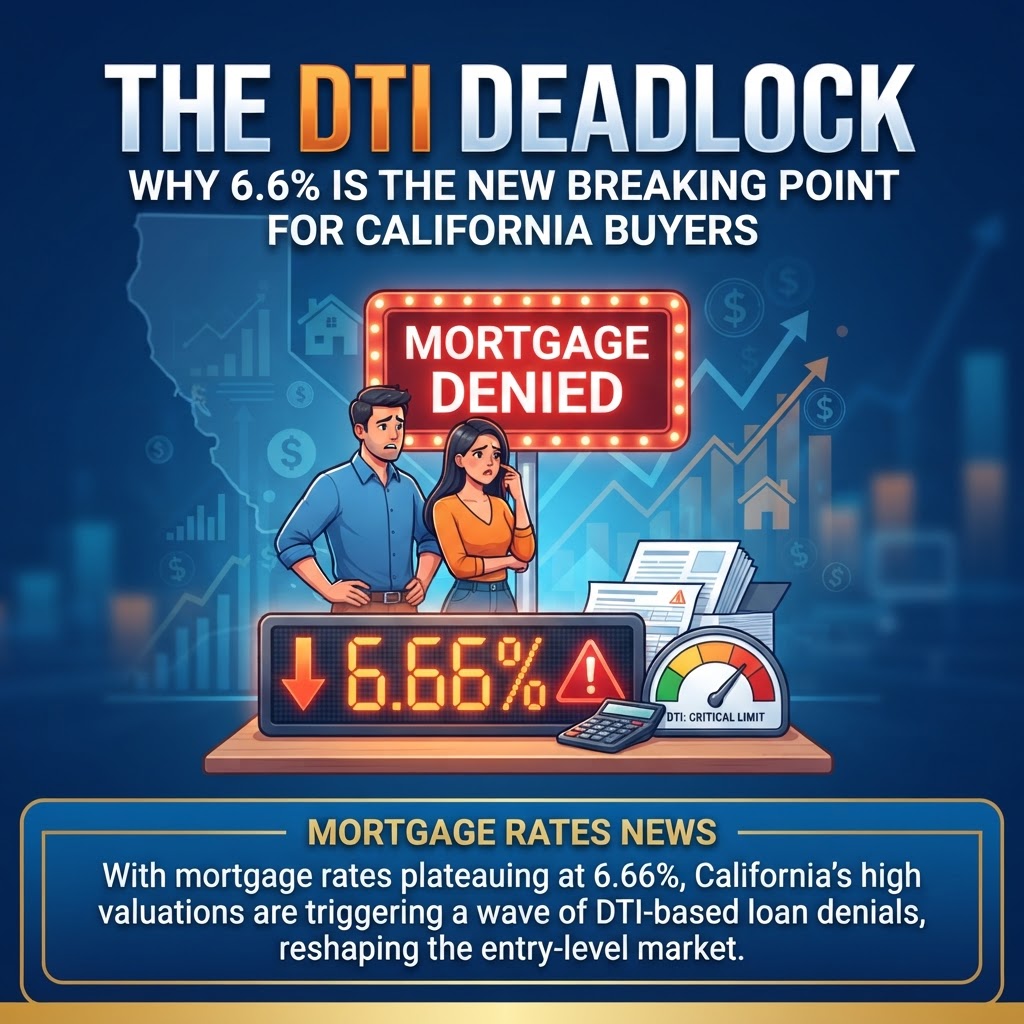
The Stagnation of 6.6%
As of August 27, 2026, the Freddie Mac Primary Mortgage Market Survey reported that the 30-year fixed-rate mortgage averaged 6.66%, a marginal increase from the previous week’s 6.65%. While this represents a slight reprieve from the 6.79% peaks seen earlier in the month, the stability of rates above the 6.5% mark is creating a structural challenge for the California housing market. Unlike previous cycles where high rates were met with price corrections, California’s median home price remains stubbornly high at approximately $905,000, according to recent market data.
The Mathematical Wall: DTI and the $905,000 Median
The primary hurdle for California buyers in late 2026 is no longer just the down payment, but the Debt-to-Income (DTI) ratio. Research from the St. Louis Fed indicates that rising interest rates are actively disqualifying potential homebuyers by pushing their DTI ratios over strict lending thresholds. In California, where the gap between income and housing costs is most pronounced, this "DTI Deadlock" is becoming the leading cause of loan denials.
According to the California Legislative Analyst’s Office (LAO), only about 22% of California households currently qualify for a mid-tier home mortgage. The math is unforgiving: at a 6.66% interest rate, a median-priced home requires a monthly payment (including taxes and insurance) of roughly $6,000. For a borrower to stay within the standard 43% DTI limit, they would need a gross monthly income exceeding $14,000, assuming zero other debts. When student loans or car payments are factored in, the qualification ceiling becomes insurmountable for the average professional.
The Rent-to-Own Chasm
The lending environment is further complicated by the widening gap between renting and owning. The LAO reports that as of mid-2026, the estimated rent for a two-bedroom home in California is approximately $2,700, while the monthly payment for a comparable purchased home is $4,600—a 66% premium. This disparity is preventing many prospective buyers from building the necessary cash reserves to lower their loan-to-value (LTV) ratios, which could otherwise help mitigate high DTI through lower interest rate offers.
Strategic Takeaways for Late 2026
- Prioritize Debt Liquidation Over Down Payment: In a DTI-constrained environment, paying off a $500 monthly car loan can often increase your borrowing power more effectively than adding that same capital to a down payment.
- Explore Non-Occupant Co-Borrowers: To bypass the DTI deadlock, more California buyers are utilizing family members as non-occupant co-borrowers to add qualifying income to the application.
- Monitor the September Pivot: With the CME FedWatch tool indicating a high probability of a Federal Reserve rate hike in September, buyers currently in escrow should consider locking rates immediately to avoid a DTI shift that could jeopardize their final approval.
- Target Submarket Volatility: While the state median is stable, specific metros in the Inland Empire and Central Valley are seeing more frequent price adjustments, offering a narrow window for buyers to secure a lower principal and stay within DTI limits.