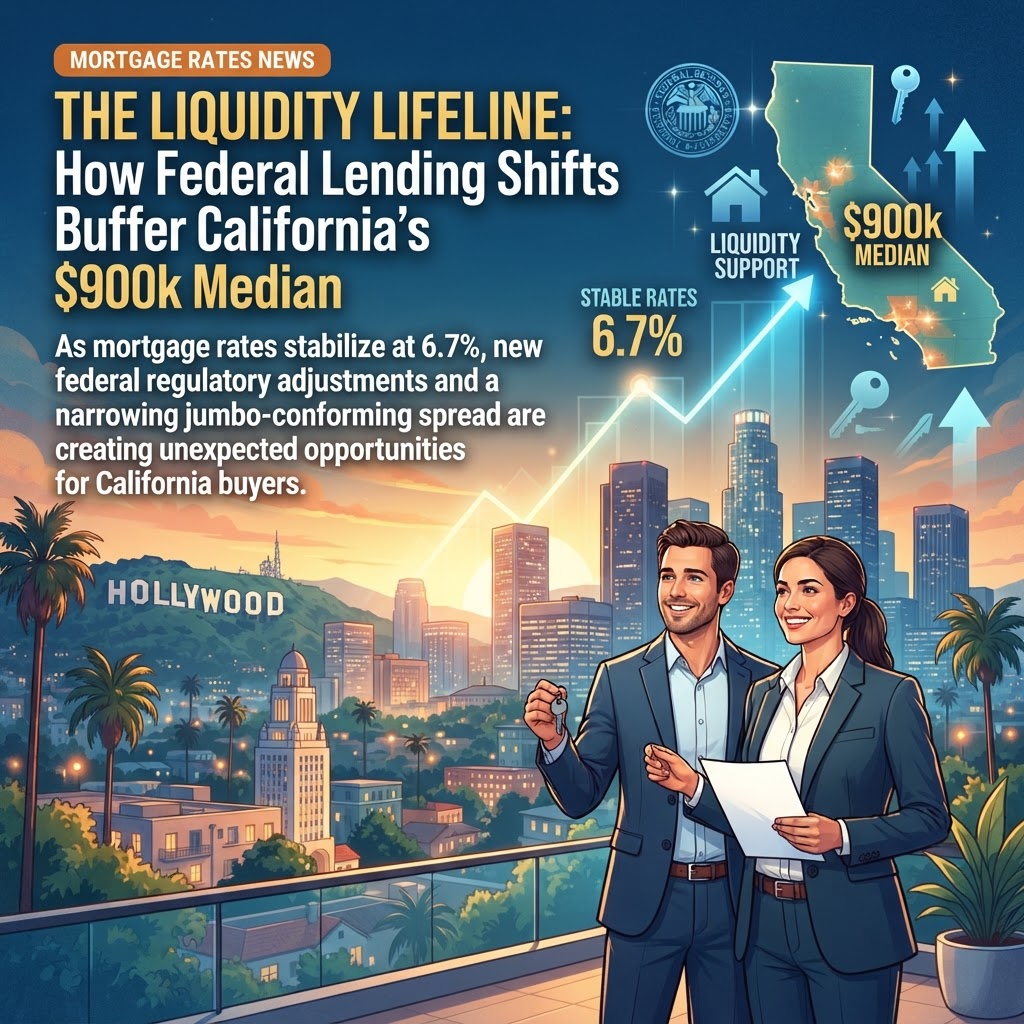
The 6.7% Stability and the Regulatory Pivot
As of August 25, 2026, the national average for a 30-year fixed-rate mortgage has settled at 6.722%, according to Fortune. While this remains significantly higher than the 6.0% forecasts issued earlier this year, a new narrative is emerging in the California market. Rather than a retreat in rates, the current environment is being defined by a "liquidity lifeline"—a combination of federal regulatory shifts and a narrowing spread between loan types that is keeping the state’s high-priced market from freezing.
Narrowing Spreads: The Jumbo-Conforming Convergence
In California, where the median home price remains resilient at $905,000 as of mid-August 2026, the distinction between conforming and jumbo loans is critical. Recent data from Money.com shows a remarkable convergence: the 30-year fixed-rate jumbo mortgage averaged 6.72% APR, nearly identical to the 6.61% APR for standard conforming loans.
This parity is a significant shift for California buyers. Historically, jumbo loans—required for the majority of single-family purchases in coastal metros—carried a steeper premium. The current compression suggests that lenders are aggressively competing for high-net-worth borrowers in the West, effectively subsidizing the entry point for California’s $900k+ median market despite the broader high-rate environment.
Federal Lending News: Easing the Servicing Friction
Beyond the daily rate tickers, significant shifts in lending policy are providing a buffer for the market. In February 2026, the Federal Reserve began considering changes to mortgage lending rules aimed at encouraging bank participation in mortgage servicing by better aligning capital requirements with actual risk, according to Banking Dive.
Furthermore, the Consumer Financial Protection Bureau (CFPB) adjusted the asset-size exemption threshold for the Home Mortgage Disclosure Act (Regulation C) to $59 million for 2026, as reported in the Federal Register. These technical adjustments reduce the compliance burden for smaller community banks, which are often the primary providers of niche lending products in California’s inland and rural regions.
California Market Resilience: Low Risk, High Barrier
Despite the affordability crisis—with the Legislative Analyst’s Office (LAO) reporting affordability at just 18%—the California market is far from a bubble. Data from the Daily Breeze indicates that just 0.7% of California’s mortgages are currently underwater, the lowest share in the nation. This equity cushion, combined with a 5.6% year-over-year decline in active inventory, continues to support price floors even as rates hover near 6.7%.
Practical Takeaways for California Stakeholders
- For Buyers: With jumbo and conforming rates converging, the "jumbo penalty" has largely vanished. Buyers should look for lenders who have optimized their portfolios for high-balance loans, as these currently offer the most competitive terms relative to historical spreads.
- For Sellers: The low percentage of underwater mortgages (0.7%) means your competition is not distressed. Pricing must be precise, but the lack of inventory remains your strongest lever.
- For Investors: Monitor the Fed’s proposed changes to servicing rules. If these rules are finalized, expect an increase in liquidity from mid-sized banks, which may lead to more flexible portfolio lending options for multi-unit properties.
While the "6% Autumn" has not materialized, the stabilization of rates at 6.7%—coupled with a federal push to improve credit access—suggests a market that is adapting to a new baseline rather than waiting for a rescue that may not come.