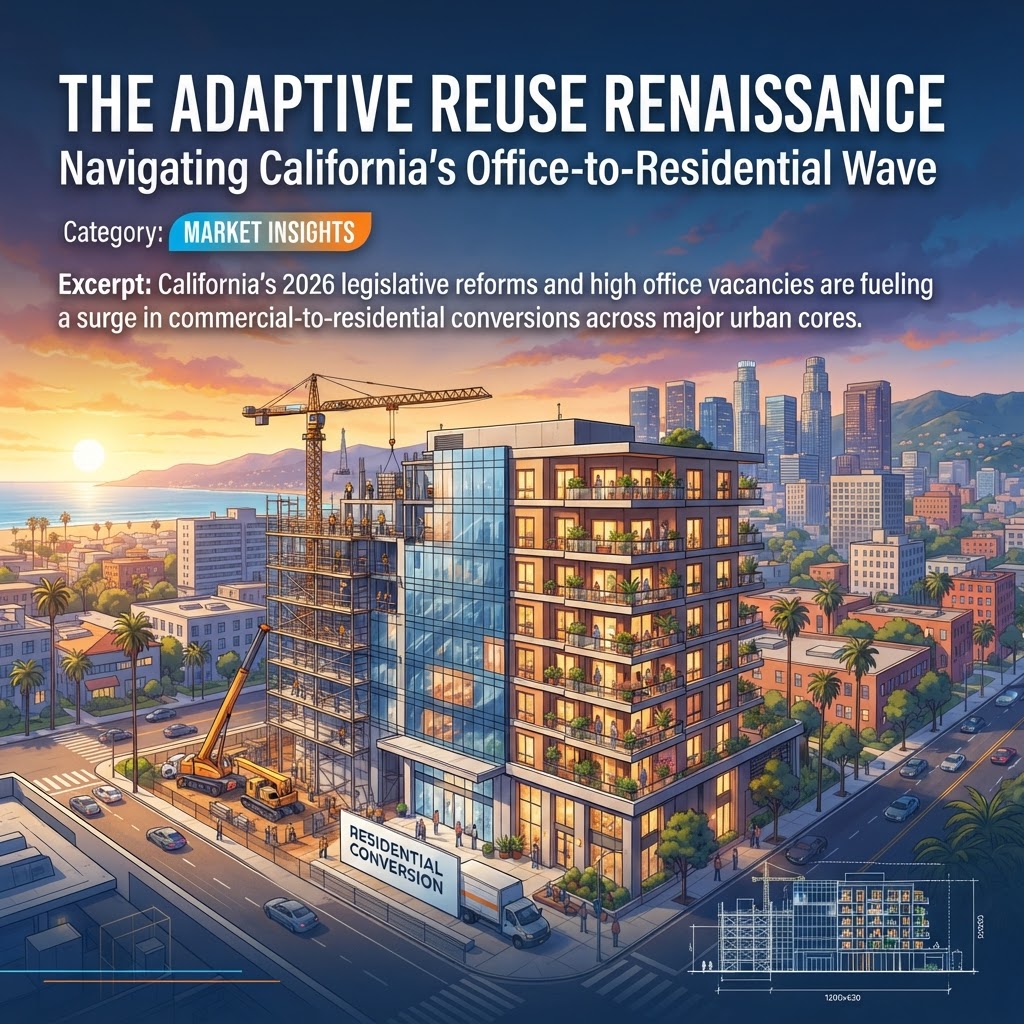
The Structural Pivot of California’s Urban Cores
As of August 2026, the California real estate market is witnessing a fundamental transformation of its metropolitan centers. While the broader residential market remains balanced with a 100% sale-to-list price ratio, a new frontier has emerged for investors and developers: the large-scale conversion of underperforming office assets into residential housing. Driven by a combination of persistent office vacancies and aggressive new state legislation, this 'Adaptive Reuse Renaissance' is reshaping the inventory landscape in San Francisco, Los Angeles, and San Diego.
Data-Backed Catalysts for Conversion
The momentum behind these conversions is supported by significant shifts in both supply and demand metrics. According to recent reports from the Bay Area Metro, the San Francisco-Oakland-Berkeley metro area is currently set to deliver 483 apartments converted from former office spaces, representing a staggering 30.7% of all adaptive reuse projects in the region. This shift is not merely a response to office vacancy; it is a reaction to the widening 'rent-versus-own' gap.
Data from the California Legislative Analyst’s Office (LAO) indicates that ownership costs in the state are now roughly 62% higher than renting a comparable two-bedroom home. This disparity has kept rental demand structurally high, even as the statewide median sold price reached $785,000 in mid-2026. For investors, the conversion of commercial space into high-density residential units offers a pathway to capture this robust rental demand in markets where traditional ground-up development remains cost-prohibitive.
Legislative Tailwinds and Permitting Reform
The primary friction point for adaptive reuse has historically been California’s stringent regulatory environment. However, the 2026 legislative package has introduced critical reforms designed to compress project timelines. Key measures now in effect include:
- CEQA Infill Exemptions: New exemptions for residential conversions in transit-rich areas have reduced environmental review periods by an average of 12 to 18 months.
- Private Plan-Checker Pathways: Cities like Los Angeles and San Diego have implemented programs allowing developers to utilize certified private plan-checkers to bypass municipal backlogs.
- By-Right Conversions: In San Diego, updated land use programs now allow for office-to-residential conversions 'by right' in most commercial zones, significantly reducing entitlement risk.
Economic Trends and Investment Perspectives
The economic backdrop of late 2026 adds a layer of complexity to these projects. While the Consumer Price Index (CPI) saw an energy-driven spike to 4.2% in May 2026, core inflation remains more stable at 2.9%. For developers, this means that while construction material costs may fluctuate, the long-term yield on residential assets remains attractive. JLL Research notes that private capital now accounts for approximately 65% of commercial real estate transactions below $50 million, as high-net-worth investors pivot away from traditional office holdings toward 'living' sectors.
Practical Takeaways for Market Participants
- For Investors: Focus on 'Class B' and 'Class C' office assets in urban cores where zoning now permits by-right residential conversion. The 62% rent-vs-own gap suggests that luxury rental conversions will find a ready pool of tenants who are priced out of the purchase market.
- For Developers: Leverage the new 2026 CEQA exemptions to target infill projects. The ability to use private plan-checkers is a critical tool for maintaining project schedules in a high-interest-rate environment.
- For Urban Buyers: Monitor the pipeline of converted units in San Francisco and Los Angeles. These projects often offer unique architectural features and modern amenities in central locations that were previously unavailable for residential use.
As California continues to grapple with its structural housing deficit, the ability to repurpose existing square footage will be the defining trend of the late 2020s. The convergence of legislative support and market necessity has made adaptive reuse not just a niche strategy, but a cornerstone of the state’s housing future.