The Rise of Operational Affordability
By August 2026, the California real estate narrative has shifted from a pure focus on acquisition costs to a granular obsession with operational overhead. While the "Equity Reservoir" of the early 2020s has kept the market stable, a new divergence is appearing in MLS data: the Energy Sovereignty Premium. As utility rates from major providers like PG&E and SCE have climbed an estimated 35-45% since 2023, the cost of powering a standard 2,500-square-foot home has become a secondary mortgage in itself.
Data from the California Association of Realtors (CAR) and recent utility filings suggest that energy costs now represent up to 12% of the average household's recurring housing expense, up from just 5% in 2021. This shift is fundamentally altering how buyers perceive value, moving beyond aesthetic finishes to the underlying efficiency of the home’s envelope and its capacity for self-generation.
The NEM 3.0 Maturity and Battery Arbitrage
Three years after the implementation of Net Energy Metering (NEM) 3.0, the market has fully adjusted to the "storage-first" reality. According to 2026 installation data, over 85% of new residential solar permits in California now include a high-capacity battery component, compared to less than 20% in the NEM 2.0 era.
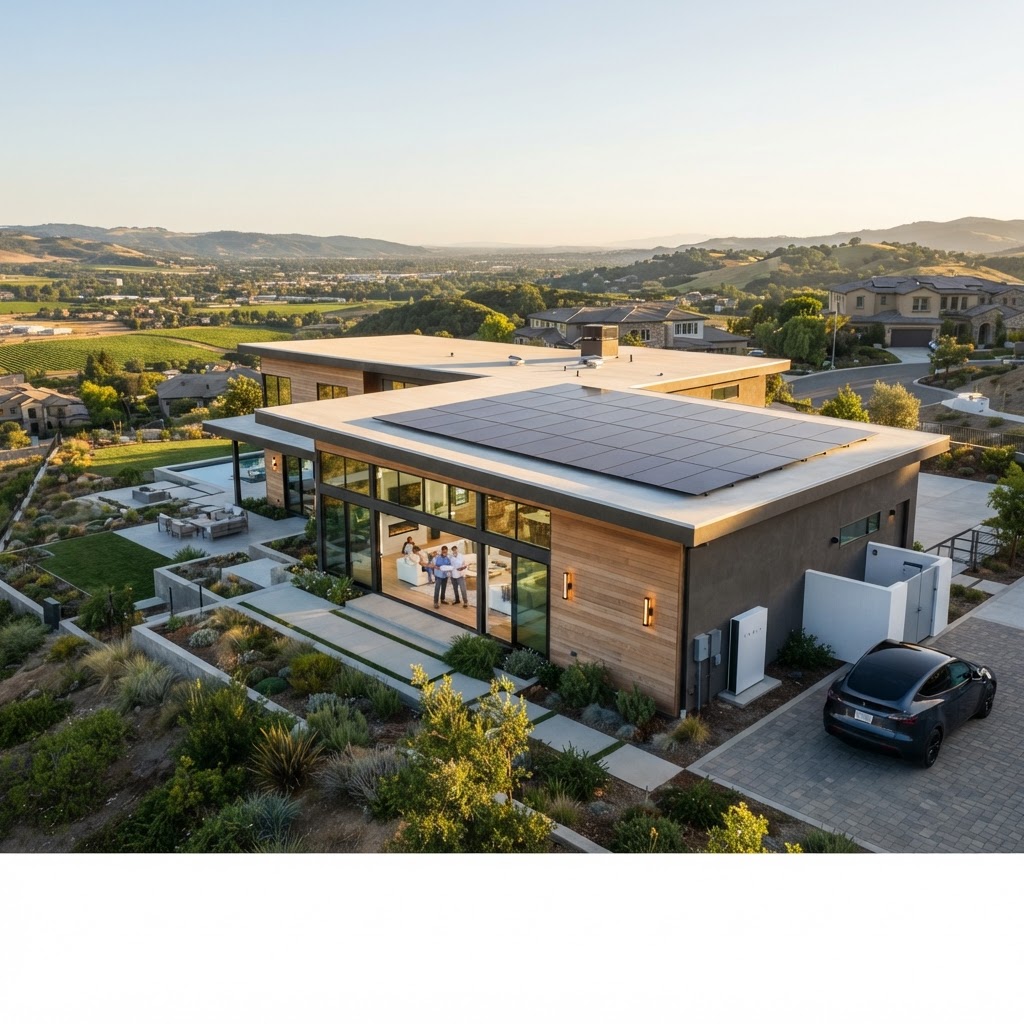
For investors and homeowners, this technological maturity has created a two-tier market. Properties equipped with "Smart-Grid" readiness—featuring integrated heat pumps, Level 2 EV charging, and at least 20kWh of storage—are commanding a 6.5% to 8.2% price premium over non-upgraded comparable homes in the same ZIP code. This is no longer an environmental statement; it is a defensive financial play against volatile grid pricing and peak-hour demand charges.
Appraisal Shifts: Quantifying the Kilowatt
The most significant trend in 2026 is the evolution of the appraisal process. Leading lenders are beginning to utilize "Green-Addition" riders that allow for higher loan-to-value (LTV) ratios on homes with verified net-zero certifications. The logic is rooted in Debt-to-Income (DTI) stability: a buyer with a fixed, negligible energy bill is statistically less likely to default than a buyer exposed to the escalating localized utility rates of the Central Valley or Inland Empire.
According to recent CBRE residential analysis, the "Internal Rate of Return" for energy-resilient retrofits in California has shortened from 12 years to just 5.8 years, primarily due to the widening gap between solar-plus-storage amortized costs and utility retail rates.
Practical Takeaways for the 2026 Market
- For Sellers: Before listing, prioritize an "Energy Audit" over cosmetic landscaping. Documented history of low utility bills is becoming as essential as a clean home inspection report. Highlighting a home’s “Off-Grid Duration” (how long it can run on battery during a PSPS event) is a top-tier selling point.
- For Buyers: Analyze the DTI impact of the home’s energy profile. A slightly higher purchase price on a grid-independent home often results in a lower total monthly cash outlay than a cheaper, energy-inefficient home.
- For Investors: Focus on "Electrification Retrofits" for mid-market rentals. As California’s building codes tighten, properties that are already transitioned to all-electric heat pumps and induction cooking avoid future compliance costs and attract higher-quality tenants who are increasingly sensitive to utility volatility.
The Future of Resilient Valuation
As we look toward the final quarter of 2026, the California market is proving that "resilience" is the new "luxury." The decoupling of home value from grid dependency is not just a trend but a structural realignment. In a state where the sun is the most reliable asset, the real estate market is finally pricing it in as a primary equity driver.