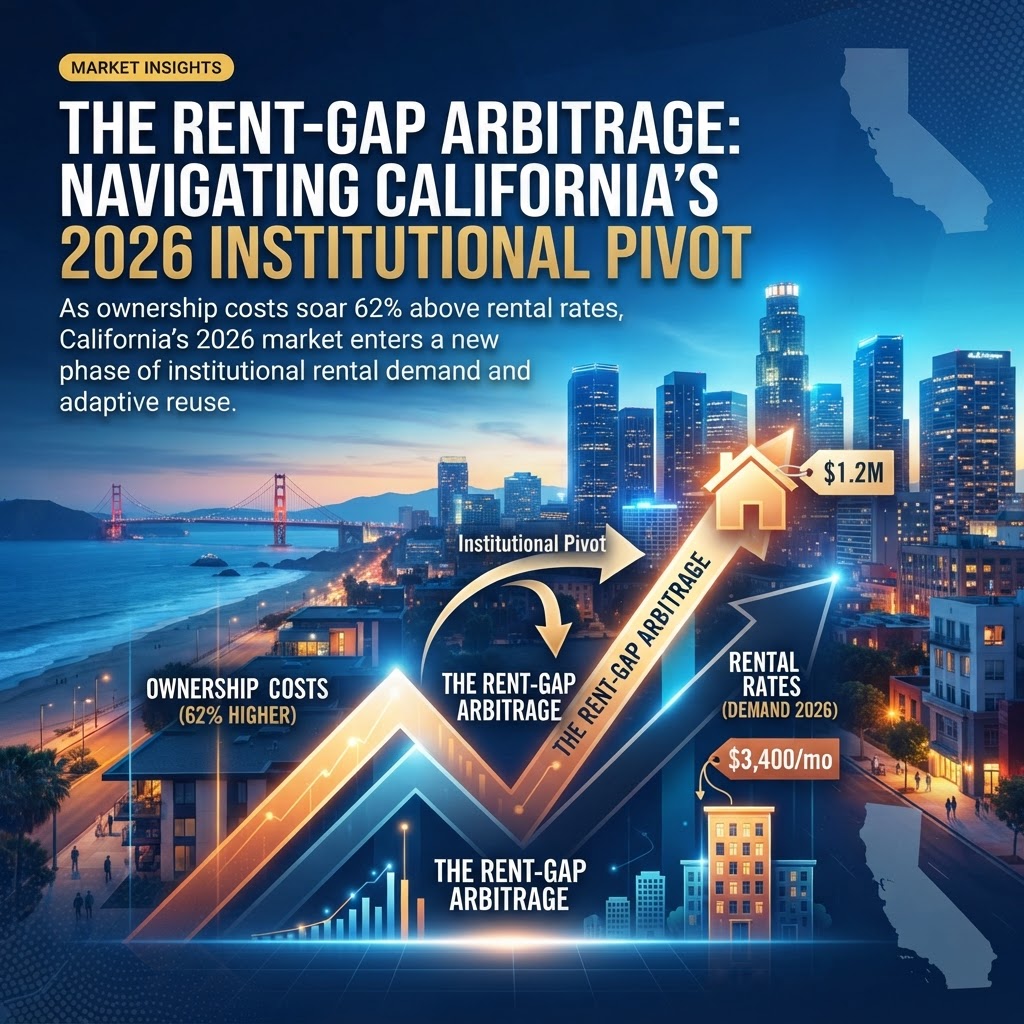
The 62% Chasm: Why the Rental Floor is Rising
As of August 2026, the California real estate market has reached a critical inflection point defined by a historic disconnect between the cost of ownership and the cost of tenancy. According to data from the Legislative Analyst’s Office (LAO), the cost of owning a median-priced home in California now sits approximately 62% higher than renting a comparable two-bedroom unit. This gap, fueled by a statewide median home price that has climbed to $905,000, has fundamentally altered the investment landscape.
For institutional investors and private equity firms, this 'Rent-Gap Arbitrage' has turned the focus away from speculative flipping toward long-term yield in the rental sector. With mortgage rates stabilizing near 6.0%, as noted in the 2026 California Housing Market Forecast, the barrier to entry for first-time buyers remains high, ensuring a captive and growing tenant base for Class B and C multifamily assets.
The Adaptive Reuse Mandate: Beyond the Office Crisis
While previous years focused on the decline of the urban core, 2026 is the year of the 'Adaptive Pivot.' Cities like San Diego and Los Angeles have streamlined regulations to allow office-to-residential conversions 'by right' in many zones. The City of San Diego’s Information Bulletin 406 has become a blueprint for developers looking to salvage distressed Class B/C office assets.
CBRE’s Midyear 2026 Outlook indicates that investment activity is on track for a 16% year-over-year increase, reaching approximately $605 billion nationally, with California’s adaptive reuse projects attracting a significant share of this capital. Investors are no longer just buying buildings; they are buying the policy-driven potential to convert underutilized square footage into high-demand housing units.
Compliance and the New Operating Reality
Operating in California in 2026 requires a sophisticated understanding of the regulatory ceiling. The statewide rent cap under AB 1482—calculated as 5% plus the regional CPI—is currently trending toward the upper 10% limit in several coastal metros due to persistent energy-driven inflation. As highlighted by North Coast Financial, property managers must now navigate a complex web of SB 326 inspection obligations and rising insurance premiums that are compressing margins for those who failed to underwrite for 2026 expense ratios.
Practical Takeaways for 2026 Stakeholders
- For Investors: Focus on 'Supply-Constrained Submarkets.' The best-performing assets are currently Class B multifamily units in coastal cities where the rent-vs-own gap is widest. Utilize 1031 exchanges to move from low-yield retail into high-upside adaptive reuse projects.
- For Sellers: Pricing discipline is paramount. With active inventory counts rising, the California Association of Realtors (C.A.R.) suggests that while equity continues to grow, homes must be priced to reflect the 6.0% rate environment to avoid stagnation on the market.
- For Developers: Leverage state-level incentives for digital infrastructure and housing. Data centers and AI-driven industrial spaces are seeing a 'flight to quality,' with prime assets commanding significant premiums over older inventory.