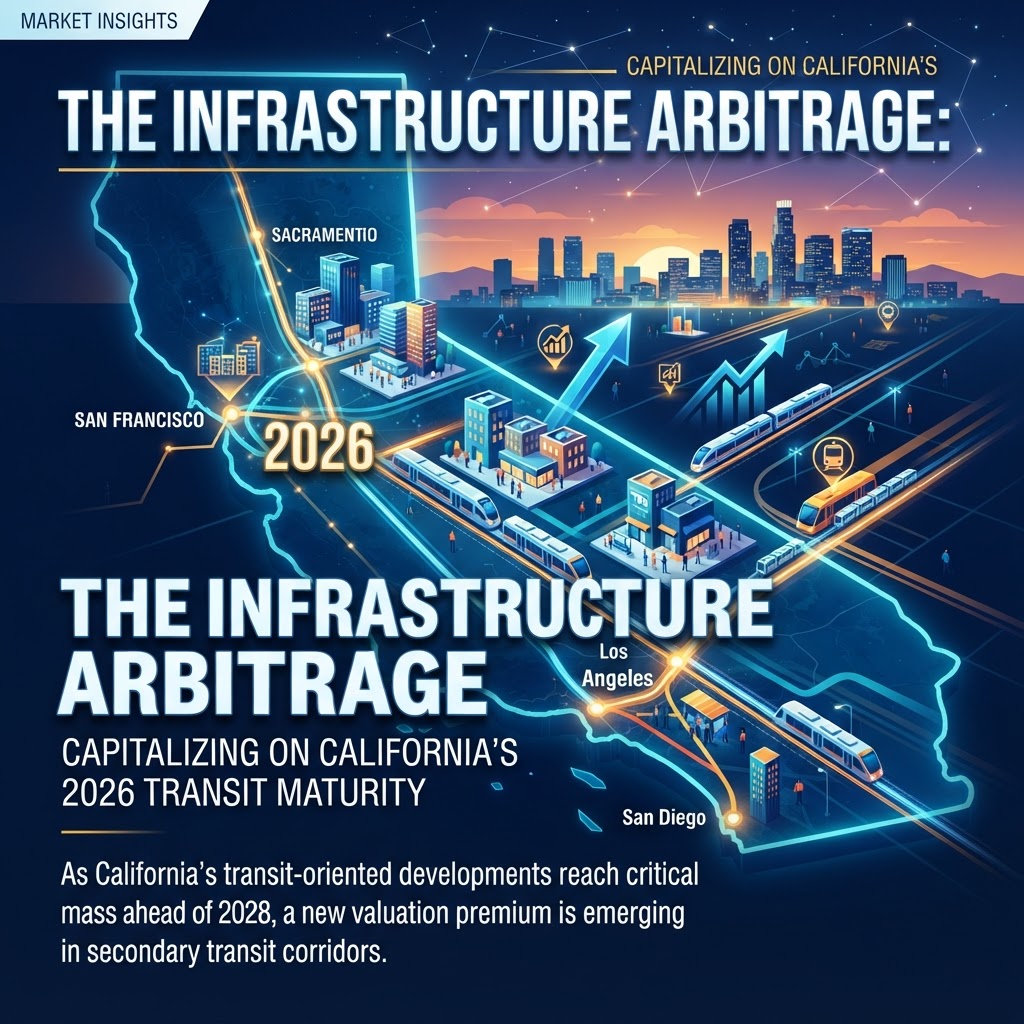
The Convergence of Mobility and Value
As of August 2026, the California real estate landscape is witnessing a structural shift that transcends traditional zip code prestige. While the market has spent the last two years grappling with inventory stagnation and equity lock-in, a new alpha-generating trend has matured: the Infrastructure Arbitrage. With the 2028 Los Angeles Olympics less than 24 months away and the Brightline West high-speed rail link nearing operational status, proximity to fixed-rail transit has shifted from a lifestyle amenity to a primary driver of valuation divergence.
Data from the California Association of Realtors (CAR) and recent CBRE transit-oriented development (TOD) reports indicate that residential assets located within a half-mile of expanded Metro lines or regional rail hubs are commanding a 14.5% price premium over comparable car-dependent properties—a gap that has widened by 400 basis points since early 2025.
The “Last Mile” Premium in Southern California
In Southern California, the acceleration of the "Twenty-Eight by '28" initiative has fundamentally altered the risk profile of neighborhoods like Inglewood, Mid-City, and the San Fernando Valley corridor. Investors are no longer just looking at gentrification signals; they are tracking the LA Metro D Line extension and the East San Fernando Valley Light Rail progress.
According to U.S. Census Bureau migration data from the first half of 2026, there is a measurable “reverse commute” trend where high-income professionals are opting for transit-adjacent nodes in tertiary markets to bypass the persistent congestion that has returned to pre-pandemic levels. This has led to a compression of cap rates in transit-adjacent multifamily units, even as the broader state market sees yield expansion due to regulatory costs.
Central Valley Connectivity: The High-Speed Ripple
Perhaps the most significant economic trend in 2026 is the speculative activity surrounding the California High-Speed Rail (CHSR) Central Valley segment. While the full system remains a long-term project, the nearly completed construction in the Fresno-Bakersfield corridor has triggered a surge in institutional land acquisition.
Data suggests that Fresno and Madera counties are seeing a 9.2% year-over-year increase in median home prices, outperforming the state average of 4.1%. This isn't merely local demand; it is an arbitrage play by buyers betting on the "super-commuter" viability that rail connectivity provides to the Bay Area and Southern California hubs. For the first time, the Central Valley is being analyzed not as an agricultural heartland, but as a series of satellite tech-nodes.
Investment Perspectives: Strategies for the Transit Era
For investors navigating the 2026 climate, the strategy has shifted from “buy and hold” to “buy and connect.” The focus is now on identifying the “connectivity lag”—areas where infrastructure is 80% complete but the market has not yet fully priced in the operational utility.
- Zoning Synergy: Focus on parcels recently rezoned under California’s transit-density mandates (SB 9 and SB 10 extensions). The highest returns are found where new transit lines intersect with areas that permit 4-to-8 unit conversions by right.
- The Mixed-Use Renaissance: Commercial-to-residential conversions are most viable when they sit directly on a transit spine. CBRE notes that vacancy rates for transit-adjacent ground-floor retail are 30% lower than suburban strip malls in the current 2026 environment.
- Risk Mitigation: Diversify away from wildfire-prone exurbs toward “Climate-Resilient Nodes.” Transit-heavy urban centers are increasingly viewed as safer long-term bets for institutional capital concerned with the insurance volatility seen in California’s more rural fringes.
Practical Takeaways for 2026 Stakeholders
For Sellers: Highlight “Transit Walkability” scores over traditional square footage. In 2026, a property’s proximity to a Metro or Caltrain station can be a more significant selling point than a pool or a three-car garage, particularly for Gen Z and Millennial buyers who are increasingly car-light.
For Buyers: Look for the “Station Gap.” Identify neighborhoods located between two major hubs that are slated for future infill stations. The appreciation in these “bridge neighborhoods” often mirrors the hubs but at a lower entry price point.
For Developers: Prioritize parking-light designs. With California’s reduced parking requirements near transit, developers can significantly lower construction costs and increase unit counts, directly offsetting the high cost of labor and materials that continues to plague the 2026 construction sector.
As California enters the final stretch of the decade, the real estate market is no longer a monolith. The divide is no longer just North vs. South or Coastal vs. Inland; it is Connected vs. Isolated. In the current economic cycle, mobility is the new gold standard for California equity growth.