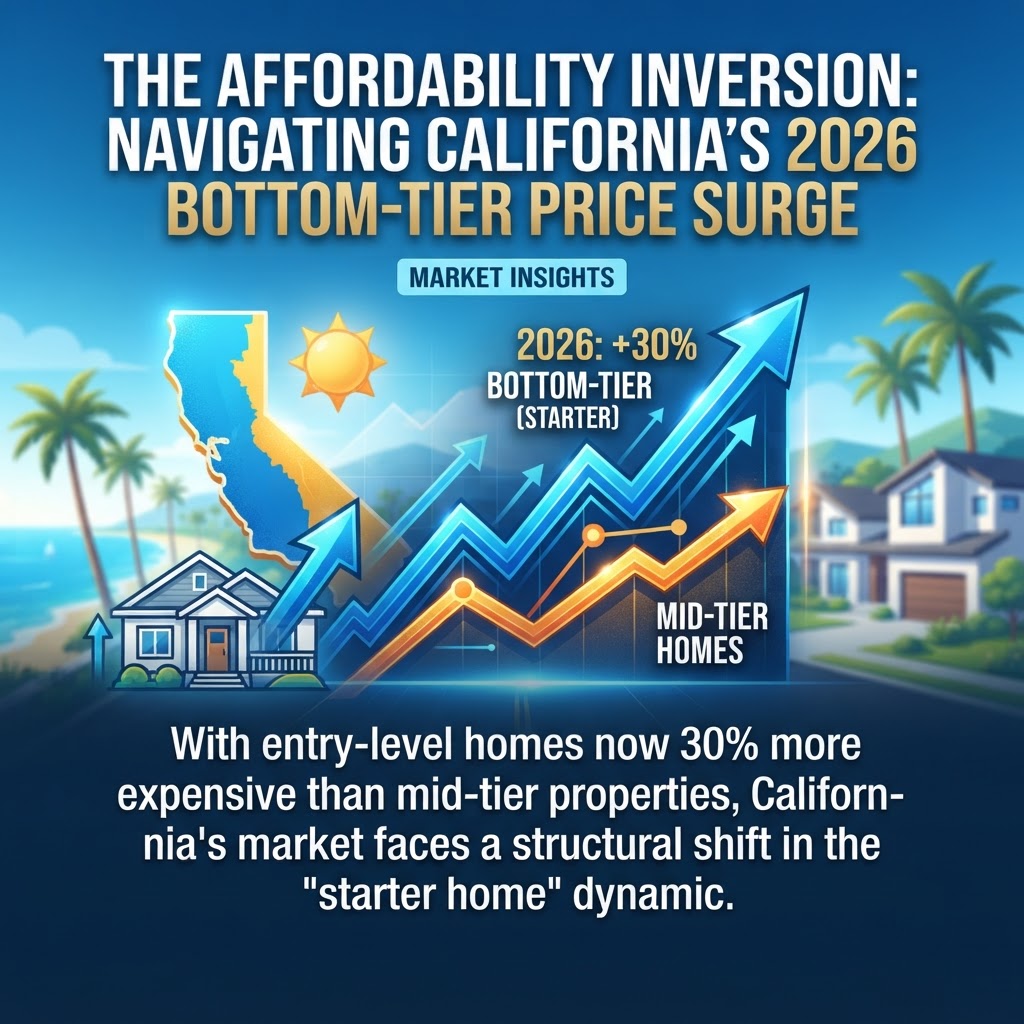
The Entry-Level Paradox
As of August 2026, the California real estate market is witnessing a historical anomaly: the 'Affordability Inversion.' According to the California Legislative Analyst’s Office (LAO), bottom-tier homes in the state have become approximately 30 percent more expensive than mid-tier homes on a relative basis, a trend that has accelerated through the first half of the year. This inversion challenges the traditional ladder of real estate investment and homeownership, as the most basic housing units now command a disproportionate premium.
Data-Driven Market Shifts
Recent data from Redfin indicates that while the statewide median price hit $777,566 in June 2026—a 2.0% year-over-year increase—the competition for entry-level inventory has reached a fever pitch. The LAO reports that only 44% of California households now qualify for a bottom-tier mortgage, down significantly from previous cycles. This scarcity is driving a 14% projected surge in existing-home sales as buyers scramble to lock in properties before further appreciation, as noted by the National Association of REALTORS® (NAR). With the number of homes for sale falling 5.6%, the supply-demand imbalance is most acute at the lowest price points.
The Inland Empire and Remote Work Influence
The inversion is most pronounced in regions like the Inland Empire, where the 'affordability arbitrage' is shifting. As AllView Real Estate highlights, remote work continues to enable high-earning coastal professionals to migrate inland, seeking relative affordability. This migration has driven rental growth to 7% in these submarkets, further compressing the supply of entry-level homes for sale. The LAO notes that the rate of fully remote work for California residents has remained steady through early 2026, sustaining this geographic redistribution of demand and keeping ownership costs roughly 62% above rent for comparable units.
Investment Implications: The New 'Prime' Asset
For investors, the bottom-tier is no longer a 'value play' but a 'premium play.' CBRE’s 2026 Capital Markets Outlook suggests that cap rates for residential assets are expected to decrease by 5 to 15 basis points as investors aggressively pursue these high-demand units. The 'flight to quality' mentioned by CBRE is manifesting in the residential sector as a flight to functional, entry-level housing that serves the hybrid workforce. Investors are increasingly prioritizing yield over appreciation, focusing on properties that can support the infrastructure needs of the modern professional.
Practical Takeaways for 2026
- For Buyers: Look for 'mid-tier' properties that may offer better square-footage value than the hyper-competitive bottom-tier. The 30% price premium on starter homes suggests that stretching for a slightly larger home may yield a better price-per-square-foot and less competition.
- For Investors: Focus on the 'Hybrid Tenant.' As market analysis suggests, allocating capital toward high-ROI amenities like home offices and upgraded infrastructure can command premium rents even in an inverted market.
- For Sellers: Entry-level homes are currently the most liquid assets in the state. With inventory down according to Redfin, sellers of starter homes hold significant leverage in negotiations and can expect multiple offers if priced near the median.