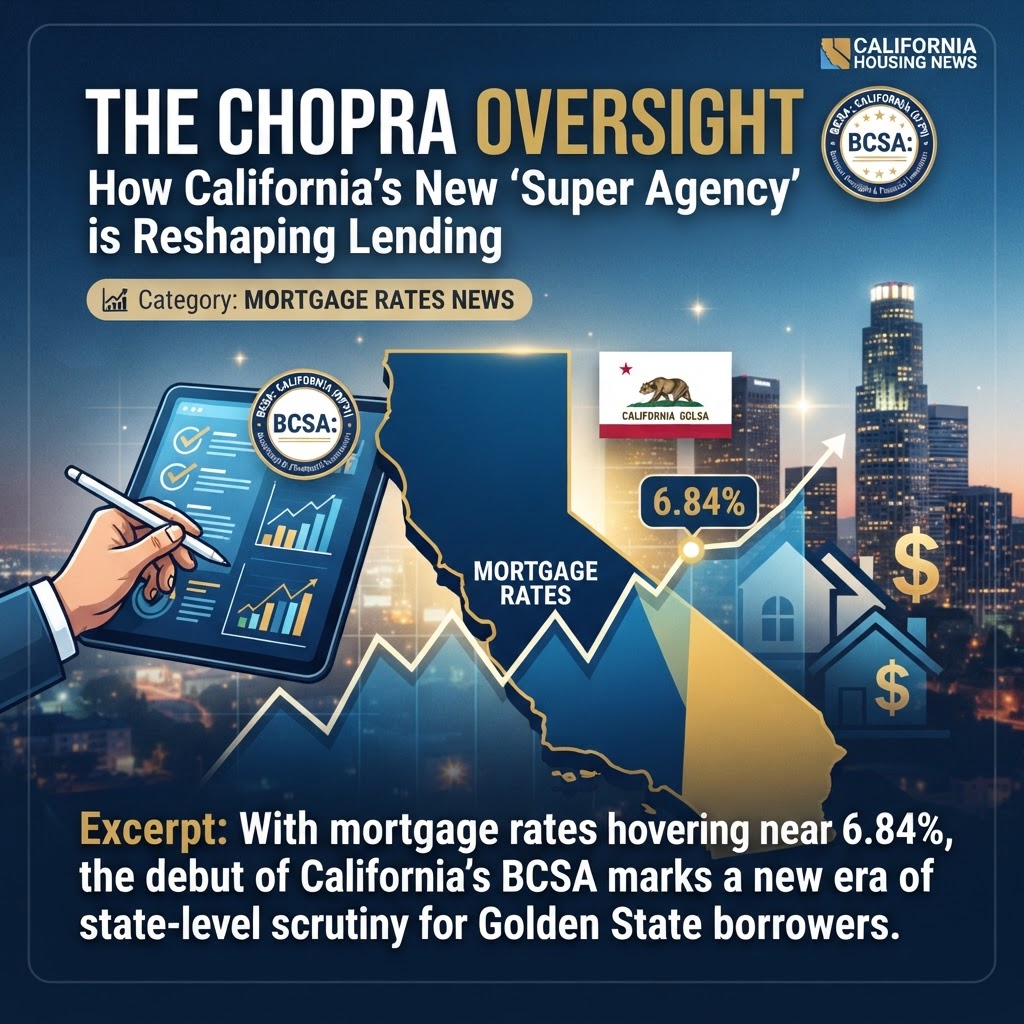
The August 12 Rate Reality
As of Wednesday, August 12, 2026, California home buyers are facing a complex lending environment where interest rates have begun to firm up following the latest inflation data. According to Bankrate, the average 30-year fixed mortgage rate in California currently stands at 6.84%, while 15-year fixed rates are averaging 6.22%. Nationally, rates have shown similar resilience, with the 30-year fixed purchase mortgage averaging 6.876% as of today, per U.S. News & World Report.
While these figures represent a retreat from the 8% peaks seen in late 2023, they remain significantly higher than the 6.0% floor many economists predicted for the second half of 2026. This 'higher-for-longer' reality is colliding with a major structural shift in how California regulates its mortgage market.
The Rise of the BCSA: A 'California CFPB'
The most significant development for California borrowers this month isn't just the rate movement, but the operational launch of the Business and Consumer Services Agency (BCSA). Led by former CFPB Director Rohit Chopra, this new 'super agency' now oversees the Department of Financial Protection and Innovation (DFPI), effectively creating a state-level counterpart to federal consumer watchdogs. According to Ballard Spahr, this consolidation is designed to coordinate enforcement across California’s financial services, signaling a period of heightened scrutiny for mortgage originators and fintech lenders.
For buyers, this means that while lending standards may become more transparent, the 'wild west' of creative financing may face stricter guardrails. The BCSA is expected to focus heavily on fee transparency and the 'true lender' doctrine, which could impact how bank-fintech partnerships offer competitive rates to California residents.
Market Dynamics: Price Softening vs. Rate Firming
Despite the stubbornness of interest rates, California’s home prices are showing signs of a seasonal cooling. The statewide median home price dropped to $904,640 in June, a 2.8% decrease from the record high of $930,260 set in May 2026, according to Norada Real Estate Investments. However, affordability remains a critical hurdle; the Legislative Analyst’s Office reports that only 44% of California households currently qualify for a bottom-tier mortgage, down from 57% in previous cycles.
Inventory levels are also providing a mixed signal. While active listings reached 108,753 in mid-2026, this is still 5.6% lower than the previous year, keeping the market competitive for well-priced 'entry-level' homes in the $700,000 to $850,000 range.
The 'True Lender' Battle and Fintech Access
A pivotal legal battle is currently moving through the California Second Appellate District Court of Appeal regarding the 'true lender' doctrine. This case challenges whether non-bank lenders can use bank partnerships to bypass state interest rate caps. For California buyers who rely on non-traditional or fintech-driven mortgage products, the outcome of this appeal could significantly alter the availability of niche loan products in the Golden State.
Practical Takeaways for California Buyers
- Monitor the BCSA’s Impact: As the new agency ramps up enforcement, look for lenders who prioritize fee transparency. The 'Chopra Effect' is likely to result in clearer Loan Estimates and Closing Disclosures.
- Leverage the Price Dip: With median prices down nearly 3% from their May peak, buyers may find more room for negotiation, even if rates remain near 6.8%.
- Evaluate 5-Year ARMs: With 5-year adjustable-rate mortgages falling to 6.27% APR according to NerdWallet, short-term ARMs are becoming a viable bridge for buyers planning to refinance when the market eventually stabilizes.
- Check CalHFA Eligibility: Given that affordability has dipped to 44%, buyers should re-examine state-sponsored assistance programs which are being bolstered under the new regulatory framework.


