The Paradox of the Frozen Gold Mine
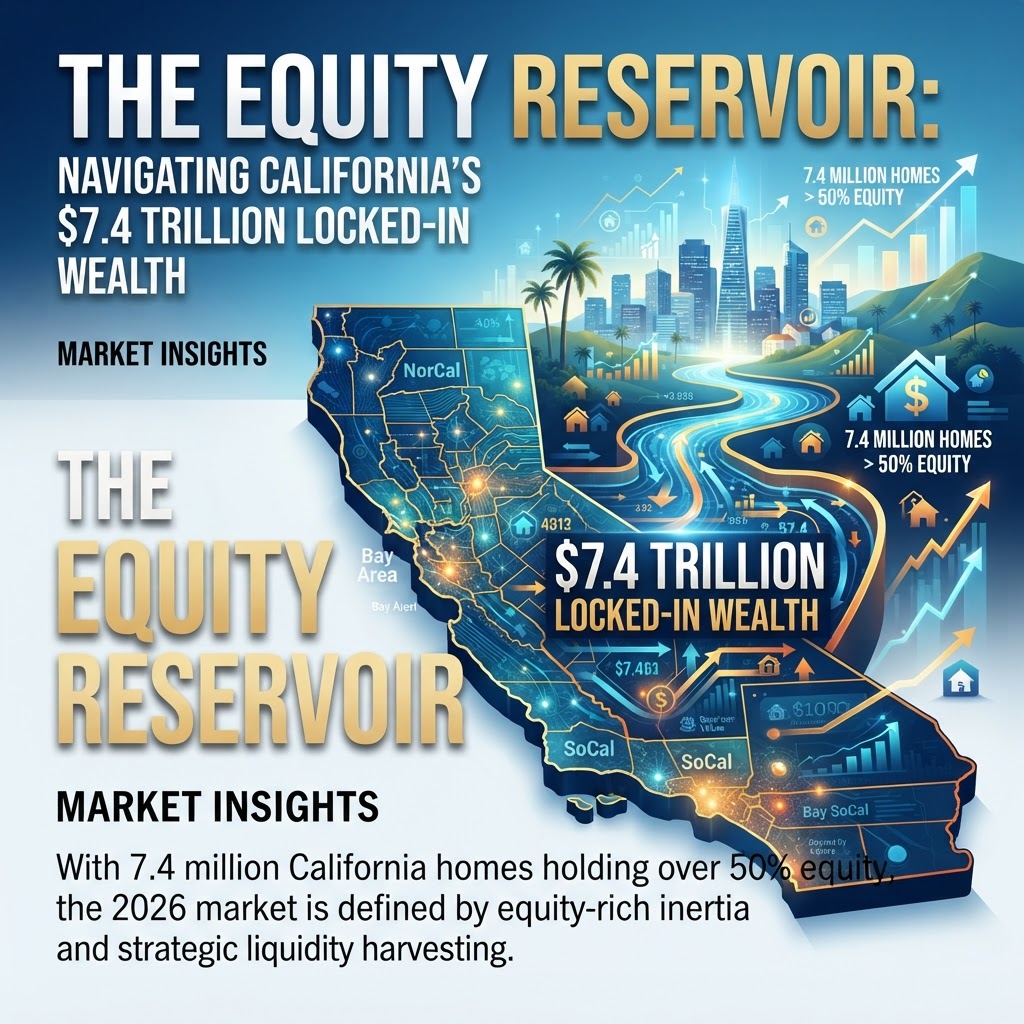
As of August 11, 2026, the California real estate market presents a striking contradiction. While transaction volumes remain near historic lows—mirroring the sluggish pace of the Great Recession—the state’s balance sheet has never been stronger. According to recent data from Property Focus, there are currently 7,484,361 properties in California with more than 50% equity. This 'Equity Reservoir' represents a massive, untapped economic force that is fundamentally altering how residents and investors approach the market.
Market Analysis: The 6.75% Standoff
The primary driver of the current stagnation is the 'lock-in effect.' With current 30-year fixed mortgage rates averaging 6.75% according to Zillow Home Loans, homeowners who secured 3% rates during the pandemic are refusing to sell. This has pushed the median price for a single-family home to $930,260, a 5.1% year-over-year increase as reported by the California Association of Realtors. The market is not 'underwater' as it was in 2008; rather, it is 'frozen in gold,' with 2.8 million homes fully paid off statewide.
The Rent-to-Own Chasm
The Legislative Analyst’s Office (LAO) notes that the monthly cost premium of ownership over renting in California remains at approximately 62%. This gap has effectively bifurcated the market. Coastal hubs like San Francisco and San Diego maintain vacancy rates below 5%, while secondary markets in the Inland Empire and Central Valley are seeing a surge in interest from buyers priced out of the 'Big Five' metros.
Investment Perspectives: Harvesting Without Selling
In 2026, the most sophisticated investors are no longer looking for traditional 'fix-and-flip' opportunities, which have been hampered by high borrowing costs and low inventory. Instead, the focus has shifted to Equity Harvesting. Owners are increasingly utilizing Home Equity Investments (HEIs) and HELOCs to deploy capital into secondary markets or accessory dwelling units (ADUs) without triggering a taxable sale or losing their low-interest primary mortgages.
- Secondary Market Migration: Investors are targeting Class B and C properties in submarkets where the rent-equity gap is narrower, such as Fresno and Riverside.
- Compliance-Driven Yield: With AB 1482 rent caps set at 5% plus CPI (capped at 10%), professional property managers are focusing on operational efficiency and tenant retention to maintain margins in a high-inflation environment.
Practical Takeaways for 2026
For Sellers: The Strategic Trade-Up
If you are among the 7.4 million owners with high equity, consider a 'bridge-to-equity' strategy. Rather than a traditional sale-and-purchase, explore porting equity into a multi-unit property where the rental income can offset the higher 6.75% interest rate on the new debt.
For Buyers: The Secondary Frontier
Look beyond the coastal core. Data from Redfin indicates that while inventory is down 6% statewide, secondary metros are seeing slightly higher listing durations, providing the rare opportunity for price negotiation.
For Investors: The Yield Play
Focus on 'infrastructure-ready' assets. As CBRE suggests, flexibility and infrastructure readiness are the new premiums. Properties that can accommodate home-based AI compute needs or flexible work-from-home layouts are commanding higher rent premiums in the 2026 landscape.
Conclusion
The California market in late 2026 is not defined by a crash, but by a massive accumulation of wealth that is currently immobile. Success in this environment requires moving away from traditional transaction-based thinking and toward equity-based strategies. Whether through leveraging existing holdings or targeting high-demand rental submarkets, the 'Equity Reservoir' remains California’s most significant economic anchor.