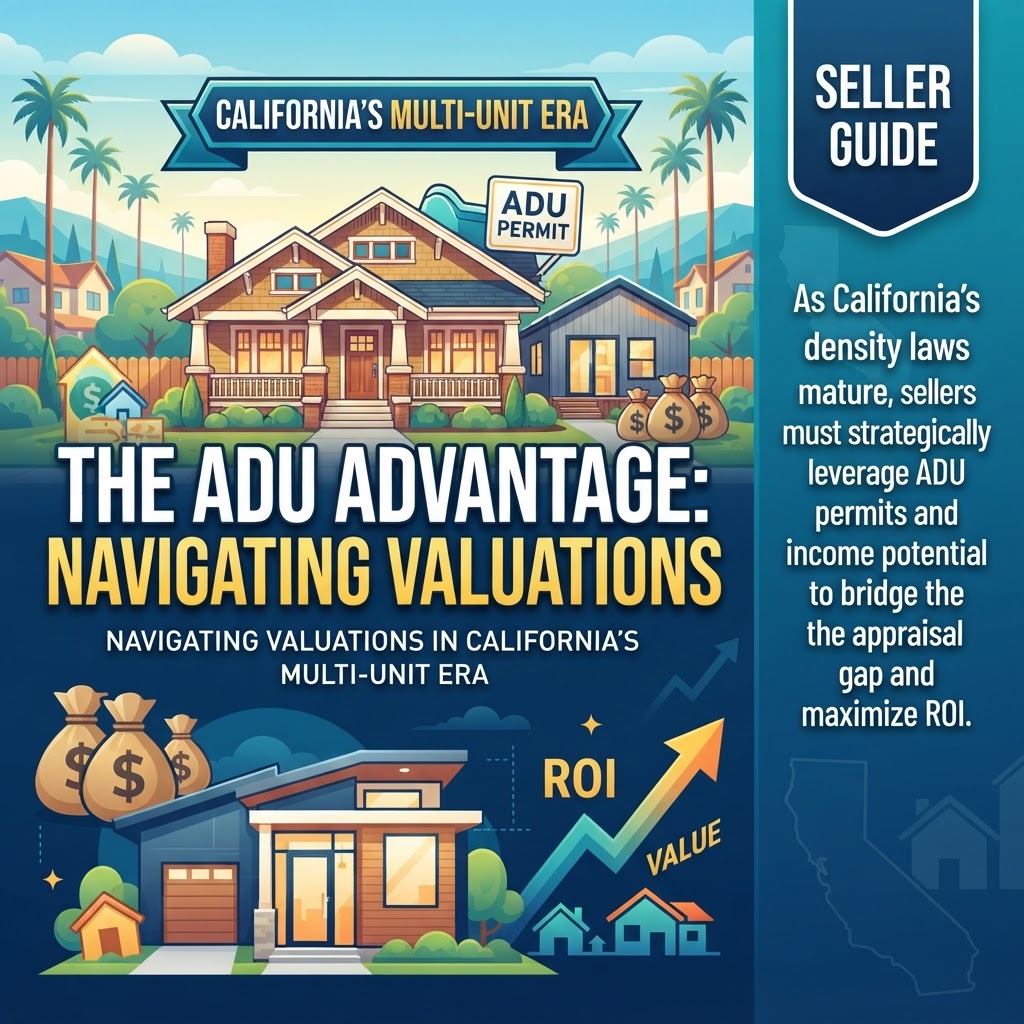
The Shift from Single-Family to Multi-Resource
As of August 2026, the California housing landscape has fundamentally shifted. Driven by legislative catalysts like SB 9 and the continued refinement of Accessory Dwelling Unit (ADU) laws, the traditional "single-family home" is being rebranded as a "multi-resource property." For sellers, this evolution presents a significant opportunity to capture a premium, but only if they can successfully navigate the complexities of multi-unit valuation and the notorious appraisal gap.
According to data from the California Association of Realtors (C.A.R.), homes with permitted ADUs in coastal metros like Los Angeles, San Diego, and the Bay Area are currently commanding price premiums of 24% to 32% over comparable single-unit properties. However, capturing this value requires more than just a finished studio over the garage; it requires a strategic approach to documentation and market positioning.
The Appraisal Hurdle: Why 'Cost' Does Not Equal 'Value'
One of the primary challenges in the 2026 market is the disconnect between construction costs and appraised value. While a homeowner may spend $250,000 on a high-end detached ADU, a conservative appraiser using traditional comparable sales (comps) might only attribute $150,000 in contributory value. To bridge this gap, sellers must provide appraisers with an Income Approach Valuation.
Recent MLS trends show that properties marketed with documented rental history or "pro-forma" income statements (validated by local property management firms) are 40% more likely to meet their appraised value during the contingency period. In a high-interest-rate environment, buyers are looking for "mortgage helpers"—rental income that offsets their monthly debt service—and lenders are increasingly receptive to these calculations when backed by proper permits.
Strategic Marketing: Selling the 'Income Offset'
In 2026, the savvy California seller moves beyond aesthetic marketing to financial storytelling. Instead of merely listing square footage, the marketing collateral should emphasize the Effective Mortgage Rate. For example, if a property’s ADU can generate $2,500 in monthly rent, that income can effectively subsidize a significant portion of a 6.5% interest rate mortgage, making the home more affordable than a cheaper property without an ADU.
Data from the U.S. Census Bureau suggests that multi-generational living in California has risen by 18% since 2022. Highlighting the ADU as a "flex space" for aging parents or adult children—rather than just a rental unit—broadens the buyer pool to include those utilizing Prop 19 tax portability benefits.
The Documentation Pack: Protecting Your Premium
To maximize value, sellers should compile a "Value Verification Folder" before the first showing. This is distinct from standard disclosures and should include:
- Certificate of Occupancy: Proof that the ADU or JADU is fully permitted for residential use.
- Utility Separation Records: Documentation of separate meters for gas, electric, or water, which significantly increases the unit's appeal to investors.
- Energy Compliance: Title 24 reports showing the unit’s energy efficiency, tapping into the current demand for lower operational costs.
- Site Feasibility Study: For homes without an ADU but with "ADU potential," providing a pre-approved architectural plan or a soil report can justify a higher asking price by reducing the buyer's future risk.
Practical Takeaways for 2026 Sellers
1. Formalize the Income Potential
If you have been renting your ADU under the table, stop. Buyers in 2026 require a paper trail. Documented rental income can be added to the buyer’s qualifying income for many conventional loan products, making your home accessible to a wider range of purchasers.
2. The 'JADU' Conversion
If you lack the space for a detached unit, consider the Junior Accessory Dwelling Unit (JADU) within the existing footprint. HCD (Housing and Community Development) reports show that JADUs are the fastest-growing segment of California density, offering a high ROI because they utilize existing plumbing and electrical systems.
3. Target the 'Move-Down' Buyer
Market specifically to retirees looking to downsize. Under Prop 19, these buyers can bring their low property tax base to your home, live in the ADU, and rent out the main house—a popular "wealth preservation" strategy in the current economy.
4. Pre-Appraisal Consultation
Hire a certified appraiser who specializes in multi-unit properties to conduct a pre-listing appraisal. Presenting this to prospective buyers’ appraisers ensures they have the right data points to justify your asking price from day one.