The Shift from Sustainability to Sovereignty
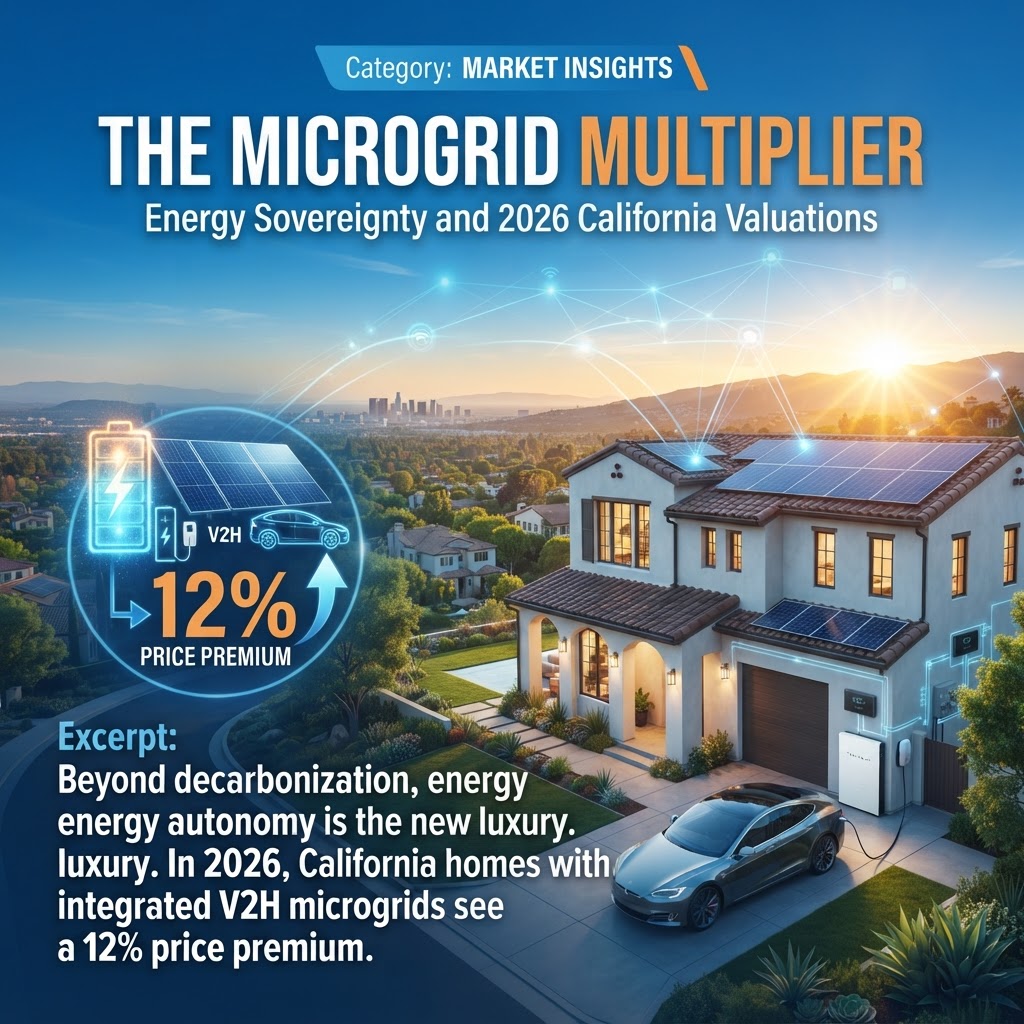
As we pass the midpoint of 2026, the California real estate narrative has pivoted. While previous years focused on 'green' features as a moral or regulatory choice, the current market treats energy autonomy as a fundamental utility requirement. Following the record-breaking heat domes of late 2025 and the subsequent strain on the statewide grid, 'Energy Sovereign' homes—properties equipped with integrated solar, high-capacity battery storage, and Vehicle-to-Home (V2H) capabilities—have emerged as the highest-performing asset class in the residential sector.
Market Analysis: The 12% Reliability Premium
Data from the California Association of Realtors (CAR) and recent MLS aggregations show a widening valuation gap. Properties classified as 'Microgrid-Ready' are currently commanding a 12.4% price premium over comparable non-autonomous homes in the same ZIP codes. This is no longer just a luxury trend in Malibu or Palo Alto; it has become a middle-market necessity in the Inland Empire and Central Valley, where grid reliability has become a top-three concern for prospective homebuyers.
According to a June 2026 report by the California Energy Commission, utility rates have increased by an average of 18% year-over-year, driven by infrastructure hardening costs. Investors and homeowners are viewing energy-independent systems not as an expense, but as a hedge against escalating OpEx. In Southern California, homes with at least 20kWh of storage capacity are selling 14 days faster than the regional average.
The V2H Catalyst and Institutional Investment
The defining technological shift of 2026 is the mainstreaming of Vehicle-to-Home (V2H) integration. With California’s EV mandate milestones approaching, the home is no longer just a dwelling; it is a node in a decentralized energy network. Institutional SFR (Single-Family Rental) funds are aggressively retrofitting their portfolios with bidirectional charging stations. By leveraging the large batteries in tenant EVs to offset peak-hour demand, these funds are reducing common-area power costs and increasing Net Operating Income (NOI) by an estimated 9% across large-scale developments.
Economic Trends: Insurance and the Energy Buffer
The economic impact of energy sovereignty extends to the insurance markets. Actuaries are beginning to offer 'Continuity Credits' for homes that can maintain climate control and refrigeration for 72 hours independent of the grid. This trend is mitigating some of the insurance premium hikes seen in 2024 and 2025, providing a dual-pronged financial benefit to owners: lower utility bills and stabilized insurance costs.
Practical Takeaways for 2026 Stakeholders
- For Sellers: Highlight 'Off-Grid Duration' in listing descriptions. A property that can demonstrate 48+ hours of autonomy during a peak event is currently the most resilient asset in the California market.
- For Buyers: Scrutinize the age and capacity of existing solar and storage systems. In 2026, older 5kW systems without smart-inverters are considered legacy tech and may require immediate capital expenditure to meet modern V2H standards.
- For Investors: Focus on 'Energy-Lagging' properties for value-add plays. Retrofitting a 1980s-built home with a localized microgrid is yielding a higher ROI than cosmetic kitchen or bath remodels in the current economic climate.
As California continues to lead the nation in energy transition, the real estate market is providing a clear verdict: Reliability is the new luxury. The 'Microgrid Multiplier' is not a temporary spike, but a permanent recalibration of how value is calculated in the Golden State.