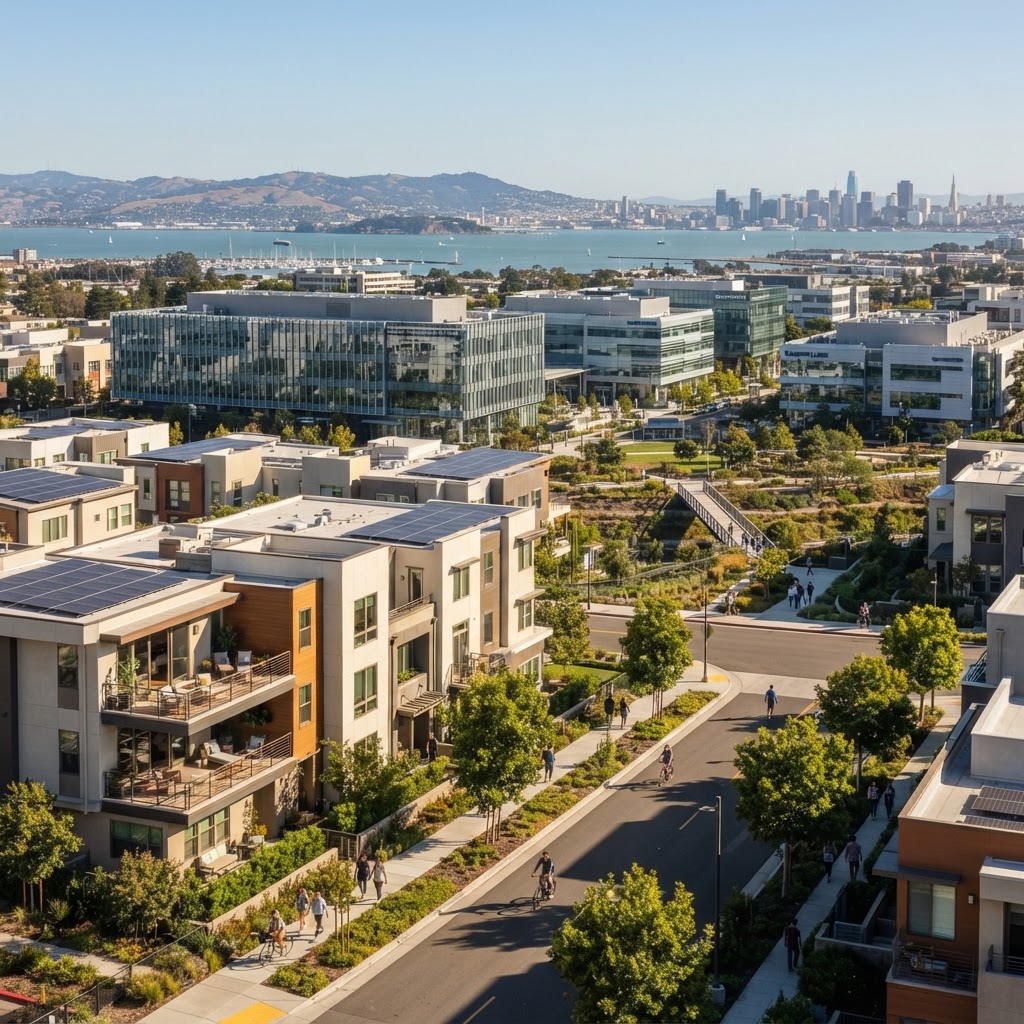
The 2026 Divergence: Why Labs Lead Residential Values
As we enter the third quarter of 2026, the California residential market is witnessing a profound divergence between traditional 'tech-commute' suburbs and specialized 'Life Science Latch' zones. While traditional office-centric regions continue to navigate the complexities of hybrid work, residential values within a five-mile radius of major biotech and pharmaceutical clusters—specifically in San Diego, the San Francisco Peninsula, and the Conejo Valley—are demonstrating a price floor significantly higher than the state average.
According to 2026 mid-year data from the California Association of Realtors (CAR) and CBRE, home prices in life science-adjacent zip codes have appreciated by 6.4% year-over-year, nearly doubling the 3.3% statewide average. The reason is structural: unlike software engineering, laboratory-based research cannot be conducted remotely. This creates a permanent, high-income localized demand that anchors neighborhood valuations.
The Core Clusters: Beyond the Silicon Valley Shadow
The 2026 market is no longer defined by a broad 'coastal vs. inland' split, but rather by 'specialized labor' nodes. Three specific regions are currently outperforming the broader market:
- The San Diego Life Science Corridor: Neighborhoods like Sorrento Valley, Torrey Pines, and University City have seen inventory levels remain 22% below the San Diego County average. 2025 NIH funding surges for immunology research have translated into a 2026 hiring boom, keeping rental yields for multi-family investments above 5.5%.
- The Peninsula’s Bio-Midpoint: While San Francisco’s core office market seeks a new identity, South San Francisco (the 'Birthplace of Biotech') remains a supply-constrained stronghold. Real estate in adjacent Burlingame and San Bruno is fetching premium prices as researchers prioritize short commutes to R&D facilities.
- The Conejo Valley Surge: Thousand Oaks has matured into a global biotech powerhouse. MLS data shows that the median days-on-market for detached single-family homes in this region is just 14 days, compared to 38 days in the broader Los Angeles County.
Economic Fundamentals and the NIH Factor
Investment perspectives in 2026 are increasingly tied to public and private R&D spending. A 2025 federal initiative to repatriate pharmaceutical manufacturing has resulted in a massive influx of capital into California’s biomanufacturing plants. This is not just 'white collar' growth; it is 'gold collar' growth, encompassing high-paid technicians, researchers, and regulatory experts.
Census data from early 2026 indicates that these clusters are seeing a net migration of high-earning professionals from other states, particularly those with backgrounds in genomics and synthetic biology. This demographic shift is insulating these micro-markets from the broader economic headwinds of fluctuating interest rates.
Practical Takeaways for 2026 Investors and Buyers
For those looking to deploy capital in the current California landscape, the following strategies are proving most effective:
- Target 'Support' Neighborhoods: Focus on residential areas located midway between life science campuses and high-performing school districts. These 'transit-safe' zones for lab workers are seeing the highest equity growth.
- Medium-Density Multi-Family: There is a chronic shortage of 1- and 2-bedroom condos near biotech hubs to house young research associates. Zoned infill projects in these areas are currently commanding a 15% rent premium over similar units in tech-centric areas.
- Monitor Lab Vacancy as a Lead Indicator: Savvy investors should track lab vacancy rates rather than retail or office vacancies. When lab vacancy drops below 5% (as it currently has in Torrey Pines), a corresponding jump in residential prices typically follows within 6 to 9 months.
The Long-Term Outlook
The 'Life Science Latch' represents a fundamental shift in how California real estate is valued. In a world of remote work flexibility, physical proximity to the lab bench has become one of the few remaining 'hard' drivers of residential demand. As we look toward 2027, these clusters are expected to remain the state's most reliable engines for both capital appreciation and rental stability.