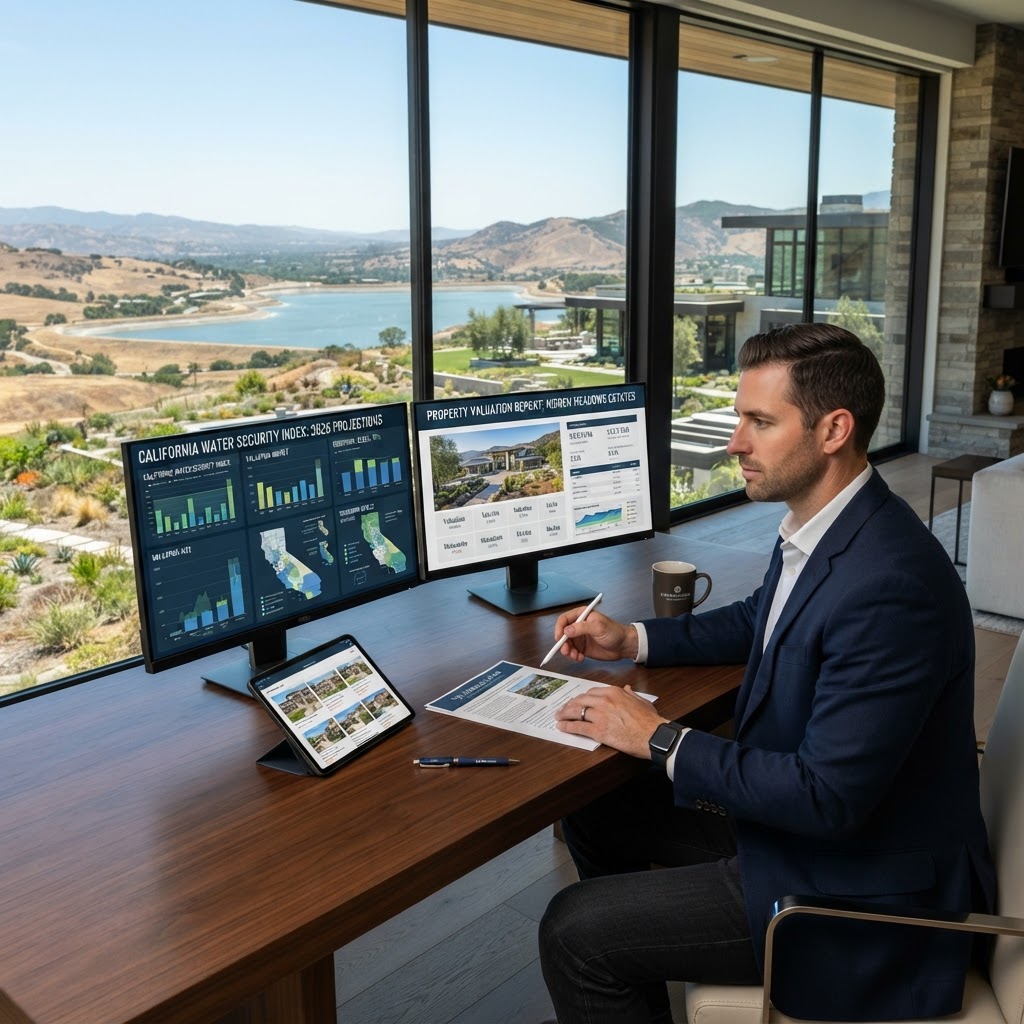
The Emergence of Resource Certainty in 2026
For decades, California real estate valuation focused on proximity—to the coast, to tech hubs, or to transit. However, as of August 2026, a new fundamental has overtaken the market: Hydraulic Alpha. While the insurance crisis of 2024-2025 rebalanced risk, the current year is defined by the quest for resource certainty. Institutional investors and savvy homebuyers are no longer just asking about fire zones; they are auditing municipal water portfolios to ensure long-term habitability and lower utility overhead.
Quantifying the Water-Secure Premium
Data from the California Association of Realtors (CAR) Q2 2026 report indicates a widening price gap. Residential properties in municipalities with independent water supplies—specifically those utilizing desalination or advanced Direct Potable Reuse (DPR)—are commanding a 9.2% premium over neighboring jurisdictions reliant solely on State Water Project (SWP) allocations. This 'Hydraulic Alpha' is most visible in coastal Southern California and parts of the Central Coast, where resource independence has become a hedge against state-mandated rationing.
The Desalination and Reclamation Advantage
The stabilization of the Carlsbad Desalination Plant and the 2025 commissioning of new brackish water reclamation facilities in the Inland Empire have created 'Blue Zones' of investment. According to CBRE’s 2026 Regional Outlook, commercial developments in these zones are seeing 15% higher pre-leasing rates. Tenants, particularly in data-sensitive or industrial sectors, are prioritizing locations where local water districts have secured 50-year sustainability plans that bypass the volatility of Sierra Nevada snowpack levels. This shift is turning previously overlooked submarkets into high-demand hubs of reliability.
Investor Perspectives: The Resilience Arbitrage
From an investment standpoint, the 2026 market favors the 'Resilience Arbitrage.' Savvy capital is shifting away from unincorporated areas with aging well systems toward 'Purple Pipe' cities—districts with extensive recycled water infrastructure for residential and commercial landscaping. This infrastructure not only lowers HOA maintenance costs but ensures aesthetic preservation during mandatory conservation cycles, directly impacting curb appeal and long-term resale value. The 'green' premium is being replaced by the 'wet' premium.
Practical Takeaways for 2026 Stakeholders
- For Buyers: Request a Municipal Water Security Audit during due diligence. Prioritize homes in districts where at least 30% of the water is sourced locally through desalination or recycled programs.
- For Sellers: Highlight 'drought-proof' features beyond xeriscaping. Properties with sub-metered greywater systems or proximity to reclamation-fed community spaces are now selling 14 days faster than the state average.
- For Investors: Target Class B multi-family assets in municipalities currently upgrading to DPR (Direct Potable Reuse) systems. The infrastructure completion often acts as a trailing indicator for significant cap rate compression.