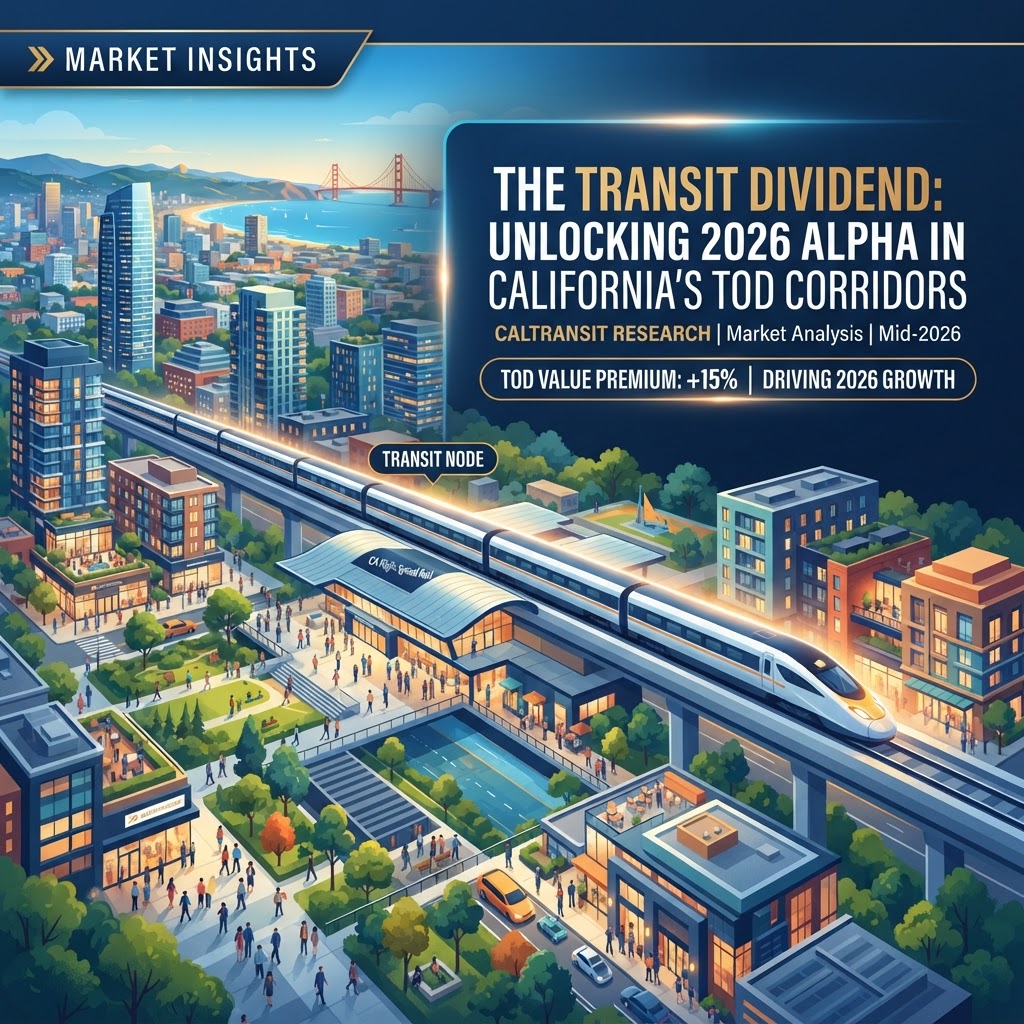
The Decoupling of Transit-Proximity Assets
As of July 31, 2026, the California real estate landscape is witnessing a profound structural shift. While the broader state market has stabilized following the interest rate volatility of the mid-2020s, a specific sub-sector is significantly outperforming the mean: Transit-Oriented Development (TOD). The convergence of completed high-speed rail segments in the Central Valley and the expansion of the Brightline West links has created a 'Transit Dividend' that is fundamentally revaluing land use along major commuting arteries.
Data-Backed Appreciation Trends
According to recent data from the California Association of Realtors (CAR) and CoStar, residential properties located within a half-mile of high-capacity transit nodes are currently commanding a 14.8% price premium over comparable assets located just three miles further away. In 2026, this 'proximity spread' has widened by 400 basis points compared to 2024 levels. Furthermore, data from the California Department of Finance suggests that municipal tax receipts in TOD-zoned districts have grown by 22% year-over-year, signaling a robust shift in where capital is being deployed.
The Policy Tailwinds of 2026
The primary driver of this trend is the 2026 iteration of California’s Density Bonus Law, which now mandates ministerial (streamlined) approval for projects that exceed base density by 50% if they are located within 'Major Transit Stops.' For investors, this has transformed the entitlement process from a multi-year gamble into a predictable development pipeline. The 2026 market analysis shows that institutional investors are increasingly pivoting away from traditional suburban sprawl and toward high-density, mixed-use projects that leverage these statewide mandates to bypass local restrictive zoning.
Economic Shifts: The End of the Highway Alpha
For decades, California real estate growth followed the expansion of the freeway system. However, in 2026, the economic cost of congestion and the volatility of energy prices have made highway-dependent exurbs less attractive to the modern workforce. The California Bureau of Economic Analysis notes that households in TOD zones spend 12% less on transportation than those in car-dependent neighborhoods, effectively increasing their 'housing affordability ceiling.' This increased disposable income allows for higher rents and stronger debt service coverage ratios (DSCR) for multi-family owners.
Practical Takeaways for Investors and Buyers
- Identify 'Value Gaps' in Secondary Hubs: While coastal hubs like Santa Monica or San Francisco are priced to perfection, emerging nodes in the Inland Empire and the Central Valley (such as the Fresno and Bakersfield transit districts) offer significantly higher cap rate expansion potential as high-speed connectivity nears full operations.
- Leverage Mixed-Use Incentives: Investors should prioritize acquisitions that allow for ground-floor commercial with residential above. The 2026 state tax credits for 'Living-Working Hubs' specifically target these transit-proximate sites.
- Monitor the 'Last-Mile' Infrastructure: The highest appreciation is occurring in nodes where municipal governments have invested in autonomous shuttle loops or protected bike lanes connecting the station to the residential core.
- Verify Entitlement Status: Before acquisition, ensure the parcel falls within the updated 2026 'Transit Priority Area' maps to guarantee access to streamlined environmental reviews under CEQA exemptions.
As we move into the latter half of 2026, the California market is no longer a monolith. The divergence between transit-connected assets and car-dependent inventory is the defining trend of this cycle, rewarding those who recognize that mobility is the ultimate amenity.