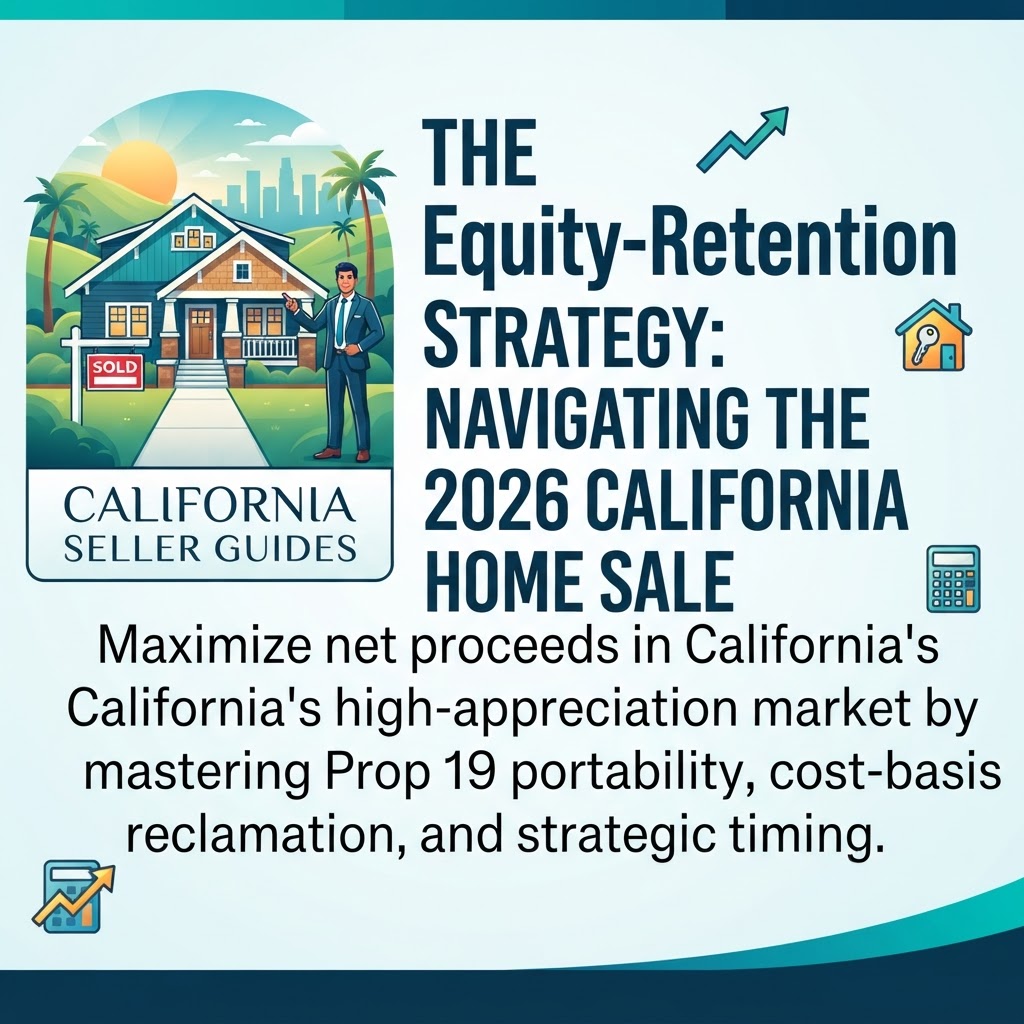
The 2026 California Seller’s Financial Mandate
As of July 2026, the California real estate market remains characterized by record-high equity levels and significant friction for sellers transitioning into new homes. With the statewide median home price hovering near $885,000—a 4.2% year-over-year increase according to California Association of Realtors (C.A.R.) data—the primary challenge for sellers is no longer just finding a buyer, but protecting their accumulated equity from tax erosion and market volatility. Success in this environment requires a transition from 'aesthetic staging' to 'financial engineering.'
Phase 1: Leveraging the Prop 19 Portability Playbook
For sellers aged 55 and older, or those with qualifying disabilities, Proposition 19 is the most powerful tool in the 2026 market. This law allows for the transfer of a primary residence's property tax base to a replacement home of any value, anywhere in California, up to three times. To maximize this, sellers should obtain a 'Tax Base Portability Certification' before listing. By demonstrating that their move is tax-shielded, sellers can aggressively price their current home while remaining competitive for their next purchase, effectively neutralizing the 'locked-in' effect of low-interest rates from the early 2020s.
Phase 2: The Cost-Basis Reclamation Audit
In a market where many long-term owners have seen appreciation exceeding the federal $250,000/$500,000 capital gains exclusion, documenting cost basis is critical. Data from the IRS suggests that 18% of California sellers in 2025 faced unexpected tax liabilities due to poor record-keeping. Practical Action: Sellers must compile a comprehensive dossier of all capital improvements made during their tenure—ranging from HVAC upgrades to roof replacements. These expenditures increase the home’s 'adjusted basis,' reducing the taxable gain and potentially saving tens of thousands of dollars in state and federal taxes.
Phase 3: ROI-Driven Preparation and the 2026 Aesthetic
While previous years favored maximalist renovations, the mid-2026 market demands 'High-Utility Minimalism.' Focus preparation on three specific areas that current MLS data shows yield the highest Return on Investment (ROI):
- Smart-Grid Readiness: Ensuring the electrical panel can support an EV charger and battery storage, even if the hardware isn't installed.
- Water-Neutral Interiors: Upgrading to ultra-high-efficiency fixtures that meet the latest California Green Building Standards (CALGreen).
- Acoustic Isolation: With 38% of Californians still working in hybrid environments, soundproofing home offices has become a 'must-have' rather than a 'nice-to-have.'
Phase 4: Market Strategy and Timing the July-August Window
July 30, 2026, marks the transition into the late-summer market. Historical trends indicate that while spring sees the highest volume, the 'Late-Summer Squeeze' often sees the highest price-per-square-foot as families rush to close before the school year. Sellers should utilize a 'Price-to-Velocity' strategy: listing at 97% of the projected AI-appraised value to trigger multiple-offer scenarios within the first seven days, thereby securing 'clean' offers with minimal contingencies.
Strategic Takeaways for Sellers
- Audit Your Basis: Consult with a CPA to verify your adjusted cost basis before setting your net-proceeds expectations.
- Verify Prop 19 Eligibility: Ensure your replacement property search aligns with the 24-month window required for tax-base transfer.
- Pre-Certify Inspections: In 2026, a seller-provided, third-party certified home inspection report is the standard for reducing 'deal-drift' during the escrow period.
- Target the 'Equity-Rich' Buyer: Market specifically to buyers coming from high-appreciation coastal zones who are looking for secondary-market stability.