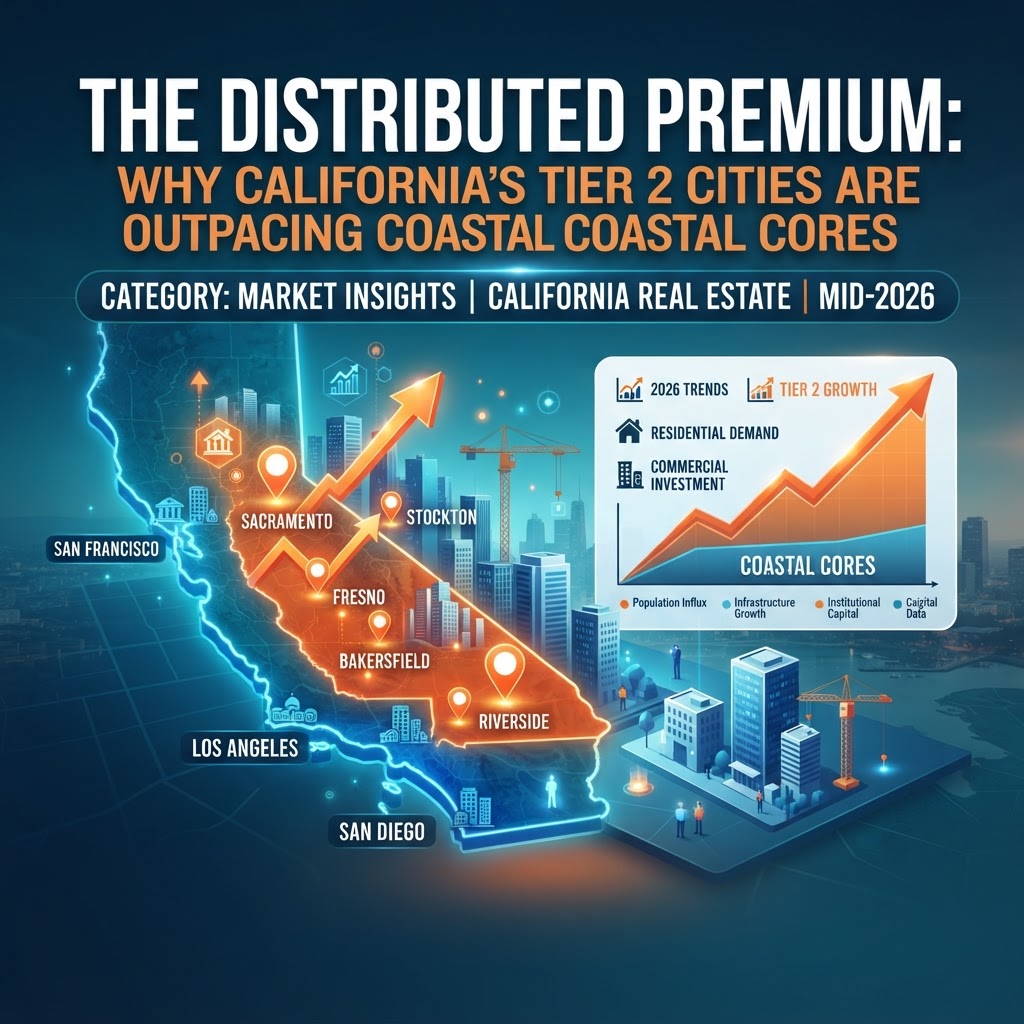
The Great Decoupling: A New Era for California Real Estate
As of late July 2026, the California real estate market is witnessing a historic divergence. For decades, the 'Coastal Core'—comprising San Francisco, Los Angeles, and San Diego—served as the undisputed engine of state-wide appreciation. However, data from the California Association of Realtors (CAR) and recent Census Bureau migration patterns indicate that the 'Distributed Premium' is now the primary driver of alpha for investors and homeowners alike.
While coastal markets have reached a plateau of price-to-income exhaustion, Tier 2 cities such as Sacramento, Riverside, and Fresno are seeing sustained year-over-year growth exceeding 7.2%, compared to a modest 1.8% in the Bay Area. This is not a temporary flight; it is the structural maturation of the distributed workforce.
The Connectivity Dividend and the 2026 Workforce
The primary catalyst for this shift is the stabilization of hybrid work mandates. By mid-2026, the 'Return to Office' volatility of 2024 has settled into a permanent 3-2 or 4-1 hybrid model. This has expanded the 'commutable radius' from 30 miles to nearly 100 miles. Consequently, markets that were once considered 'exurbs' have transformed into primary residential hubs.
- Infrastructure Integration: The 2025 completion of key regional transit expansions and the widespread adoption of high-speed satellite and fiber arrays in the Central Valley have removed the 'technological penalty' of living inland.
- Price Arbitrage: According to MLS data from Q2 2026, the median price per square foot in the Inland Empire remains approximately 40% lower than in coastal Los Angeles, despite nearly identical remote-work utility.
Institutional Pivot to Mid-Market Density
Institutional investors, who previously concentrated on Class-A assets in coastal downtowns, are aggressively pivoting. We are seeing a surge in 'Middle-Market Density' projects—mid-rise apartments and townhome clusters in Tier 2 downtowns. CBRE’s 2026 Mid-Year Outlook highlights that cap rates in Sacramento and Fresno are currently 120-150 basis points higher than in San Francisco, attracting significant private equity interest.
This institutional influx is driving a 'quality of life' gentrification, bringing high-end retail and amenities to previously underserved inland corridors. This creates a self-reinforcing cycle of value: better amenities attract higher-earning remote professionals, which in turn justifies higher residential valuations.
Economic Trends: The Tax and Cost of Living Hedge
In 2026, the 'Cost of Living Hedge' has become a critical metric for home buyers. With California’s state insurance premiums and utility costs rising, the lower property tax basis (relative to coastal acquisition prices) and newer, more energy-efficient housing stock in inland developments offer a significant monthly carry advantage.
Practical Takeaways for 2026 Market Participants
For those navigating the current landscape, the strategy has shifted from 'buy-and-hold coastal' to 'targeted inland expansion':
- For Investors: Focus on 'Transit-Adjacent Tier 2.' Properties within a 15-minute radius of regional rail hubs or major highway interchanges in cities like Roseville, Fontana, and Clovis are showing the highest rent-growth potential.
- For Sellers: If you are offloading coastal assets, 2026 represents a peak liquidity window before potential 2027 inventory increases. 1031 exchanges into high-performing Tier 2 multifamily units are currently a favored move for capital preservation.
- For Buyers: Look for 'Neighborhood Maturity.' Identify inland pockets where institutional capital has recently funded mixed-use developments, as residential values typically follow these commercial 'anchor' investments within 18–24 months.
The 2026 California market is no longer a monolith. By recognizing the 'Distributed Premium,' savvy participants can capitalize on the inland migration that has redefined the state’s economic geography.