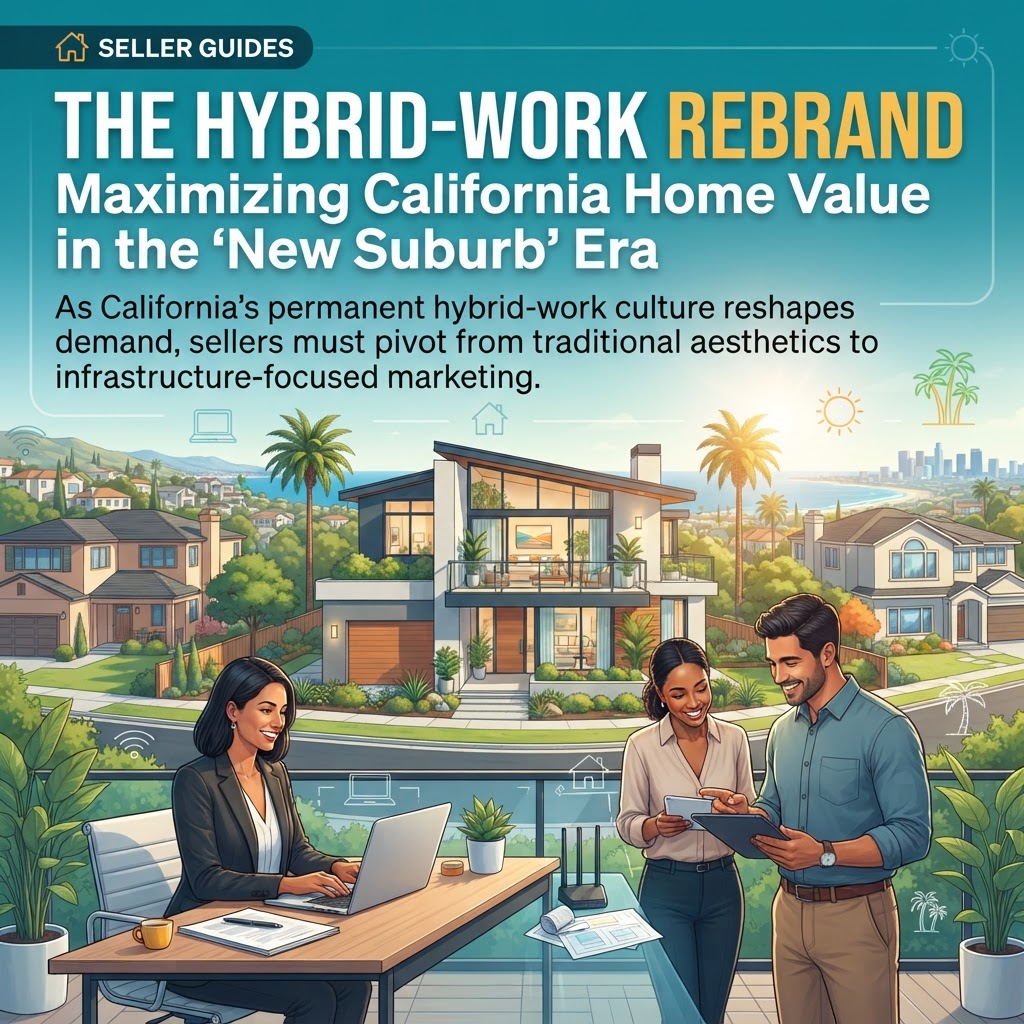
The 2026 Shift: From 'Bedroom Community' to 'Productivity Hub'
As of July 2026, the California real estate market has reached a definitive turning point. The 'return-to-office' mandates of 2024 and 2025 have largely settled into a permanent hybrid rhythm, with the California Association of Realtors (C.A.R.) reporting that 42% of professional homebuyers in the state now prioritize 'home office infrastructure' over traditional amenities like formal dining rooms. For sellers in the Inland Empire, Sacramento, and the North Bay, the strategy has shifted: you are no longer just selling a home; you are selling a high-performance workspace.
The Acoustic and Digital Audit: Meeting Buyer Requirements
In the current market, a 'den' is no longer sufficient. To maximize value, sellers must demonstrate that their property can support a multi-user professional environment. Data from the National Association of Realtors (NAR) indicates that homes marketed with 'dedicated sound-dampening' and 'fiber-ready' status see a 3.4% price premium in suburban California markets.
- Acoustic Partitioning: Consider replacing standard hollow-core doors with solid-core alternatives in designated office spaces. In high-density areas, adding acoustic wall panels or 'quiet-rock' drywall to a primary office can be a major selling point.
- Redundant Connectivity: In 2026, a single ISP connection is a vulnerability. Highlight the availability of secondary high-speed options, such as low-earth orbit satellite backups or multi-gigabit fiber, which have become the gold standard for the 'Bay Area exiles' moving into the Central Valley.
The 'Commute-Lite' Amenities: Preparing for the 2-Day Trek
With the average California hybrid worker commuting to a metropolitan core only twice a week, the priority has shifted toward 'mid-week' convenience. Sellers should focus on features that ease the burden of the long-distance commute. According to recent MLS data, homes within a 15-minute radius of transit hubs (ACE, Metrolink, or SMART) are currently appreciating 12% faster than those in isolated cul-de-sacs.
Strategic Positioning: The 'Third Space' Marketing Strategy
To capture the 2026 buyer, your listing narrative must move beyond the property line. Marketing materials should emphasize the 'Third Space'—local amenities that serve as an extension of the home office. This includes proximity to high-end coffee shops with reliable Wi-Fi, co-working memberships that convey with the HOA, and walkable parks for 'walking meetings.'
Practical Takeaways for the 2026 Seller
To secure a top-tier offer in today’s environment, follow these preparation steps:
- Infrastructure Certification: Provide documentation of your home's internal networking speeds. A 'Network Health Report' showing consistent Wi-Fi 7 coverage across the property can reassure tech-reliant buyers.
- The Hybrid Staging Flip: Convert that underutilized third bedroom into a 'Dual-Executive Suite' rather than a guest room. Show potential buyers how two people can work from home simultaneously without interference.
- EV-Ready Documentation: While most CA homes now have basic charging, a 240V Level 2 charger is now an expected baseline. If you have a bidirectional charging setup (V2H), ensure this is prominently featured in your 3D tour.
By positioning your home as a lifestyle-integrated productivity hub, you tap into the primary driver of California’s 2026 migration patterns: the pursuit of a home that works as hard as its owner does.