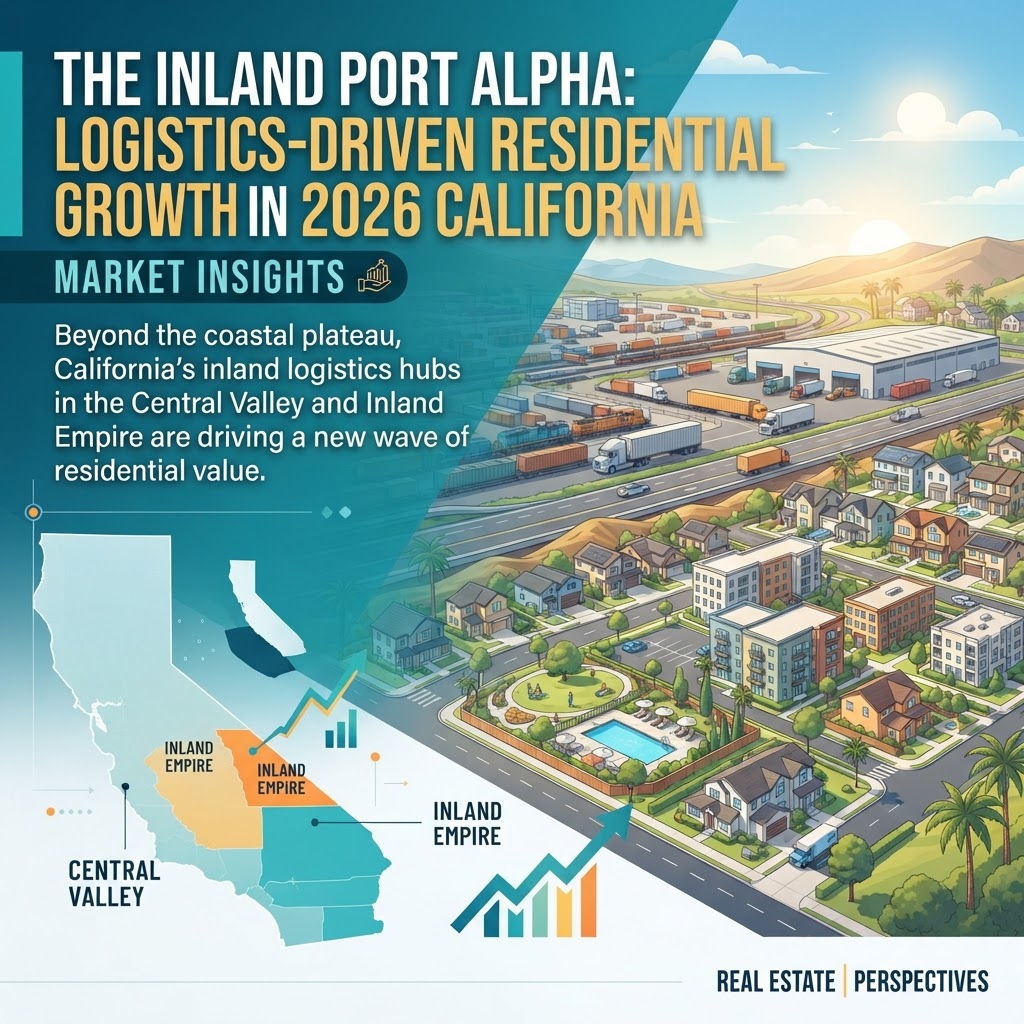
The Shift from Coastal Premium to Inland Utility
By mid-2026, the California real estate narrative has fundamentally pivoted. While the 'Great Mobility Thaw' has addressed inventory shortages in coastal hubs like Santa Monica and Palo Alto, the most aggressive price appreciation is no longer found on the Pacific. Instead, it is concentrated in the 'Logistics Golden Triangle'—the region connecting the Inland Empire, the Port of Stockton, and the South Central Valley. As of July 2026, the traditional coastal premium is being challenged by a new driver of value: industrial-adjacent residential demand.
Data-Driven Growth: The Logistics Link
According to Q2 2026 industrial reports from CBRE, vacancy rates in California’s primary logistics corridors remain below 3.5%, despite a massive surge in new warehouse deliveries over the last 24 months. This industrial strength is bleeding directly into the residential sector. In cities like Riverside, San Bernardino, and Fresno, residential property values have seen a 6.8% year-over-year increase, significantly outperforming the state average of 3.2% reported by the California Association of Realtors (CAR). This 'Logistics Ripple' is creating a localized economic boom that is insulated from the broader volatility seen in tech-heavy coastal markets.
The Executive Migration and Mid-Market Luxury
Unlike previous cycles, this growth isn't just about blue-collar workforce housing. The maturation of logistics infrastructure—driven by automated supply chains and regional distribution hubs—has brought a new class of high-income management and tech-operations professionals to these regions. MLS data shows a 14% increase in 'Luxury Tier' home sales ($1.2M+) in the Central Valley and the Inland Empire. These buyers are often hybrid-remote executives who prioritize modern, large-scale construction over the aging, smaller-lot inventory typically found at the same price point in coastal cities.
Investment Perspective: Cap Rate Compression vs. Yield Potential
For institutional and private investors, the arbitrage between coastal and inland markets is the defining strategy of 2026. Coastal multi-family assets are currently hovering at a 3.5% to 4.1% cap rate, largely suppressed by high entry costs and stringent local regulations. In contrast, emerging inland sub-markets are still yielding 5.2% to 5.8%. While this spread is narrowing as capital flows eastward, the 'Inland Port Alpha' remains the most viable play for investors seeking a combination of cash flow and long-term equity growth.
Practical Takeaways for 2026 Investors and Homeowners
- Target 'Last-Mile' Pockets: Investors should focus on residential pockets within 15 miles of major distribution nodes. These areas show the highest rent-to-price stability due to a constant influx of workforce demand.
- Pivot to Executive Amenities: Sellers in inland hubs should emphasize 'Executive Home Offices' and high-end finishes. The buyer profile in these regions has shifted from entry-level to professional-class, demanding higher standards of living.
- Watch Municipal Infrastructure: Look for 'In-Fill' opportunities in downtowns like Stockton, Riverside, and Modesto. Municipal revitalizations are currently trailing the industrial boom, offering a secondary wave of appreciation for early movers.