The Great Silicon Valley Transformation
As of mid-2026, the most significant shift in California real estate isn't happening in high-rise downtowns, but in the sprawling suburban office parks of the South Bay. Sunnyvale’s Moffett Park, once a sea of low-slung R&D buildings and surface parking, has officially transitioned into a national model for 'Eco-Innovation' districts. According to the 2023 Moffett Park Specific Plan—which reached critical construction milestones this year—the area is on track to deliver 20,000 new housing units, signaling a pivot from commercial monoculture to a vibrant, mixed-use ecosystem.
The 15-Minute City in a Tech Hub
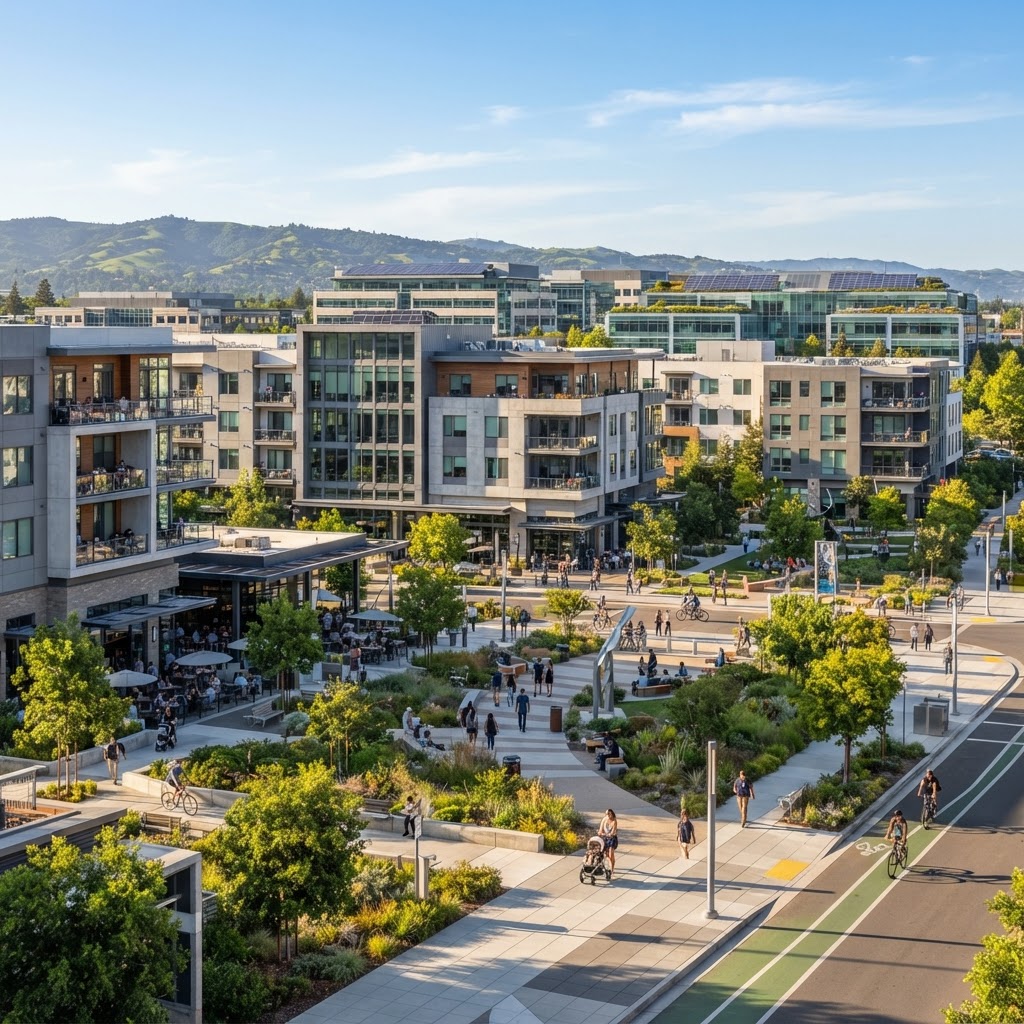
The appeal of Moffett Park in 2026 lies in its departure from the traditional Silicon Valley commute. By integrating residential towers with existing tech campuses like Google and Meta, the district has achieved a '15-minute city' status. Data from the Silicon Valley Leadership Group indicates that residents in the newly completed Phase 1 developments have reduced their average daily vehicle miles traveled (VMT) by 40% compared to those in traditional Sunnyvale neighborhoods. The district features 31 acres of new parkland and an ecological spine designed to manage sea-level rise while providing recreational greenways.
Schools and Community Infrastructure
Despite the urban density, the district remains anchored by the prestigious Sunnyvale School District and Fremont Union High School District. To accommodate the influx of families, the city has utilized developer impact fees to fund the new Discovery Education Center, a STEAM-focused primary school integrated directly into the mixed-use core. Amenities include the 'Innovation Plaza,' a retail hub that has eschewed traditional big-box stores for local micro-grocers, bouldering gyms, and co-working social clubs, catering to a demographic that prioritizes wellness and community over square footage.
Transportation and Connectivity
Moffett Park’s evolution is tethered to its transit-first design. The VTA Light Rail’s Orange Line serves as the district's backbone, connecting residents to the Great Mall, Levi’s Stadium, and the Caltrain corridor. Furthermore, the 2026 completion of the automated shuttle loop now provides seamless 'last-mile' connectivity between residential clusters and the major employment hubs along Mathilda Avenue. For those still relying on personal vehicles, immediate access to Highway 237 and US-101 remains a logistical advantage, though parking ratios in new developments have been reduced to 0.7 spots per unit to encourage transit use.
Investor and Buyer Takeaways
- For Buyers: The district offers a rare opportunity to enter the Sunnyvale market at a lower price point via high-density condos and townhomes, without sacrificing proximity to top-tier employers.
- For Investors: With a projected 25% increase in the local daytime population by 2030, commercial assets focusing on 'third-place' retail and services are seeing higher yield potential than traditional office leases.
- Market Context: Per MLS data, the median sales price in Sunnyvale has remained resilient at $2.2M, but the new inventory in Moffett Park is providing a 'missing middle' tier ranging from $950,000 to $1.4M, attracting first-time tech buyers who previously sought housing in the East Bay.
Ultimately, Moffett Park 2026 represents a pragmatic response to the dual crises of housing scarcity and office vacancy. It is no longer just a place where work happens; it is a blueprint for how the modern Californian suburb must evolve to survive.