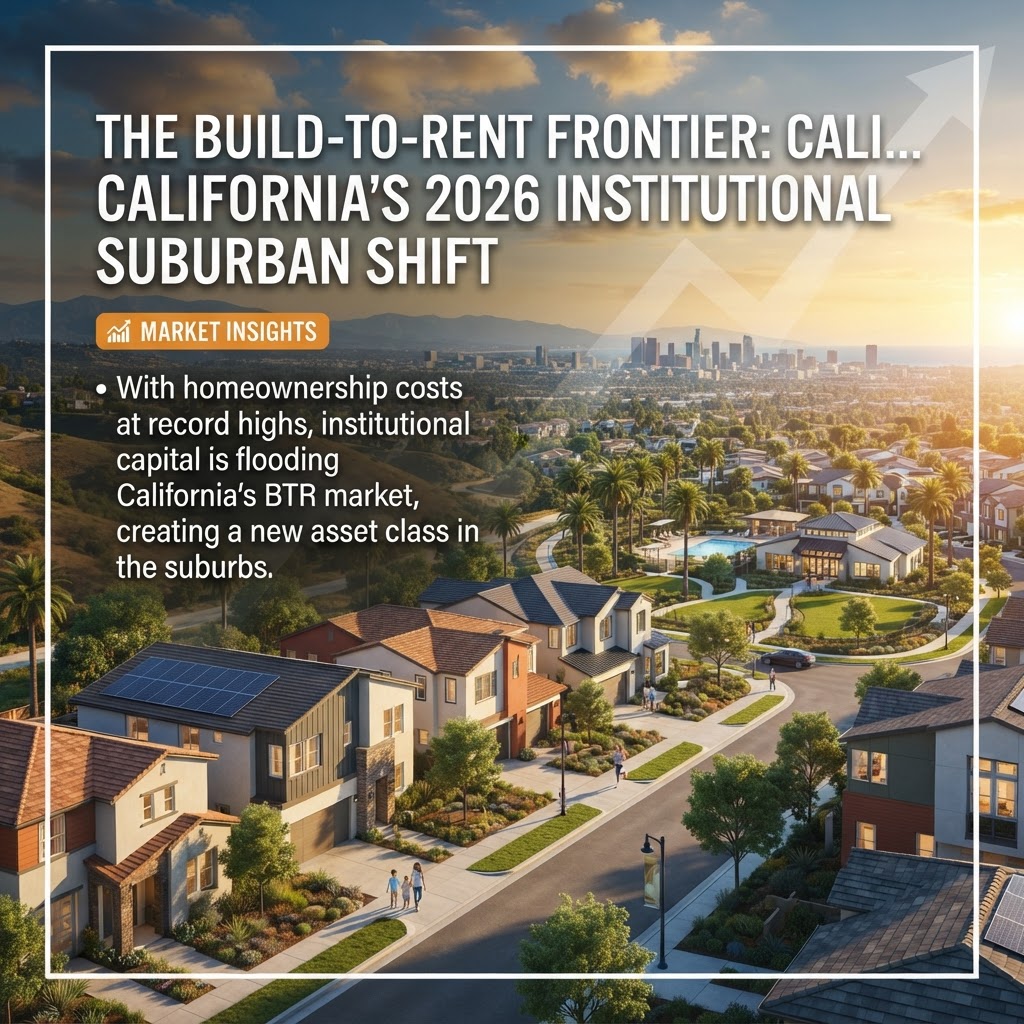
The Rise of Managed Suburbia
As of July 2026, the California real estate landscape is witnessing a structural transformation: the professionalization of the single-family rental. While the 'Great Mobility Thaw' of earlier this summer brought a surge in traditional inventory, a significant portion of the state’s suburban growth is no longer for sale. Instead, institutional developers have pivoted aggressively toward Build-to-Rent (BTR) communities—purpose-built neighborhoods of single-family homes managed like luxury apartments.
Bridging the 'Aspiration Gap'
Data from the California Association of Realtors (CAR) and recent Census Bureau updates indicate that while the median home price has stabilized after the volatility of 2024-2025, the qualifying income for a median-priced home in the Bay Area or Southern California remains nearly 40% higher than the state’s median household income. This 'Aspiration Gap' has fueled a 22% year-over-year increase in BTR completions across the state.
Institutional players like Greystar and Blackstone have shifted their focus from fragmented acquisitions to master-planned BTR developments. According to 2026 CBRE mid-year reports, these communities are maintaining a 96.5% occupancy rate, significantly outperforming traditional Class-A multifamily assets in urban cores, which have seen a slight softening due to the continued decentralization of the workforce.
The Geographic Shift: Beyond the Coastal Core
The 2026 BTR boom is concentrated in California’s 'Growth Triangle'—the region spanning from the Inland Empire up through the Central Valley to the Greater Sacramento area. These markets offer the land-use flexibility that coastal cities lack. In the Inland Empire alone, over 4,500 BTR units have been delivered in the first half of 2026, providing families with the amenities of suburban life—backyards, garages, and community parks—without the high-interest debt burden of a traditional mortgage.
Investment Dynamics: Cap Rate Compression
From an investment perspective, BTR has emerged as a preferred hedge. Cap rates for BTR assets in California are currently hovering between 4.8% and 5.2%, a tightening spread compared to traditional multifamily. The appeal lies in 'stickiness'; BTR tenants stay an average of 50% longer than apartment dwellers, reducing turnover costs and providing more predictable cash flows for institutional REITs. Furthermore, the 2026 'Density Bonus' updates to state housing laws have allowed developers to increase unit counts on suburban-fringe parcels, enhancing the yield-on-cost for new projects.
Actionable Takeaways for 2026 Stakeholders
- For Investors: Look toward the 'Next-Tier' cities like Fresno, Roseville, and Temecula. The yield on BTR developments in these areas is outpacing traditional residential flips, especially as the state provides streamlined CEQA (California Environmental Quality Act) pathways for high-density rental projects.
- For Local Sellers: Large lot owners in the path of development should evaluate the 'Institutional Premium.' Developers are currently paying a premium for parcels that can accommodate 50+ contiguous units, often outbidding traditional retail homebuilders.
- For Policy Watchers: Monitor the 2027 local general plan updates. Many municipalities are beginning to treat BTR as a distinct zoning category, which could impact future land valuations and entitlement timelines.
As we move through the remainder of 2026, the 'managed suburb' is no longer a niche alternative; it is a pillar of California’s housing economy, providing a crucial safety valve for a market still grappling with systemic underproduction.