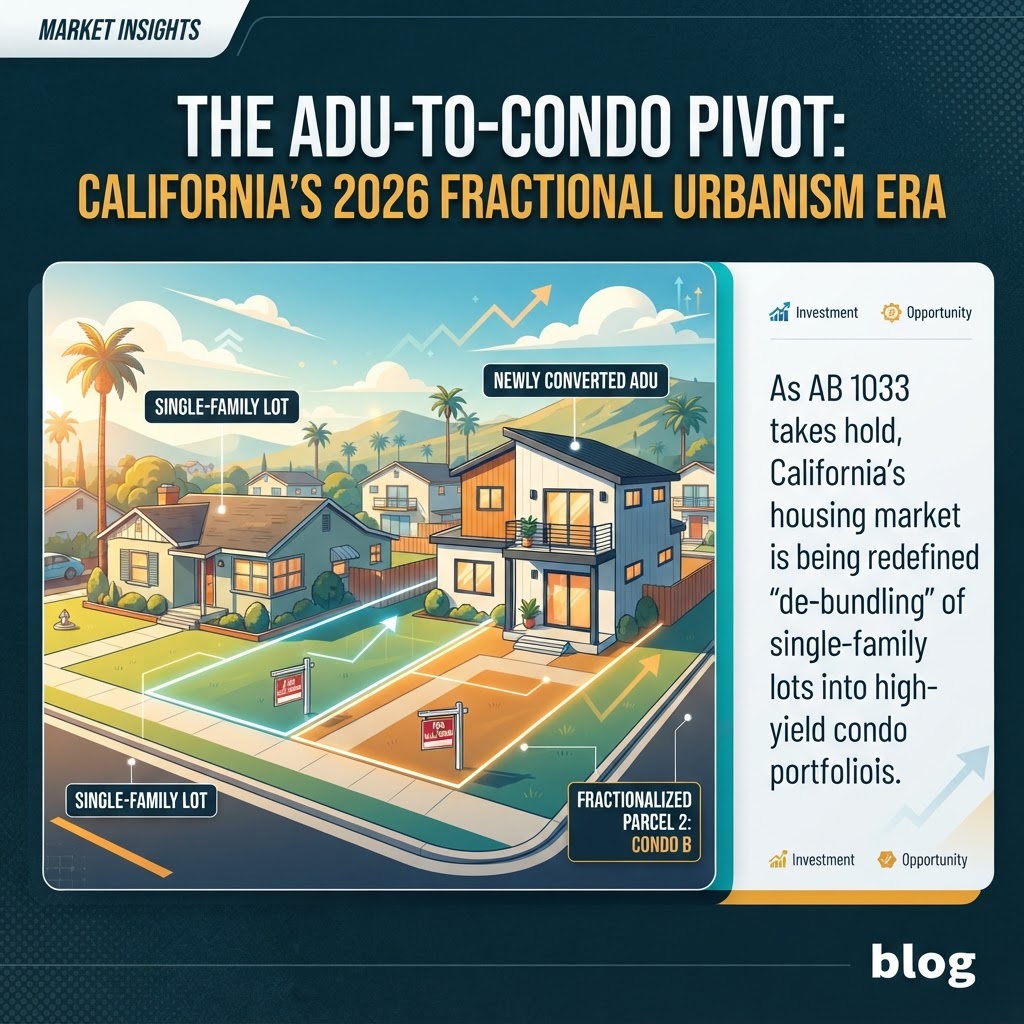
The Rise of Fractional Urbanism in California
By July 2026, the 'backyard cottage' has evolved from a supplemental rental project into a primary engine of California real estate wealth. While previous years focused on the production of Accessory Dwelling Units (ADUs) for the rental market, the current trend is defined by 'Fractional Urbanism'—the legal separation and sale of ADUs as independent condominiums. This shift, catalyzed by the statewide maturation of AB 1033, is fundamentally revaluing residential land across Los Angeles, San Diego, and the Bay Area.
The AB 1033 Maturation: From Rental to Retail
Until recently, California investors used ADUs primarily for yield-focused cash flow. However, as of Summer 2026, more than 40 California municipalities have opted into the AB 1033 framework, allowing homeowners to convert ADUs into condos that can be sold separately from the primary residence. Data from the California Department of Housing and Community Development (HCD) indicates that ADU-condo conversions have increased by 215% year-over-year. This has created a new 'entry-level' tier for first-time buyers and a high-velocity exit strategy for developers who previously faced the liquidity constraints of a single-title property.
The 'Three-Unit Play' and Sub-Market Arbitrage
Institutional interest is moving away from the large-scale multifamily projects that dominated 2023–2024, pivoting instead toward 'micro-density' portfolios. Savvy investors are utilizing SB 9 and AB 1033 in tandem to perform the 'Three-Unit Play': buying a distressed single-family residence (SFR) on a 5,000+ square foot lot, adding a full-size ADU and a Junior ADU (JADU), and then titling them as three distinct condo units. Current market analysis shows that this strategy can yield a combined valuation 35-50% higher than the original SFR, even after accounting for construction costs and the current 2026 interest rate environment.
2026 Economic Drivers: The Financing Breakthrough
A critical factor in the 2026 surge is the stabilization of ADU-specific financing. Following the 2025 updates to FHA and Freddie Mac guidelines, lenders now permit 75% of projected rental income from an ADU to be used for mortgage qualification. This has unlocked a massive pool of buyers who were previously priced out of California's coastal markets. Furthermore, the 2026 California Dream For All program has been restructured to specifically incentivize the purchase of ADU-condos, providing the necessary down-payment assistance to sustain the bottom end of this new market segment.
Practical Takeaways for Investors and Homeowners
- For Sellers: Before listing a single-family home, perform a feasibility study on AB 1033 conversion. The potential to sell the backyard as a separate asset often outweighs the 'lot size' premium of a traditional sale.
- For Buyers: Target municipalities that have streamlined the ADU-condo conversion process. 'Fractional' ownership represents the most viable path to equity in California’s high-cost urban cores.
- For Investors: Focus on 'lot-splitting' opportunities in secondary markets like Long Beach, Oakland, and Sacramento, where land costs remain lower relative to the eventual condo exit prices.
As we move through the third quarter of 2026, the ability to 'un-bundle' land is the single most important delta in California real estate. Those who view a residential lot as a single asset are missing the multi-unit reality of the modern California landscape.