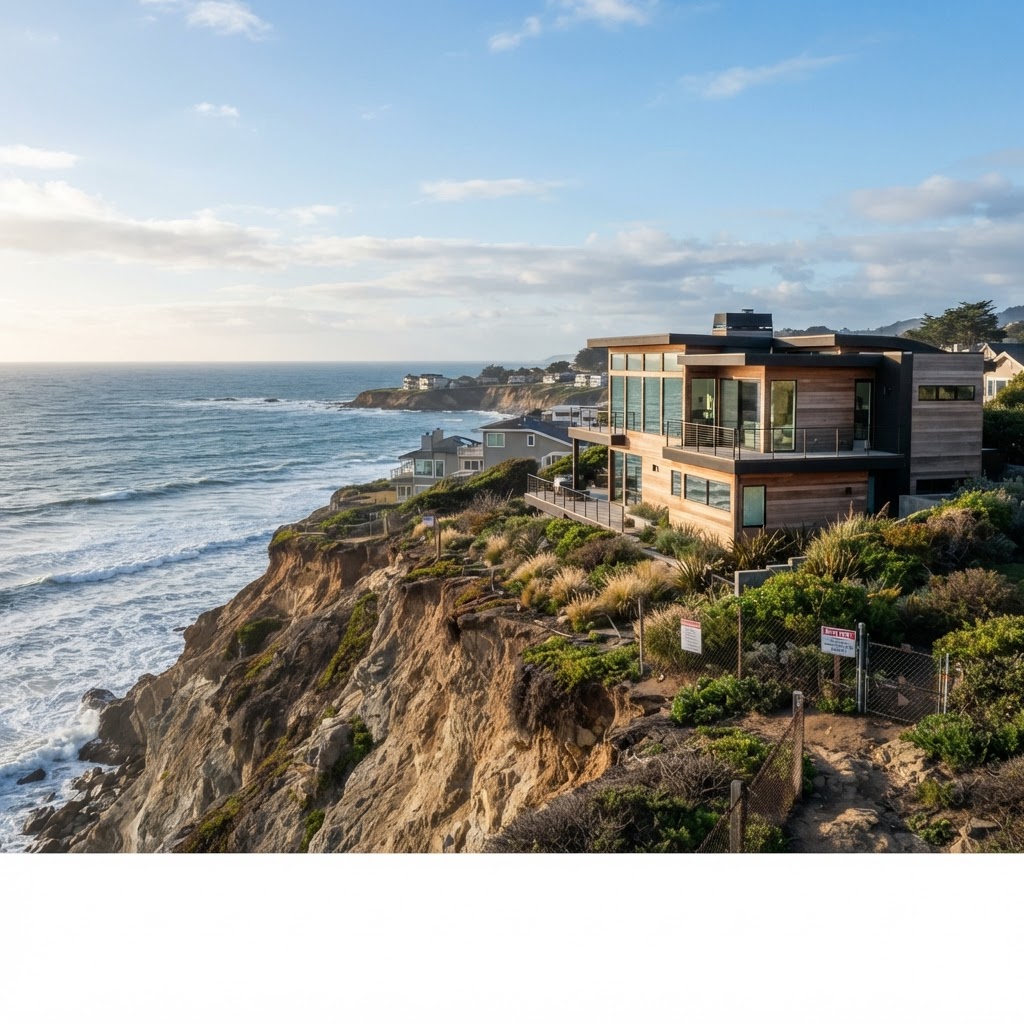
The End of the Shoreline Premium?
For decades, California’s coastal real estate was considered the safest bet in the luxury market. However, as of July 22, 2026, a new regulatory reality is forcing a pricing reset. Following the full implementation of the California Coastal Commission’s (CCC) 2026 Managed Retreat Framework, properties situated in 'High-Hazard Erosion Zones' are seeing their first significant valuation decoupling from the broader market.
Data Points: The 15% Coastal Correction
According to mid-year data from the California Association of Realtors (CAR) and the Scripps Institution of Oceanography’s Economic Division, beachfront home prices in Malibu, Newport Beach, and Del Mar have seen a 14.2% average decline in price-per-square-foot compared to July 2025. In contrast, 'Bluff-Safe' properties—those located at least 50 feet above the projected 2050 mean high-tide line—have seen a 9% appreciation over the same period.
This 'Resilience Gap' is driven by the CCC’s new restriction on 'Hard Armoring.' As of January 2026, the state effectively banned the construction of new sea walls and the repair of existing ones for residential structures built after 2015. For older structures, the new 'Trigger-Based Permitting' system means that once a property’s primary structure is within 10 feet of the bluff edge, the owner is legally required to begin 'Managed Retreat'—which can include partial demolition or relocation of the structure.
The Rise of Transferable Development Credits (TDCs)
To mitigate the economic impact on homeowners, the state has expanded the Transferable Development Credit (TDC) program. This allows owners of at-risk coastal parcels to sell their 'lost' density to developers in inland 'Opportunity Zones' or the newly rezoned SB 9.2 corridors. In Santa Barbara, TDCs are currently trading at approximately $180,000 per unit, providing a vital, albeit partial, equity hedge for coastal residents.
Practical Takeaways for the 2026 Market
- For Buyers: The 'Coastal Hazard Disclosure' is now more critical than the home inspection. Ensure any purchase agreement includes a 'Maturity of Armor' clause, detailing the legal lifespan of existing sea walls under current state mandates.
- For Sellers: If your property is in a high-risk zone, the current market favors those who leverage TDCs early. Selling the development rights while the inland demand for density is high can offset the depreciation of the physical lot.
- For Investors: Focus on 'Second-Tier Coastal'—properties located 2-3 blocks inland that offer ocean views but sit outside the 50-year erosion projection. These assets are absorbing the demand from former beachfront buyers who are de-risking their portfolios.
A New Definition of Luxury
Industry analysts suggest that the California coast is not losing its appeal, but rather its permanence. 'The market is shifting from an ownership mindset to a stewardship mindset,' says Marcus Thorne, a senior analyst at CBRE. 'We are seeing the emergence of 30-year ground leases on high-risk parcels, reflecting a market that finally acknowledges the shoreline is moving, even if the address isn't.'


