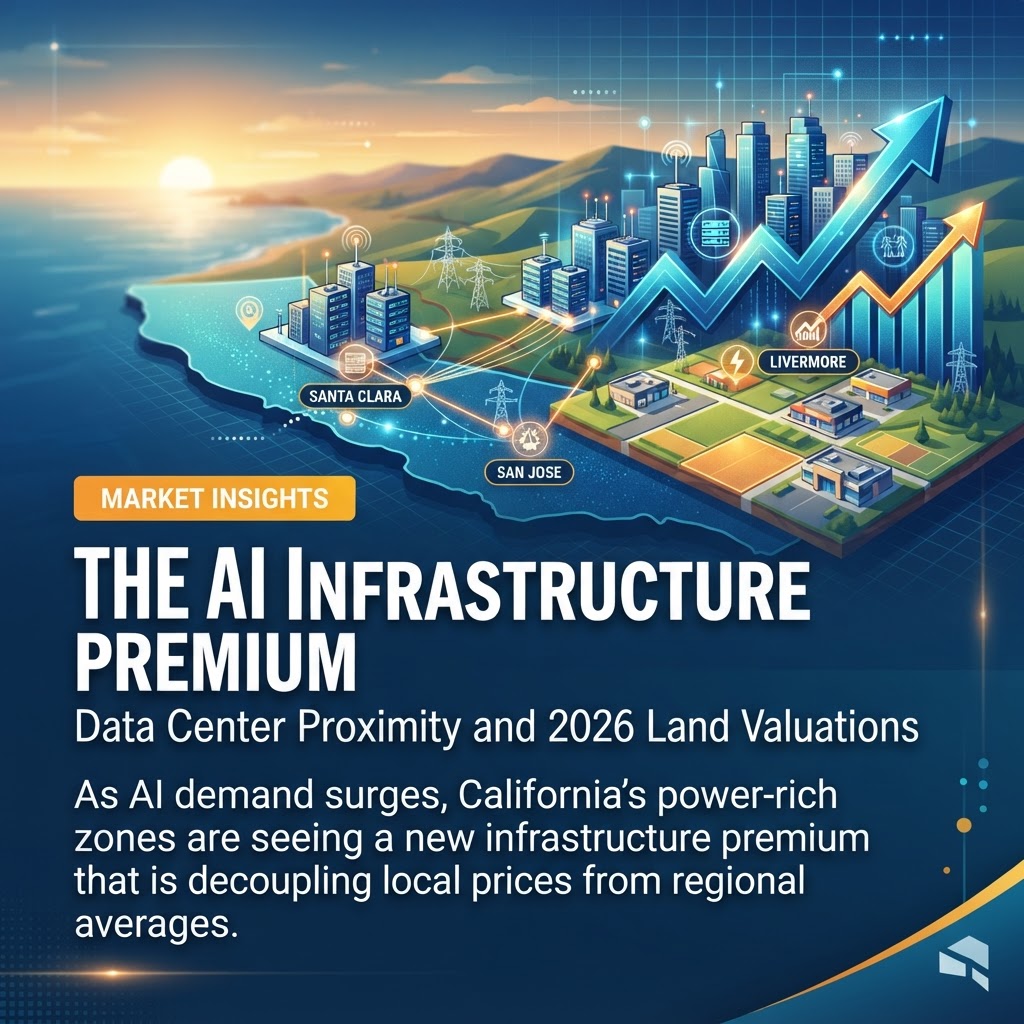
The Rise of the Compute Corridor
As of July 2026, the California real estate landscape is being reshaped by a factor previously relegated to the back pages of industrial zoning reports: high-density power availability. While the 'Remote Work' era redefined geographic desirability through lifestyle, the 'AI Era' is redefining it through infrastructure. We are witnessing the birth of the 'Compute Corridor,' where proximity to massive data center clusters is creating a distinct valuation premium for surrounding residential and commercial land.
Data-Backed Valuation Shifts
According to the Q2 2026 CBRE Data Center Trends report, California’s inventory of data center space has grown by 22% year-over-year. However, the more striking metric for real estate investors is the 'Infrastructure Halo.' Properties located within a five-mile radius of major data center hubs in Santa Clara, Folsom, and the burgeoning 'Silicon Inland' near Fresno have seen a 6.4% valuation premium compared to their broader county averages. This is driven not just by corporate land acquisition, but by the secondary demand for high-capacity fiber-optic backbone and the massive tax revenues these centers provide to local municipalities, which in turn fuels superior public amenities.
The Power-Priority Pivot
The California Energy Commission (CEC) noted in May 2026 that the state’s grid upgrades are increasingly prioritized around 'High-Demand Innovation Zones.' For residential investors, this creates a 'safety-net' effect. Neighborhoods on the same priority power circuits as critical AI infrastructure are seeing lower risks of rolling blackouts and faster utility-side investments in modernizing local distribution networks. This reliability is becoming a tangible line item in appraisal reports, particularly as climate-driven grid instability remains a concern in other parts of the state.
Practical Takeaways for 2026 Stakeholders
- For Land Investors: Target 'brownfield' sites or underutilized industrial parcels within 10 miles of planned utility substations. The capacity to handle high-voltage throughput is now a primary driver of land residual value, often surpassing traditional floor-area-ratio (FAR) considerations.
- For Residential Buyers: Look for 'Infrastructure-Adjacent' growth. Cities that have successfully permitted data centers often have more robust municipal budgets, leading to lower property tax assessments for residents or higher-quality local services, providing a 'fiscal hedge' against statewide economic volatility.
- For Commercial Developers: The conversion of logistics warehouses into 'edge computing' facilities is the new highest-and-best-use (HBU) play. Identifying buildings with ceiling heights and floor loads capable of supporting liquid-cooling server racks is currently the highest-alpha strategy in the California industrial market.
Economic Perspective: The Fiscal Anchor
The long-term play here is fiscal stability. As California continues to navigate a complex budgetary environment in 2026, municipalities with high-density compute infrastructure are reporting 15-20% higher tax revenue growth than their neighbors. For the real estate market, this translates to improved schools, better roads, and more stable property values. The 'AI Infrastructure Premium' is no longer a niche industrial trend; it is a fundamental pillar of California’s 2026 real estate valuation model.