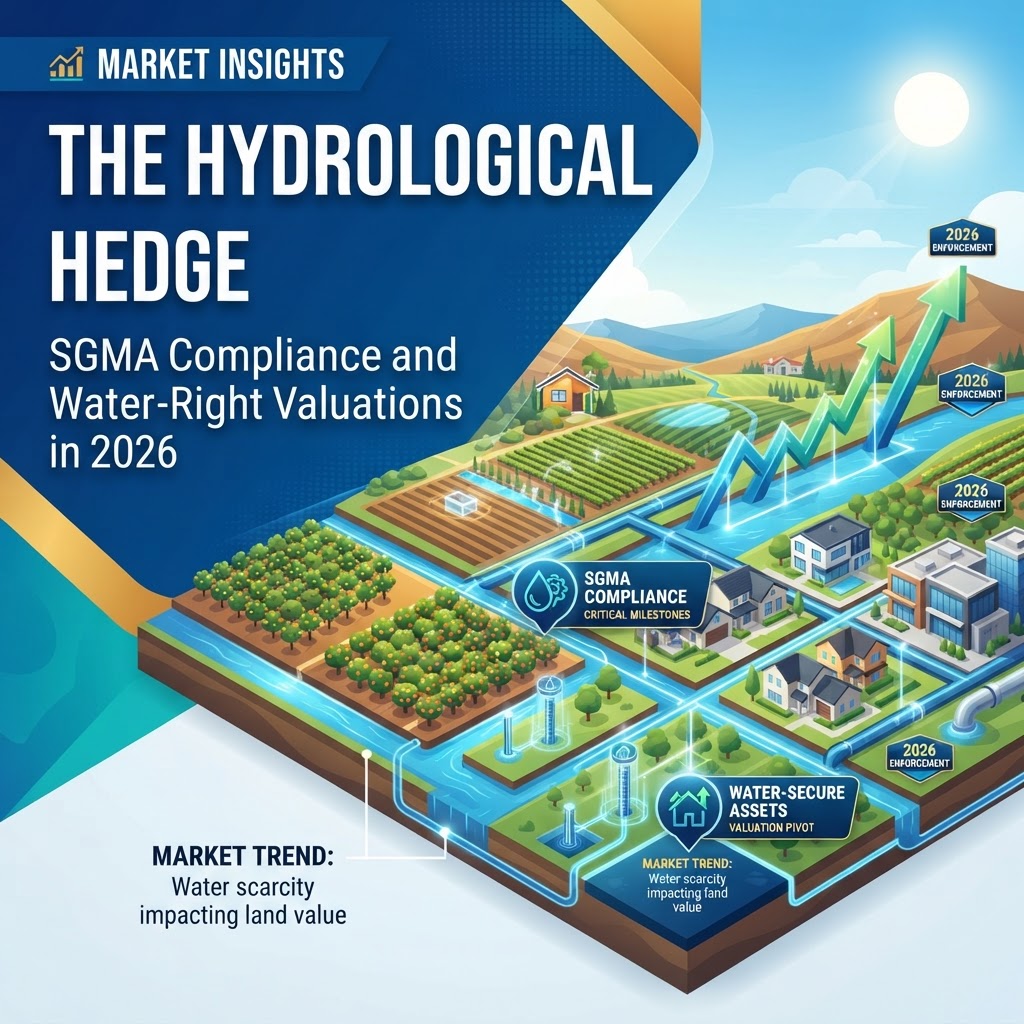
The Rise of the Hydrological Premium
As of July 2026, the California housing market has entered a phase where the most critical luxury amenity is no longer a designer kitchen or a home theater, but a secure, adjudicated water allocation. With the Sustainable Groundwater Management Act (SGMA) reaching its latest implementation benchmarks this summer, the Department of Water Resources (DWR) has moved from advisory roles to strict enforcement. This shift has created a tangible 'Hydrological Hedge' in property valuations, distinguishing between assets with secure rights and those facing imminent pumping restrictions.
Data Trends: The Water-Security Spread
According to MLS data for the second quarter of 2026, residential properties located within adjudicated basins—where water rights are legally defined and protected by court decrees—are trading at a 14.2% premium compared to similar assets in unmanaged or critically overdrafted basins. In the Central Valley and the Inland Empire, this price spread has nearly tripled since 2024. Furthermore, CBRE's mid-year report indicates that institutional multi-family investors are now applying a 'Hydrological Discount Rate' (HDR) to acquisitions in regions where groundwater pumping caps are projected to increase utility overhead by more than 25% over the next five years.
Economic Shifts in Asset Valuation
The economic reality of 2026 is that water is no longer a guaranteed utility; it is a finite asset attached to the deed. This has led to a bifurcation in the market. 'Blue Assets'—properties with grandfathered well rights, priority municipal access, or integrated atmospheric water generation—are becoming the defensive core of California portfolios. This trend is most visible in the high-end agricultural-residential crossover market, where estates in regions like Paso Robles and the Santa Ynez Valley are now appraised with specific line-item valuations for water storage capacity and sustainable flow rates.
Practical Takeaways for Investors and Buyers
- Perform Hydrological Due Diligence: Before entering escrow, buyers must consult the DWR’s SGMA Portal. Identifying if a property is in a 'critically overdrafted' basin is now as essential as a structural inspection.
- Water-Rights Contingencies: Modern 2026 purchase agreements should include specific contingencies for water-right verification. Investors should require proof of historical pumping volumes and compliance with local Groundwater Sustainability Agency (GSA) mandates.
- Invest in Efficiency Infrastructure: Properties equipped with advanced greywater recycling and smart-irrigation systems are seeing a 1.9x return on investment (ROI) compared to traditional xeriscaping. As municipal tiered-pricing becomes more aggressive, these systems directly impact net operating income for rental assets.
For the remainder of 2026, the California market will continue to reward resource transparency. Sellers who can provide documented water-usage history and certified resource security will find themselves insulated from the cooling effects felt in less-secure zip codes. In the new California economy, liquidity refers to more than just cash—it refers to the water under the ground.