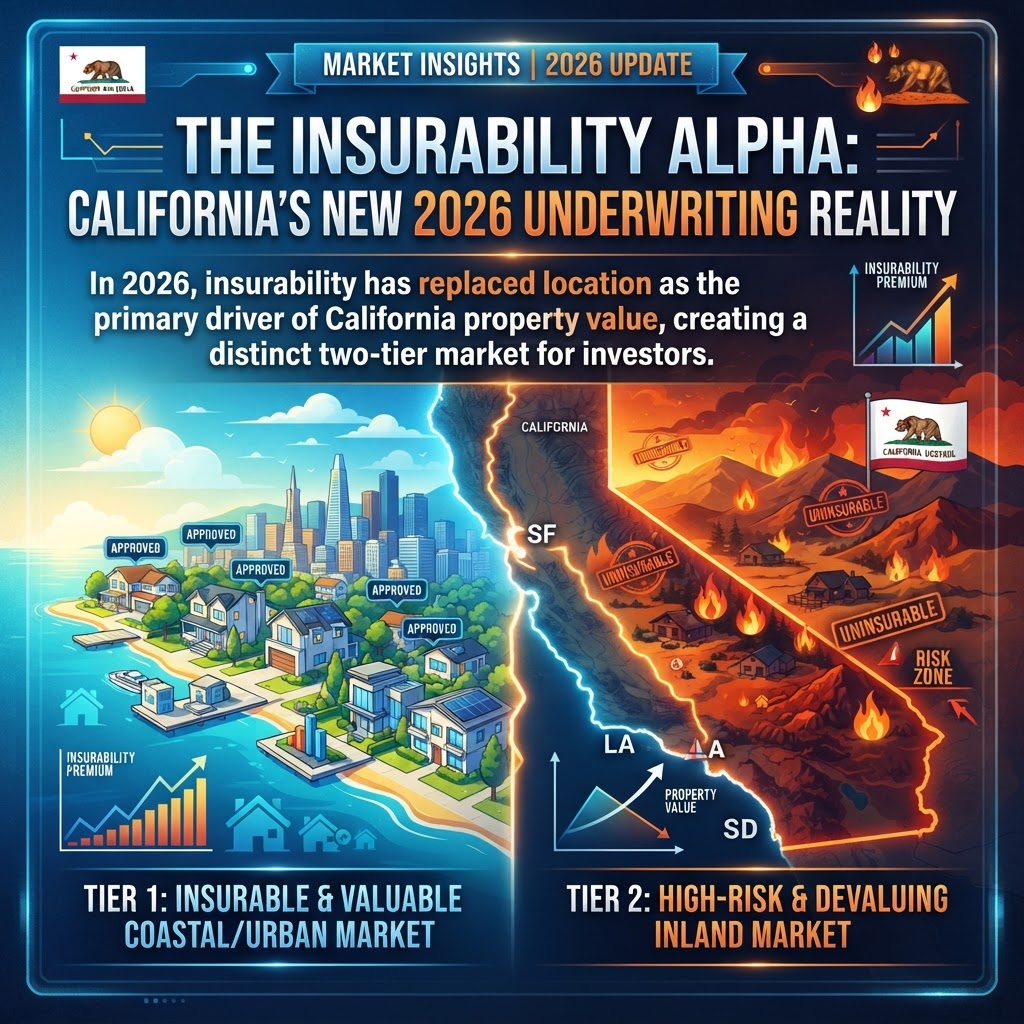
The Shift from Location to Limit-to-Loss
As of July 2026, the California real estate landscape has undergone a fundamental shift. While 'location, location, location' remains the historic mantra, the market has pivoted toward a new metric: 'insurability, resilience, and risk-mitigation.' Following the 2025 regulatory overhaul of the California Fair Access to Insurance Requirements (FAIR) Plan, property values are now decoupling based on their ability to secure private-market coverage versus state-backed last-resort policies.
The Data: A Two-Tiered Pricing Discovery
According to data from the California Association of REALTORS® (CAR) and recent Q2 2026 MLS reports, a clear pricing delta has emerged. Properties that qualify for 'Preferred Resilience' status—defined by Class 1 fire-resistive construction and audited defensible space—are commanding a 14% price premium over adjacent properties reliant on the FAIR Plan. In high-risk zones, such as the Wildland-Urban Interface (WUI) of the Sierra Foothills and coastal canyons, escrow fall-through rates reached 22% in the first half of the year, primarily due to insurance premiums exceeding the buyer’s debt-to-income (DTI) thresholds during the final underwriting phase.
The Rise of the 'Insurance Certificate' Contingency
In 2026, the traditional 17-day inspection contingency has been superseded by the 'Insurability Validation Period.' Institutional investors and savvy retail buyers are no longer satisfied with a standard binder. Market leaders like CBRE and Redfin report that 85% of successful transactions in California now include a pre-certified insurance quote as part of the initial disclosure package. Sellers who proactively engage in 'home hardening'—replacing attic vents with ember-resistant mesh and upgrading to multi-pane tempered glass—are seeing a return on investment (ROI) of nearly 180% at the point of sale, as these upgrades unlock lower-tier insurance premiums for the next owner.
Investment Perspectives: The 'Uninsurable' Arbitrage
For the opportunistic investor, the current market offers a specific type of arbitrage. 'B-Grade' assets that have lost value due to lapsed insurance coverage or non-compliance with the latest California Building Standards Code (Title 24) are being acquired at steep discounts. The strategy for 2026 involves 'CapEx for Coverage': aggressive retrofitting designed specifically to move a property from the FAIR Plan back into the private admitted market. Once private coverage is secured, the property's cap rate often compresses significantly, allowing for a rapid exit or a high-yield hold in a market starved for low-risk inventory.
Practical Takeaways for the 2026 Market
- For Sellers: Do not list without an 'Insurability Audit.' Providing a pre-vetted insurance quote from a private carrier can reduce days-on-market by an average of 12 days.
- For Buyers: Ensure your lender’s pre-approval accounts for the 2026 premium spikes. A property that fits your mortgage budget at 4% interest may become unaffordable if the annual insurance premium exceeds $8,000.
- For Investors: Focus on 'Hardened Hulls.' Prioritize properties built after the 2008 Chapter 7A wildfire building standards, as these assets are maintaining the highest liquidity and appreciation rates in the current cycle.
Economic Outlook: The Long-Term Resilience Premium
As we move into the second half of 2026, the California Department of Insurance (CDI) expects further stabilization as the new 'Risk-Based Pricing Model' matures. While this has caused temporary pain in wildfire-prone regions, it is creating a more sustainable and transparent market. Investors who prioritize climate-resilient infrastructure over aesthetic upgrades are the ones currently capturing the 'Resilience Alpha'—a trend that is expected to dominate the California market for the remainder of the decade.