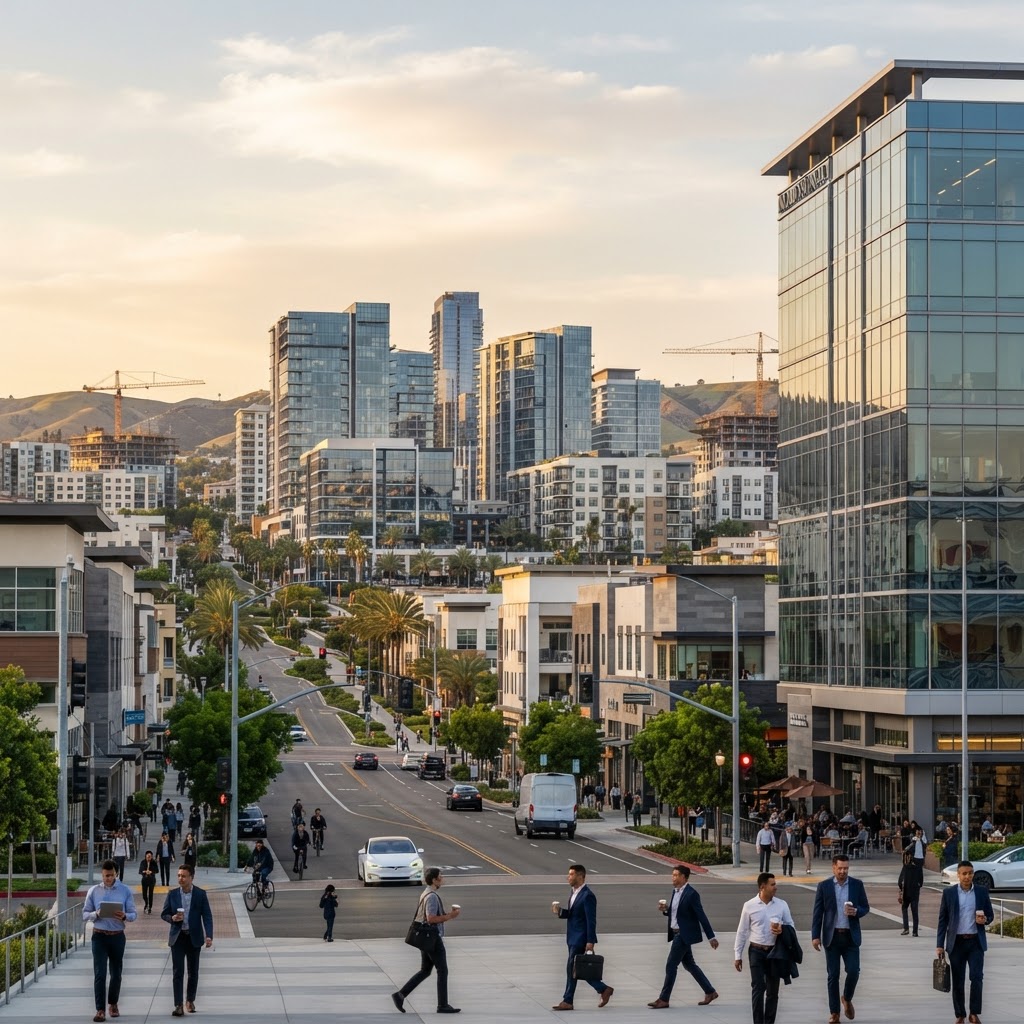
The Shift from Bedroom Community to Economic Engine
For decades, regions such as the Inland Empire, Greater Sacramento, and the Central Valley served primarily as 'relief valves' for California's coastal housing pressure. However, as of July 2026, a structural transformation has solidified. We are witnessing the rise of the Secondary Central Business District (CBD)—a phenomenon where former bedroom communities are evolving into self-sustaining economic hubs. Unlike the transit-oriented growth of previous years, this 2026 trend is driven by local employment density and the permanent maturation of hybrid work models.
Data Points: Growth Beyond the Coast
Recent data from the California Association of Realtors (CAR) and the U.S. Census Bureau highlights this migration of capital and people. In Q2 2026, the Riverside-San Bernardino-Ontario metro area saw a 5.8% year-over-year increase in median home prices, outpacing the state average of 3.2%. More tellingly, office occupancy rates in 'satellite cities' like Roseville and Temecula have stabilized at 82%, significantly higher than the 68% observed in traditional high-rise cores in San Francisco or Los Angeles. This disparity suggests that while workers are eschewing long commutes, they are still gravitating toward localized professional clusters.
The Investment Perspective: Yield Hunting in Secondary Hubs
For investors, the 2026 market presents a unique window. The 'Inland Renaissance' is characterized by a compression of cap rates in secondary markets as institutional investors seek the stability of diversified local economies. According to CBRE’s mid-year outlook, industrial and multi-family assets in the Central Valley are now commanding a 'stability premium' previously reserved for coastal Tier-1 cities. The driver is no longer just cheaper land; it is the infrastructure of a '15-minute city' manifesting in places like Fresno and Bakersfield, where localized tech and logistics ecosystems are fostering a permanent resident base.
Economic Trends: The Decentralization of Services
The economic tailwinds for this shift include a massive reallocation of state infrastructure spending toward inland connectivity and localized utility resilience. As coastal markets grapple with inventory shortages, the inland corridors have utilized streamlined permitting processes to bring medium-density projects to market. This supply-side responsiveness has attracted a demographic of 'Equity Migrants'—homeowners from the coast who are liquidating high-value assets to purchase superior properties inland while retaining high-paying remote or hybrid roles.
Practical Takeaways for 2026 Stakeholders
- For Investors: Target 'Secondary CBDs' that show a high ratio of local job creation to housing permits. Look for retail-to-residential conversions in suburban downtowns that offer walkable amenities.
- For Sellers: In inland markets, highlight 'professional-grade' home infrastructure. With the 2026 buyer looking for a permanent base, high-speed fiber connectivity and dedicated, sound-insulated office spaces are no longer luxuries; they are valuation drivers.
- For Buyers: Look beyond the 'commute distance' to the coast. Evaluate the local municipal health and the growth of local enterprise zones. The goal is to buy into a market where the local economy—not just the proximity to a larger city—sustains the property value.