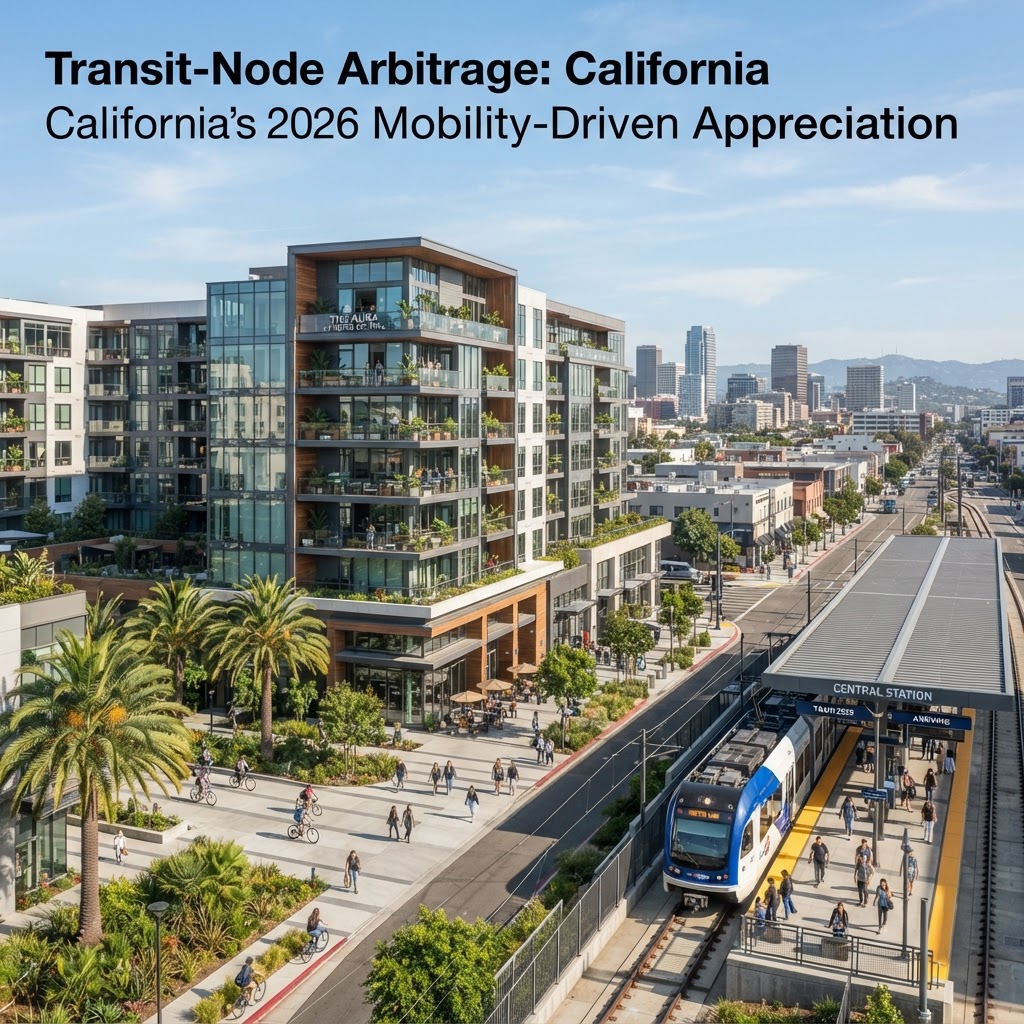
The Shift from Commuter Hubs to Transit-Nodes
As we cross the midpoint of 2026, the California real estate landscape is being fundamentally reshaped not by traditional suburban sprawl, but by the strategic realization of multi-billion dollar transit infrastructure. With the 2028 Los Angeles Olympics less than two years away and the Brightline West high-speed link between Las Vegas and Rancho Cucamonga entering its final testing phase, a new investment phenomenon has emerged: the Transit-Node Arbitrage. Unlike the generic 'transit-oriented development' of the previous decade, the 2026 market is pricing in a 'mobility premium' that is decoupled from traditional office-centric commutes.
The Inland Empire’s Rancho Cucamonga Node
Data from the California Association of Realtors (CAR) in Q2 2026 indicates that residential property values within a three-mile radius of the Rancho Cucamonga transit terminus have appreciated by 14.2% year-over-year, nearly triple the statewide average of 4.8%. This 'halo effect' is driven by the convergence of the Metrolink expansion and the nearing completion of the high-speed rail corridor. Investors are no longer looking at the Inland Empire as a low-cost alternative to Los Angeles, but as a primary logistics and transit nexus. For the first time in history, the median home price in specific Rancho Cucamonga micro-pockets has surpassed established coastal neighborhoods in the South Bay, signaling a permanent shift in demand.
Central Valley: The High-Speed Rail Catalyst
In the Central Valley, specifically Fresno and Bakersfield, the real estate market is reacting to the 2026 milestones of the California High-Speed Rail project. With track laying reaching critical density, institutional capital has begun pivoting toward multifamily assets in these 'mobility corridors.' CBRE reports a cap rate compression of 60 basis points for Class-A multifamily units located within walking distance of proposed stations. The investment thesis here is 'The 90-Minute Commute': the ability for professionals to live in Fresno while maintaining hybrid roles in Silicon Valley or Los Angeles, facilitated by the impending speed of rail travel.
Economic Trends: High-Density Up-Zoning
Statewide legislative mandates (SB 9 and its 2025-2026 refinements) have finally met market demand at these transit nodes. We are seeing a 22% increase in multi-unit permit filings in transit-rich districts compared to 2024 levels. This is creating a 'Micro-Core' effect, where small, hyper-dense urban centers are forming in what were once sprawling suburban municipalities. From an economic perspective, this represents a transition toward a more European-style urbanization of the California interior, providing a supply-side solution to the persistent inventory shortage.
Practical Takeaways for 2026 Stakeholders
- For Investors: Focus on 'Last-Mile Mobility' infrastructure. Properties located near integrated bike-share and micro-transit hubs that feed into major rail lines are seeing the highest rental growth.
- For Sellers: Highlight 'Transit Connectivity' over 'Freeway Access.' In 2026, the marketing value of being five minutes from a rail station outweighs the proximity to major highway interchanges.
- For Developers: The focus should be on mixed-use 'Transit Villages.' The 2026 buyer profile prioritizes walkability and high-speed transit access over traditional yard space, particularly in the 25-40 age demographic.
As we look toward 2027, the correlation between proximity to heavy-rail infrastructure and asset appreciation is expected to tighten further. The 'Transit-Node Arbitrage' represents the final maturation of the California market into a truly multi-modal economy.