The Urban Transformation of Lankershim and Magnolia
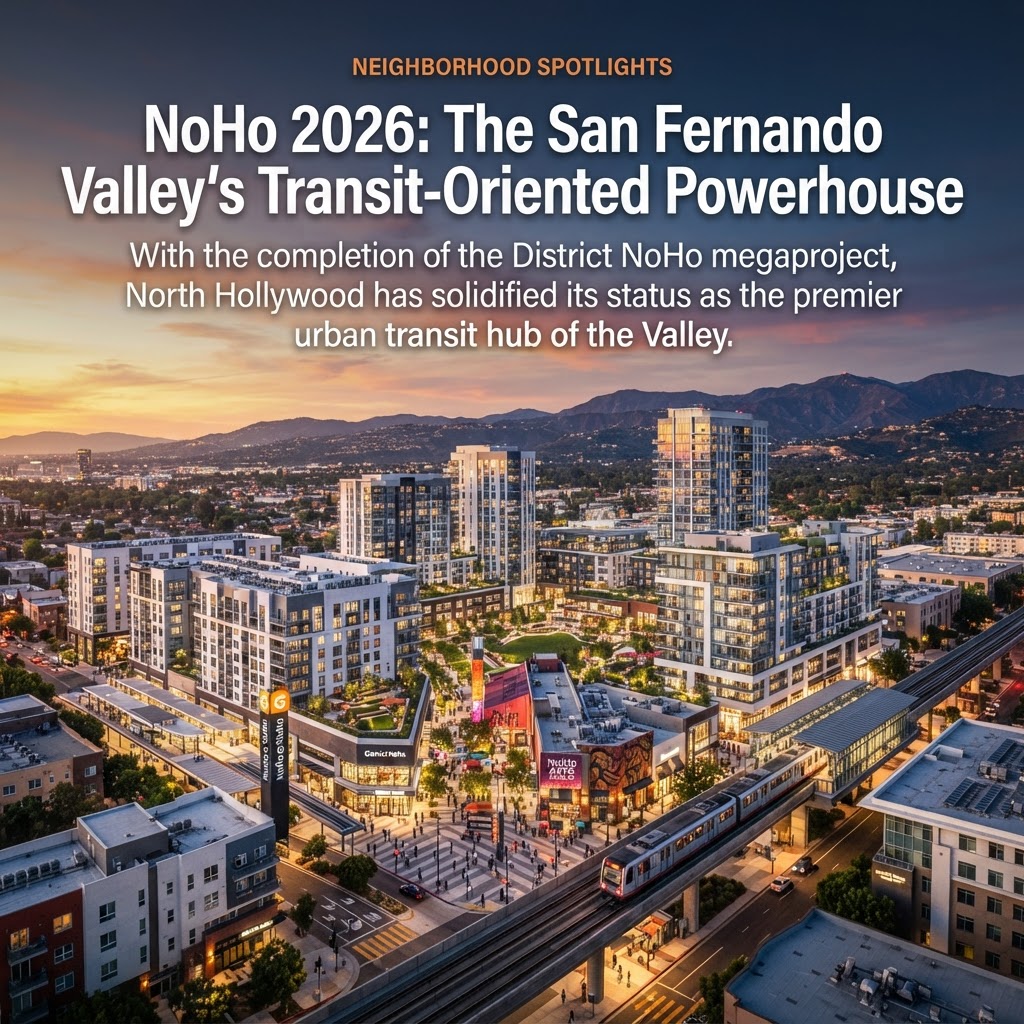
In mid-2026, the intersection of Lankershim and Magnolia Boulevards represents the most dramatic urban shift in the San Fernando Valley’s recent history. No longer merely a collection of independent black-box theaters and mid-century storefronts, the North Hollywood (NoHo) Arts District has matured into a high-density, transit-oriented core. This evolution is anchored by the substantial completion of 'District NoHo,' a 15.5-acre joint development between Metro and Trammell Crow Company that has effectively created a 'city within a city' at the Valley’s busiest transit terminus.
The District NoHo Catalyst
The primary driver of the 2026 real estate landscape is the delivery of over 1,500 new residential units and 500,000 square feet of office space integrated directly into the Metro B Line (Red) and G Line (Orange) stations. According to recent data from CBRE, the area within a half-mile radius of the NoHo station has seen a 22% rental premium compared to the broader San Fernando Valley average, driven by a new demographic of hybrid workers who value the 25-minute commute to Downtown Los Angeles via the B Line.
Community features now include:
- The Transit Plaza: A three-acre open space serving as a community living room, hosting the weekly NoHo Farmers Market and seasonal art festivals.
- The Theatre Row Revival: While modern high-rises dominate the skyline, the preservation of over 20 independent theaters remains the neighborhood's cultural soul, bolstered by new city grants for the performing arts.
- Retail Integration: A focus on 'maker spaces' and local boutiques rather than big-box retail, maintaining the neighborhood's eclectic character.
Connectivity and Infrastructure
North Hollywood’s appeal in 2026 is fundamentally rooted in its status as a multi-modal hub. The G Line Bus Rapid Transit (BRT) improvements, completed last year, have shortened the trip to the Warner Center tech corridor to under 35 minutes. Furthermore, the district serves as the northern gateway for the Hollywood Way bike path expansion, connecting NoHo directly to the Burbank media district. This connectivity has made the 91601 ZIP code a primary target for 'car-light' living, a rarity in the historically auto-centric Valley.
The Real Estate Outlook
As of July 2026, MLS data indicates that the median price for a two-bedroom condo in the Arts District has climbed to $785,000, reflecting a 6.5% year-over-year increase. While inventory remains tight, the influx of 'missing middle' housing—including townhomes and small-lot subdivisions—has provided a gateway for first-time buyers who have been priced out of nearby Studio City and Toluca Lake.
Education remains a draw for young families, with the highly-rated Colfax Charter Elementary and the North Hollywood High School highly gifted magnet program consistently ranking among the top in the Los Angeles Unified School District (LAUSD).
Practical Takeaways
- For Investors: Look for older rent-stabilized multi-family assets on the periphery of the Arts District (north of Chandler Blvd). These properties offer significant value-add potential as the 'halo effect' of the District NoHo project expands the walkable radius.
- For Buyers: Focus on the 'NoHo West' border. While slightly further from the Metro, the ongoing redevelopment of the former Laurel Plaza site continues to drive residential demand and price appreciation in adjacent blocks.
- For Sellers: Position properties with 'work-from-home' amenities. The buyer pool in NoHo is dominated by content creators and tech professionals who prioritize high-speed fiber connectivity and dedicated office space.
The NoHo Arts District of 2026 proves that density and transit-centricity can coexist with a neighborhood's historical identity. For those seeking the most 'urban' experience in the San Fernando Valley, the search begins and ends at the NoHo station.