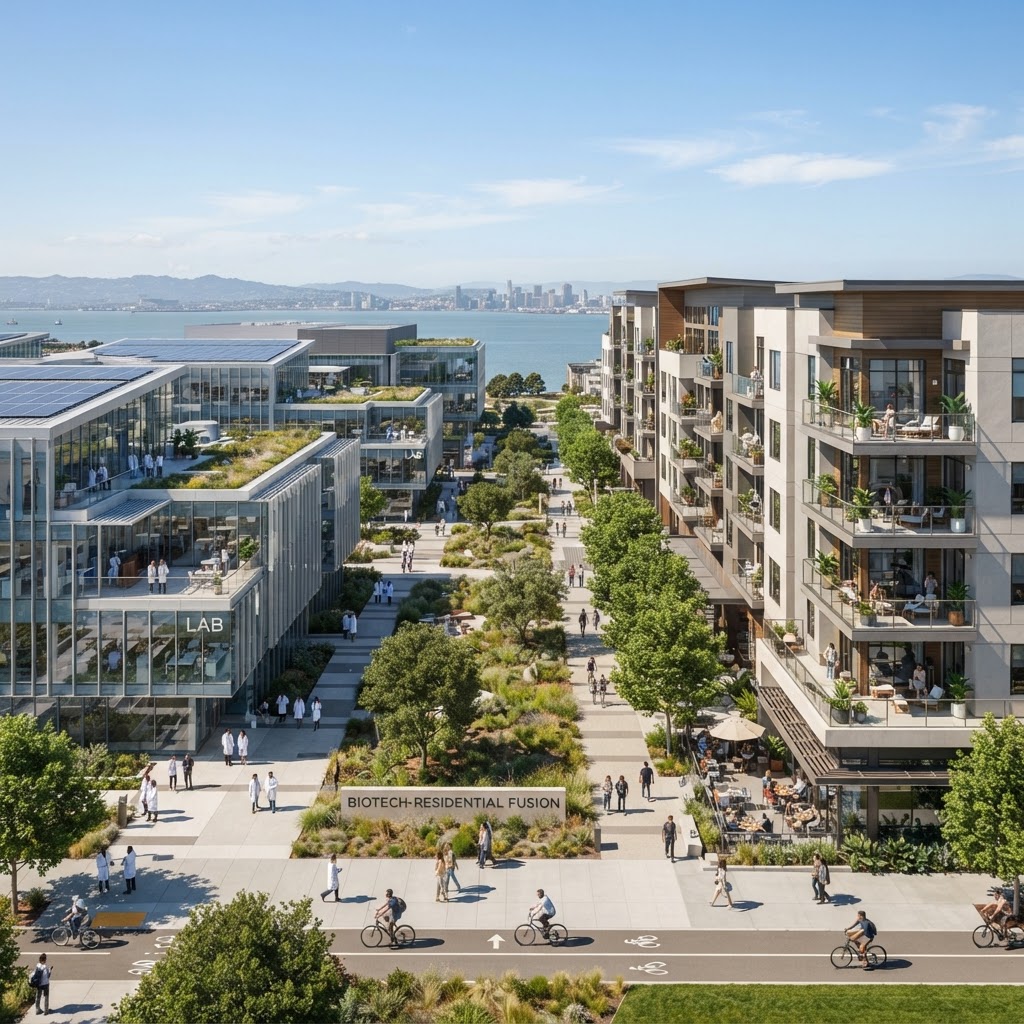
The 2026 Shift: Beyond the Software Standard
As of July 2026, the California real estate narrative has fundamentally decoupled from the general 'work-from-home' tech volatility that defined the early 2020s. While traditional commercial office vacancy rates in San Francisco and Los Angeles remain elevated at 18-22%, a new asset class is driving localized residential spikes: the Innovation District. Unlike the digital-first software industry, California’s booming Life Sciences, Synthetic Biology, and Clean-Tech sectors require a physical footprint. This 'physicality requirement' is creating a hyper-local demand for residential real estate within a three-mile radius of major lab clusters.
Data Points: The Lab-to-Living Multiplier
According to Q2 2026 data from CBRE and the California Life Sciences Association, the state has added over 4.2 million square feet of laboratory space in the last 18 months. Crucially, for every 1,000 square feet of lab space commissioned, there is a correlated demand for 1.4 units of high-end housing nearby. In hubs like San Diego’s Torrey Pines, South San Francisco, and the emerging West Berkeley 'Bio-Mile,' residential rents are commanding a 12-15% premium over the broader metropolitan statistical area (MSA) averages. This isn't just a rebound; it is a structural shift toward 'Specialized Employment Anchors' that cannot be replicated remotely.
The Investment Perspective: The Three-Mile Ring
For investors, the 2026 play is no longer about betting on 'The Bay Area' or 'Southern California' as monolithic entities. The value is found in the Three-Mile Ring—the radius around biotech incubators where specialized talent, often earning 40% above the median household income, seeks to minimize commute times. While general market appreciation in California has stabilized at a steady 3.8% annually, properties within these Innovation Districts have seen 7.2% year-over-year growth. The stability of these assets is underpinned by the 'sticky' nature of the workforce; lab technicians and research scientists have significantly lower turnover rates than the gig-economy workers of the previous decade.
Economic Trends: The Rise of the 'Live-Work-Lab' Zoning
California’s legislative environment has adapted to this trend. New 2026 zoning reforms allow for higher density in areas previously designated as light industrial. This has opened a window for 'Adaptive Infill'—converting low-rise warehouse districts into mixed-use residential hubs that cater specifically to the biotech workforce. These developments often feature specialized amenities such as high-capacity EV charging, shared creative spaces, and enhanced air filtration systems, which have become the standard for the health-conscious innovation demographic.
Practical Takeaways for the 2026 Market
- For Investors: Target 'Second-Tier' lab hubs. While South SF is mature, look to the emerging synthetic biology clusters in Davis and the Irvine-Spectrum, where land costs are lower but institutional capital is flowing.
- For Sellers: Highlight 'Proximity to Innovation' in marketing materials. Properties within walking distance of Tier-1 research institutions are currently seeing 25% fewer days-on-market than general listings.
- For Developers: Focus on the 'Bespoke Infill' model. Smaller, 10-to-20 unit projects that bypass the bureaucratic hurdles of massive towers but utilize the new 'Mixed-Innovation' zoning laws are seeing the fastest ROI in the current high-interest environment.
As we move into the latter half of 2026, the California market is proving that while the 'Office' may be dead, the 'Place' is more important than ever. The fusion of high-capital R&D and specialized residential supply is the new engine of California’s real estate wealth.