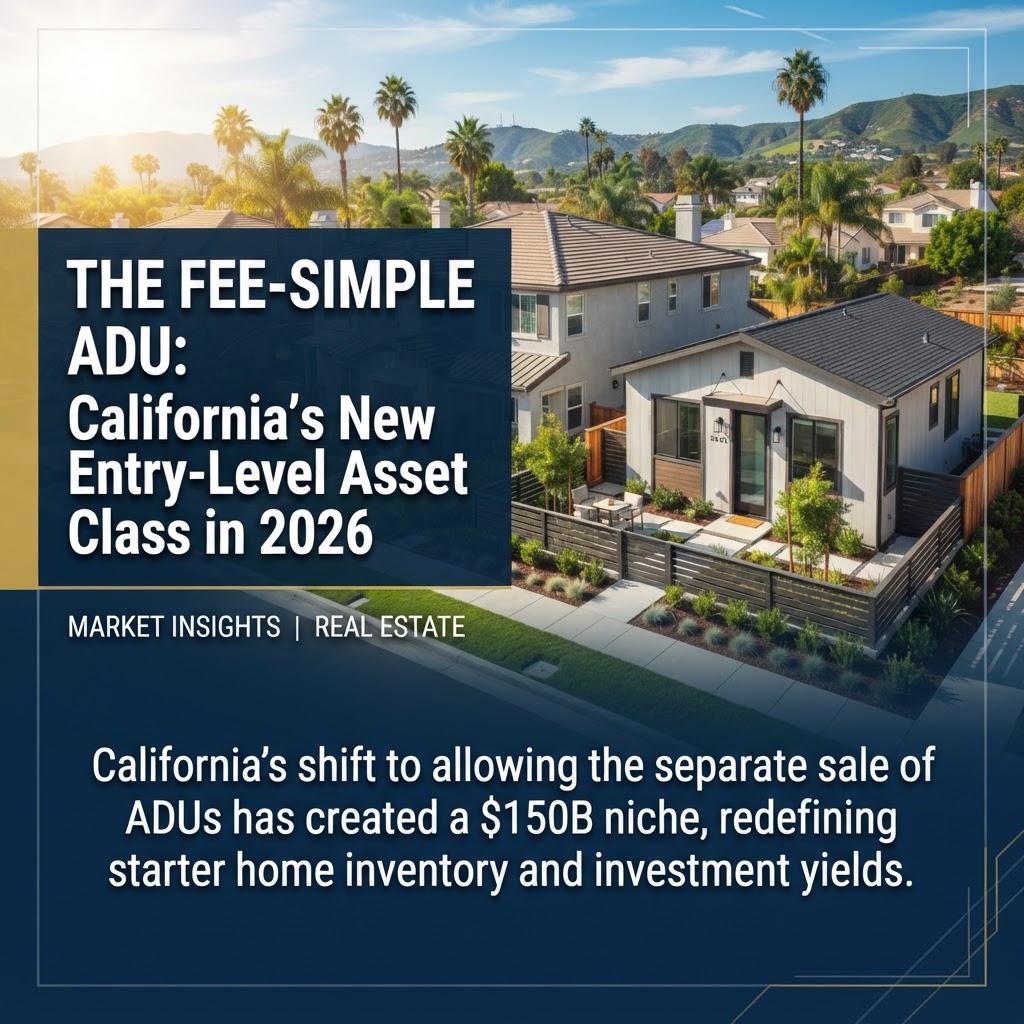
The Emergence of the Saleable ADU
As of July 2026, the California real estate landscape has undergone a structural transformation that few predicted three years ago. While much of the narrative has focused on interest rate stabilization and institutional shifts, the most significant movement is occurring in the backyards of suburban California. Following the full implementation of legislative frameworks like SB 477 and the maturation of local ordinances allowing Accessory Dwelling Units (ADUs) to be sold as separate, fee-simple condominiums, a new asset class has emerged.
Data-Driven Market Analysis
According to the California Department of Housing and Community Development (HCD), ADU permits accounted for nearly 24% of all housing starts in the state over the last 18 months. However, the 2026 trend is not just about building units for rent, but building for liquidation. Data from the California Association of Realtors (CAR) indicates that 'ADU-Condos'—units built on existing single-family lots and sold separately—now command a price point 30-40% lower than traditional detached single-family homes in the same ZIP codes.
In Los Angeles and San Diego counties, the median price for a fee-simple ADU currently sits at $545,000, providing a much-needed 'missing middle' entry point for first-time buyers who have been priced out of the $900,000+ traditional market. This has created a secondary market that is largely decoupled from the volatility of high-end luxury assets.
The Investor Perspective: The 'Split and Sell' Strategy
For investors, the 2026 play has shifted from traditional 'fix-and-flip' to 'split-and-sell.' Institutional and mid-sized private equity firms are increasingly targeting undervalued single-family residences (SFRs) on oversized lots. The investment thesis is straightforward: acquire an SFR, utilize streamlined SB 9 and ADU permitting to add a high-density secondary structure, and exit the investment by selling two separate titles.
CBRE’s latest regional outlook suggests that this strategy offers a 15-20% higher Internal Rate of Return (IRR) compared to traditional multi-family development, primarily due to lower impact fees and the ability to tap into the high demand for homeownership among Millennials and Gen Z. The 'Hardened Asset Premium' mentioned in recent insurance-adjusted valuations also favors these new builds, as they are constructed to the latest 2025-2026 fire and seismic codes, resulting in significantly lower insurance premiums compared to aging stock.
Economic Trends and Practical Takeaways
The rise of the saleable ADU is also a response to the 'Lock-in Effect' of 2021-era mortgages. Homeowners with 3% interest rates who cannot afford to move are instead 'cashing in' on their equity by developing an ADU, selling it off as a separate title, and using the proceeds to pay down their primary mortgage or reinvest in other markets. This 'Equity Liquidation without Relocation' is a unique 2026 economic phenomenon.
- For Buyers: Look for 'Homeowner Association (HOA) Lite' structures. Many of these ADU-condo splits involve minimal shared costs, offering the benefits of homeownership without the massive fees associated with high-rise living.
- For Sellers: If your lot size exceeds 6,000 square feet in a high-demand coastal or transit-adjacent zone, your backyard may be more valuable as a separate title than as a landscaped amenity.
- For Investors: Focus on municipalities that have streamlined the 'tenants-in-common' or 'condo-map' conversion processes. Cities like San Jose and Sacramento are currently leading the state in processing times.
As we look toward the final half of 2026, the 'Fee-Simple ADU' represents the most viable solution to California’s inventory crisis, providing a scalable model for density that respects the character of existing neighborhoods while unlocking billions in dormant land value.