The Great Reconnection: Healing the Urban Scar
For decades, the western edge of Pasadena’s Central District was defined by the '710 stub'—a concrete canyon that served as a reminder of abandoned mid-century freeway ambitions. As of July 2026, this 50-acre master plan has transitioned from a civic dream to California’s most significant urban infill success. By reclaiming this land, Pasadena has effectively stitched its historic Old Pasadena core back to its residential Westside, creating a seamless, walkable corridor that has sent property values in the Central District soaring.
The 15-Minute City in a Historic Frame
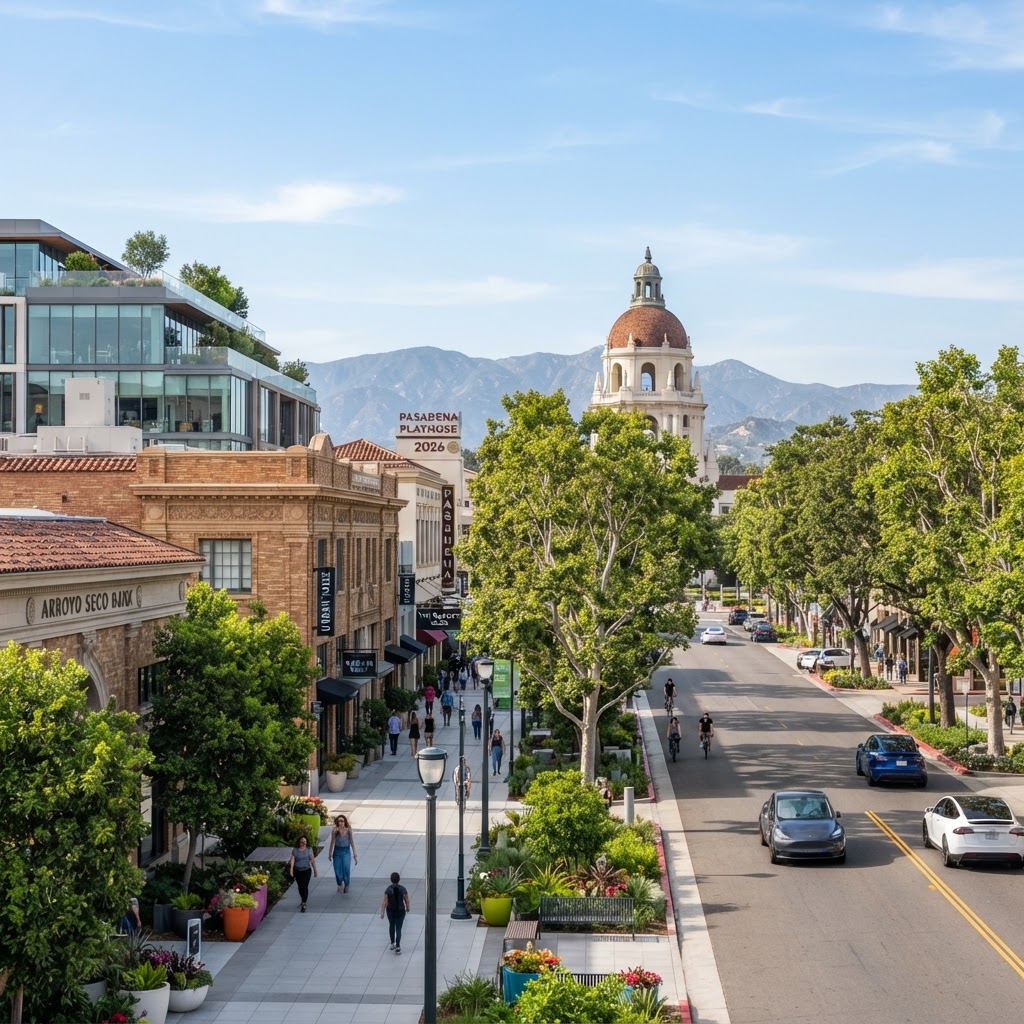
Unlike the glass-and-steel verticality of DTLA, Pasadena’s 2026 evolution prioritizes 'Human-Scale Density.' The Central District now boasts a Walk Score of 96, supported by the completion of the 'Green Loop,' a three-mile landscaped pedestrian path connecting the Playhouse Village, Old Pasadena, and the South Lake Avenue business district. Amenities include the newly expanded Norton Simon Museum gardens and a surge in 'experiential retail'—boutiques that prioritize service over inventory, catering to a demographic that values time as the ultimate luxury.
By the Numbers: The 2026 Real Estate Climate
According to Q2 2026 data from the California Association of Realtors (CAR) and local MLS listings, the Central District has decoupled from broader Los Angeles County volatility. The median sales price for a luxury condo in the district now sits at $1.45 million, representing a 6.8% year-over-year increase. Rental markets remain tight, with vacancy rates hovering at 3.2%, driven by the 'Caltech Effect.' As the California Institute of Technology expands its quantum computing labs, a new wave of high-earning researchers is eschewing the suburbs for the turnkey lifestyle of Central Pasadena.
Transportation and Accessibility
The L.A. Metro A-Line (formerly the Gold Line) remains the neighborhood’s circulatory system, but the 2026 story is about 'Micro-Mobility.' The city’s autonomous shuttle pilot now services the entire Central District, providing free, zero-emission transport between the Del Mar station and the South Lake shopping precinct. For those commuting to the entertainment hubs in Burbank or the tech nodes in Santa Monica, the proximity to the 134 and 210 freeways remains a logistical advantage, though the district is increasingly becoming a 'live-work' destination in its own right.
Strategic Takeaways for Investors and Buyers
- For Buyers: The '710 Reclamation Zone' offers the highest appreciation potential. Look for mid-rise mixed-use developments that offer 'flex-rooms' designed for hybrid work, as these units are seeing the highest resale premiums.
- For Sellers: Historic preservation remains a value-add. Properties that retain original Craftsman or Mediterranean details while integrating 2026-standard smart home technology (AI-driven energy management) are fetching 12% above neighborhood averages.
- For Investors: The 'Golden Triangle' between Colorado Blvd and California Blvd is seeing a shift from traditional office space to medical-office suites and boutique hospitality, following the 15% increase in local health-tech employment reported by CBRE.
The Verdict
Pasadena’s Central District in 2026 proves that urban growth does not require the erasure of local character. By healing its historical geographic divide and doubling down on transit-oriented, high-design living, the 'Crown City' has secured its position as the premier destination for capital seeking stability and residents seeking the quintessential California lifestyle.