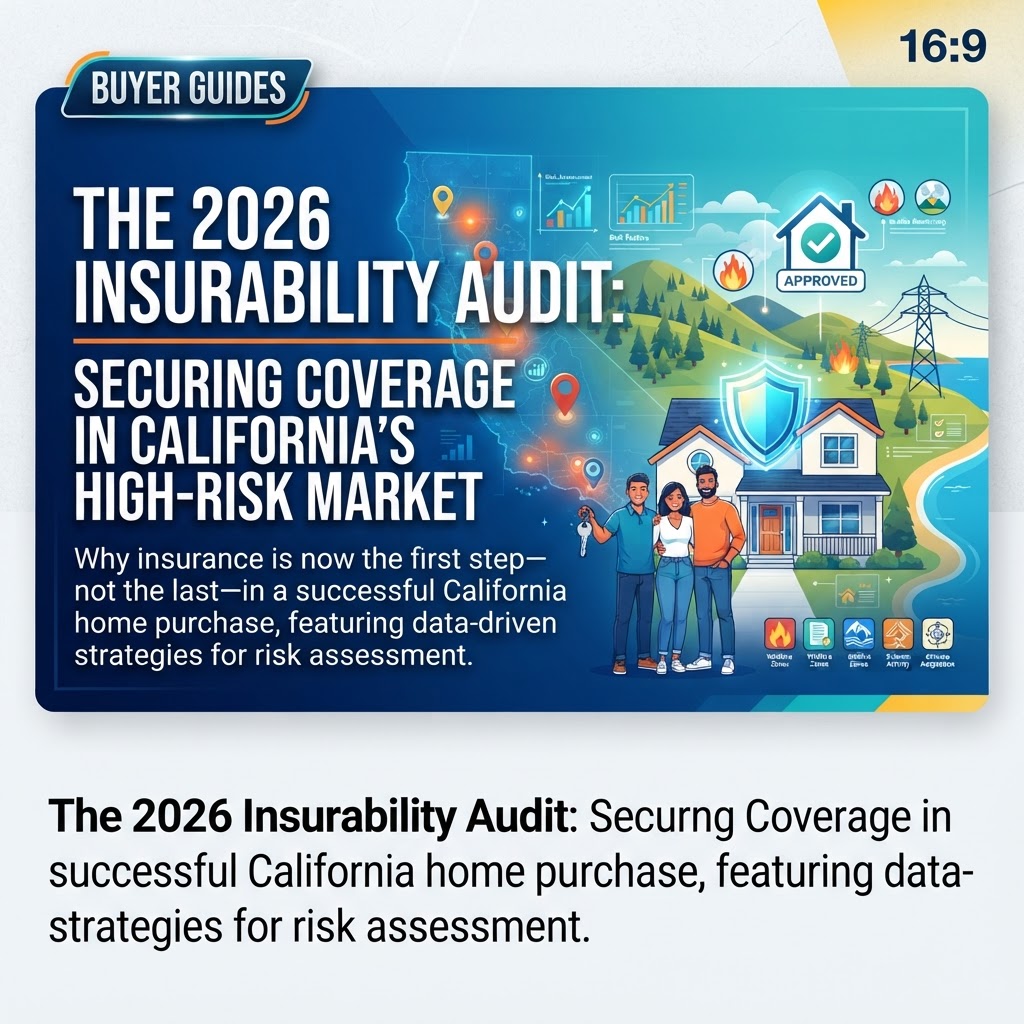
The Shift to Insurance-Led Due Diligence
In the California real estate landscape of July 2026, the traditional sequence of home buying has been fundamentally inverted. While a pre-approval letter remains the ticket to entry, the 'Insurability Audit' has emerged as the primary gatekeeper for successful escrow closings. Following the full implementation of the California Department of Insurance’s Sustainable Insurance Strategy, the market has seen a cautious return of private carriers, yet many remain highly selective based on hyperlocal risk data.
Why Insurability is the New Pre-Approval
Waiting until the end of the contingency period to secure a homeowners policy is a relic of the past. In the current market, lenders have tightened their requirements, often refusing to fund loans if the projected premium exceeds the initial DTI (Debt-to-Income) projections. According to recent MLS data, nearly 18% of failed escrows in high-risk zones in early 2026 were attributed to insurance unavailability or unaffordability.
- The C.L.U.E. Report Strategy: Successful buyers now demand a Comprehensive Loss Underwriting Exchange (C.L.U.E.) report from the seller within the first 48 hours of an accepted offer. This document reveals the property’s 7-year claims history, which is a major factor in premium loading.
- WUI and Fire Hardening: With the Wildland-Urban Interface (WUI) expanding, buyers must verify compliance with AB 38 fire hardening disclosures. Homes that do not meet 2026 standards for ember-resistant vents and non-combustible zones (0-5 feet from the structure) are seeing premiums 40% higher than mitigated counterparts.
Navigating the FAIR Plan and Wrap-Arounds
The California FAIR Plan, once a temporary bridge, now supports over 450,000 policyholders as of mid-2026. However, relying solely on the FAIR Plan is rarely sufficient for modern financing. Savvy buyers are now budgeting for 'Difference in Conditions' (DIC) policies. These wrap-around products cover the gaps left by the FAIR Plan, such as water damage, liability, and theft, which are essential for comprehensive asset protection.
The 2026 Due Diligence Checklist
To navigate this environment, buyers should adopt a three-pronged insurability check during the inspection period:
- The Preliminary Quote: Obtain a non-binding quote during the 17-day (or shortened) contingency period. If the quote exceeds 1.5% of the home's value annually, it may indicate underlying risk factors that traditional inspections miss.
- The IBHS Fortified Evaluation: Check if the property meets the Insurance Institute for Business & Home Safety (IBHS) 'Fortified' designation. Homes with this certification are often eligible for mandatory discounts under current California law.
- Elevation and Flood Mapping: Beyond fire, the 2026 buyer must consult updated FEMA flood maps, which were revised in late 2025 to reflect new atmospheric river patterns. This can add an unexpected $200-$400 to monthly carrying costs.
Practical Takeaways
Before entering a contract, buyers should consult with an independent insurance broker—rather than a direct writer—to access the surplus lines market if traditional carriers decline. Sellers, conversely, should invest in 'defensible space' certification prior to listing to ensure their property remains financeable. In 2026, a home that cannot be insured at a reasonable rate is a home that cannot be sold at market value.


