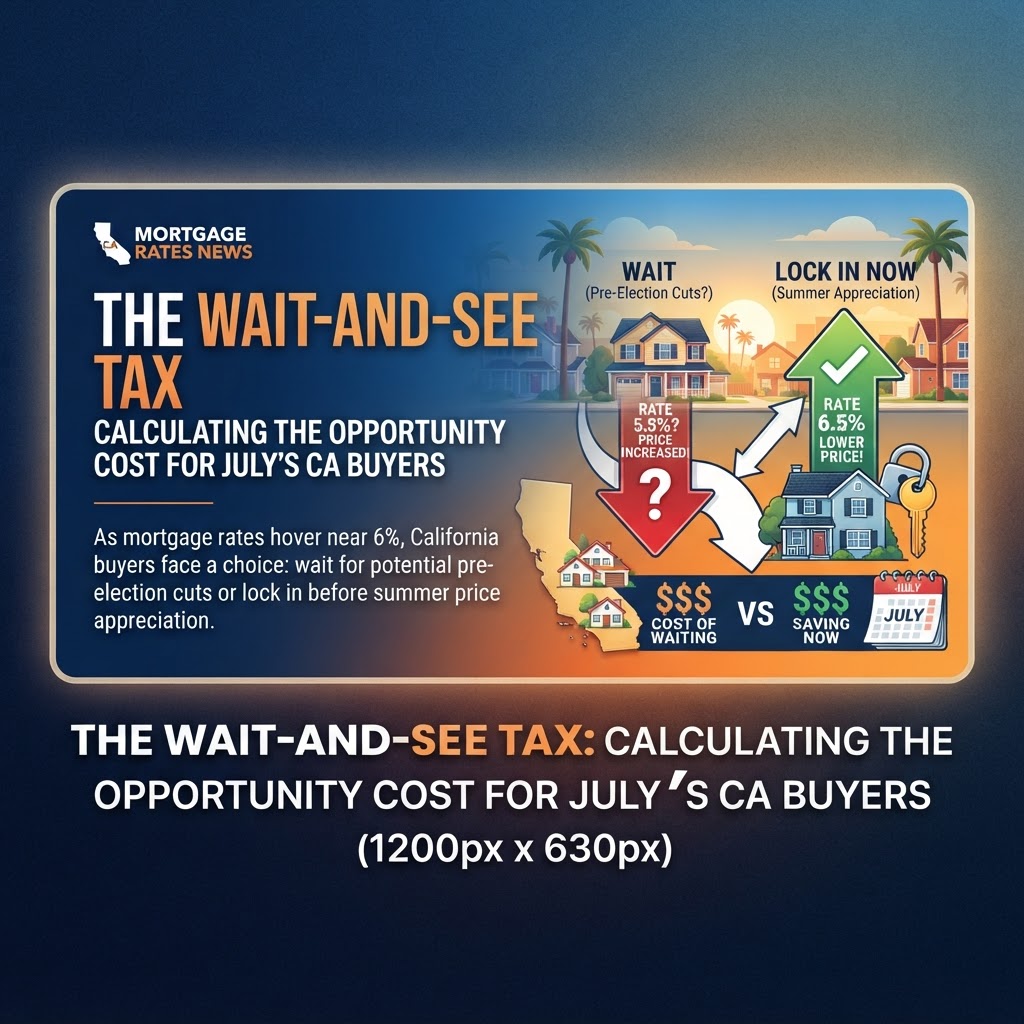
The July 2026 Rate Landscape
As of Monday, July 6, 2026, the national average for a 30-year fixed-rate mortgage has found a tentative floor at 6.04%, according to Freddie Mac’s latest survey. While this represents a significant cooling from the volatility of previous years, California’s high-balance markets are reacting with a unique phenomenon: the 'Wait-and-See Tax.' For buyers in regions like Orange County or the Bay Area, the cost of waiting for a sub-6% rate is beginning to be outweighed by the steady climb in asset prices driven by a persistent 2.6-month housing supply.
The Appreciation-Rate Mismatch
Recent data from the California Association of Realtors (CAR) and the National Association of Realtors (NAR) suggests that while mortgage rates have stabilized, home prices in California’s coastal hubs are projected to appreciate by 4.5% to 5.2% over the next 12 months. In a market where the median home price hovers near $900,000, a buyer waiting six months for a hypothetical 50-basis-point drop in interest rates may find that the $40,000 increase in purchase price more than offsets the monthly savings on interest.
The Math of Hesitation
- Current Scenario: A $1,000,000 home at 6.05% interest with 20% down results in a principal and interest payment of approximately $4,821.
- The 'Wait' Scenario: Six months from now, that same home appreciates to $1,045,000. Even if rates drop to 5.50%, the new payment on a larger loan balance would be approximately $4,747.
While the 'Wait' scenario saves $74 per month, the buyer has lost $45,000 in equity gains and must come up with an additional $9,000 for the down payment to maintain the 20% LTV ratio. For the California investor or move-up buyer, the math increasingly favors securing the asset now and utilizing a refinance strategy later.
Tactical Takeaways for the Q3 Market
As we move deeper into the summer selling season, several strategies are emerging as essential for navigating the current rate-inventory deadlock:
1. The 'Rate-Refi' Buffer
Lenders are increasingly offering 'No-Cost Refinance' certificates valid for 18–24 months post-closing. This allows buyers to commit to the current price level while maintaining a low-friction path to a lower rate if the Federal Reserve signals further cuts in late 2026.
2. Focus on Days on Market (DOM)
Despite the supply crunch, listings exceeding 30 days on the market in the Central Valley and suburban Los Angeles are seeing an uptick in seller concessions. Buyers are successfully using these credits—often ranging from 2% to 3% of the purchase price—to fund a 2-1 temporary buydown, effectively dropping their first-year rate to 4.04%.
3. The High-Balance Advantage
In many California counties, the 2026 conforming loan limits have allowed more buyers to stay within the conforming-high-balance secondary market rather than jumping to Jumbo products. This provides more flexible underwriting and lower down payment requirements, which is critical as price appreciation continues to outpace wage growth.
The Bottom Line
The July 2026 market is defined not by the fear of high rates, but by the risk of being priced out of equity growth. With the FOMC signaling a neutral stance for the remainder of the summer, the window to capture 2026 pricing before the projected 2027 spring surge is narrowing. Buyers should prioritize the purchase price and long-term equity potential over the pursuit of the 'perfect' interest rate.