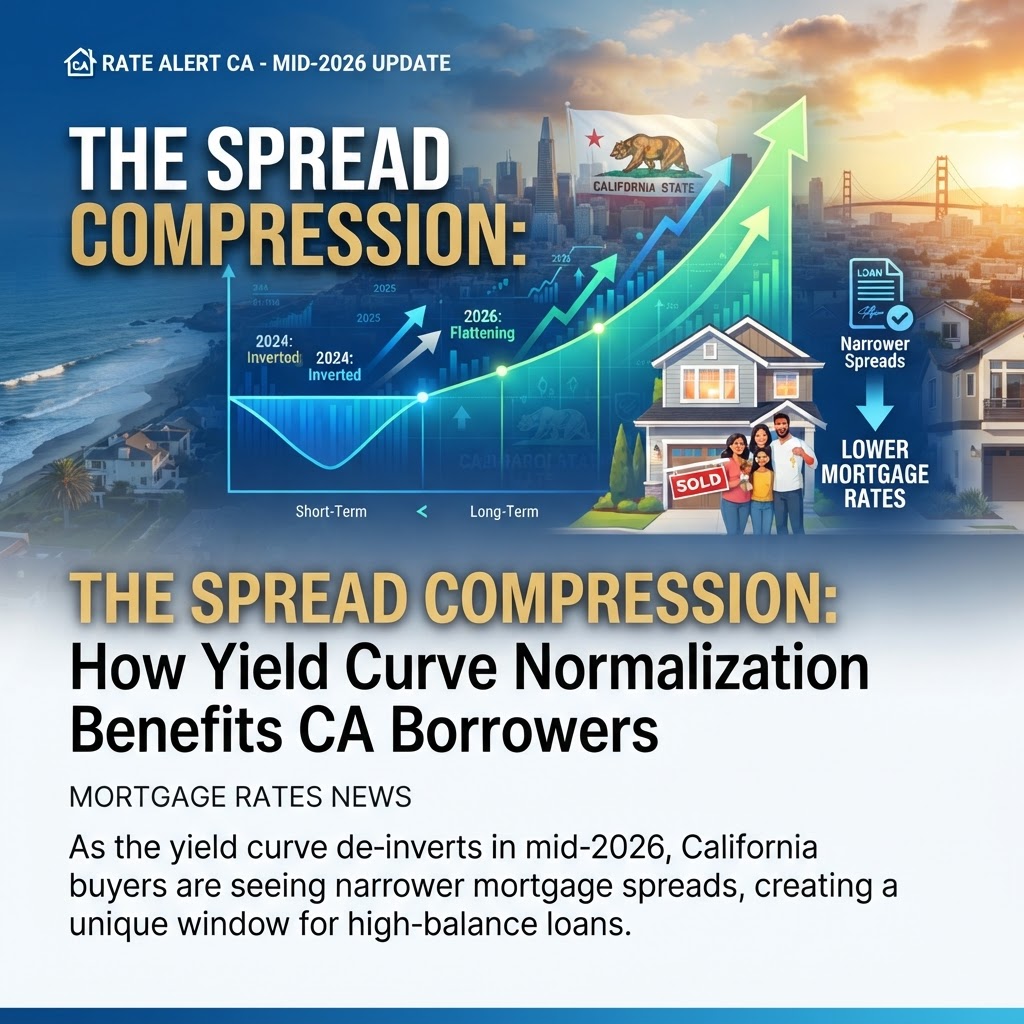
The De-Inversion Milestone and the California Market
As of July 5, 2026, the primary narrative in the mortgage sector has shifted from 'how high will they go' to 'how narrow will they get.' For the first time in nearly four years, the yield curve has sustained a healthy, upward-sloping normalization. This structural shift in the bond market is having a profound, localized impact on California real estate, where high loan balances make the 'spread'—the difference between the 10-Year Treasury yield and the 30-year fixed mortgage rate—a critical factor in monthly affordability.
Understanding the Yield Spread Compression
Historically, the spread between the 10-Year Treasury and mortgage rates averages around 170 to 200 basis points. During the volatility of 2023 and 2024, this spread ballooned to over 300 basis points as lenders priced in extreme secondary market risk. Today, data from the Mortgage Bankers Association (MBA) and recent Federal Reserve commentary suggest that as economic volatility has subsided, this spread is finally compressing back toward the 180-basis-point range.
With the 10-Year Treasury hovering around 4.1% this July, we are seeing 30-year fixed rates stabilize near 5.9% to 6.1%. For a California buyer taking out a $900,000 loan, this 100-basis-point reduction in the spread (compared to the 2024 peak) represents a monthly savings of approximately $600—independent of any movement in the underlying Treasury yields.
Why California is the Primary Beneficiary
California’s market is uniquely sensitive to these technical shifts due to the prevalence of high-balance conforming and jumbo loans. According to the California Association of Realtors (CAR), the state’s median home price remains significantly above the national average, meaning even a fractional tightening of lender margins translates into five-figure lifetime interest savings.
- Increased Secondary Market Appetite: As the yield curve de-inverts, mortgage-backed securities (MBS) become more attractive to institutional investors, driving down the yields required by lenders.
- Portfolio Lender Aggression: California-based regional banks, which had pulled back from jumbo lending during the inversion, are now returning to the market with more competitive pricing to rebuild their balance sheets.
Practical Takeaways for Buyers and Investors
The current environment requires a more nuanced approach than the 'wait and see' strategy of previous years. Here is how to navigate the mid-2026 landscape:
1. Monitor the 10-Year Treasury, Not Just the News
In a normalized market, mortgage rates will track the 10-Year Treasury yield with more predictability. If the Treasury dips due to cooling inflation data, expect mortgage rates to follow suit within 24 to 48 hours. California buyers should have their paperwork ready to 'float' their rate until these technical windows open.
2. Evaluate the 'Effective' Rate on High-Balance Loans
Many lenders are currently offering 'spread-specific' discounts for loans exceeding $766,550 (the 2026 baseline conforming limit). Because the risk premium is shrinking, the gap between standard conforming rates and high-balance rates is the narrowest it has been in years. Buyers should shop specifically for lenders who have adjusted their Loan Level Price Adjustments (LLPAs) to reflect this new stability.
3. The Opportunity Cost of Hesitation
While some buyers are waiting for rates to hit 5.5%, the compression of the spread indicates that much of the 'easy' downward movement has already occurred. In high-demand California coastal markets, the inventory influx expected this summer may be offset by a surge in demand as other buyers recognize the stabilized spread, potentially driving home prices higher and negating the benefits of a further 0.25% rate drop.
Summary of the July 2026 Outlook
The normalization of the yield curve marks the end of the 'emergency pricing' era for mortgage lenders. For California borrowers, this means a return to a market where creditworthiness and loan-to-value ratios—rather than macro-economic fear—dictate the interest rate. With spreads narrowing, the 'cost of money' has reached a point of equilibrium that favors those ready to execute in the current summer window.


