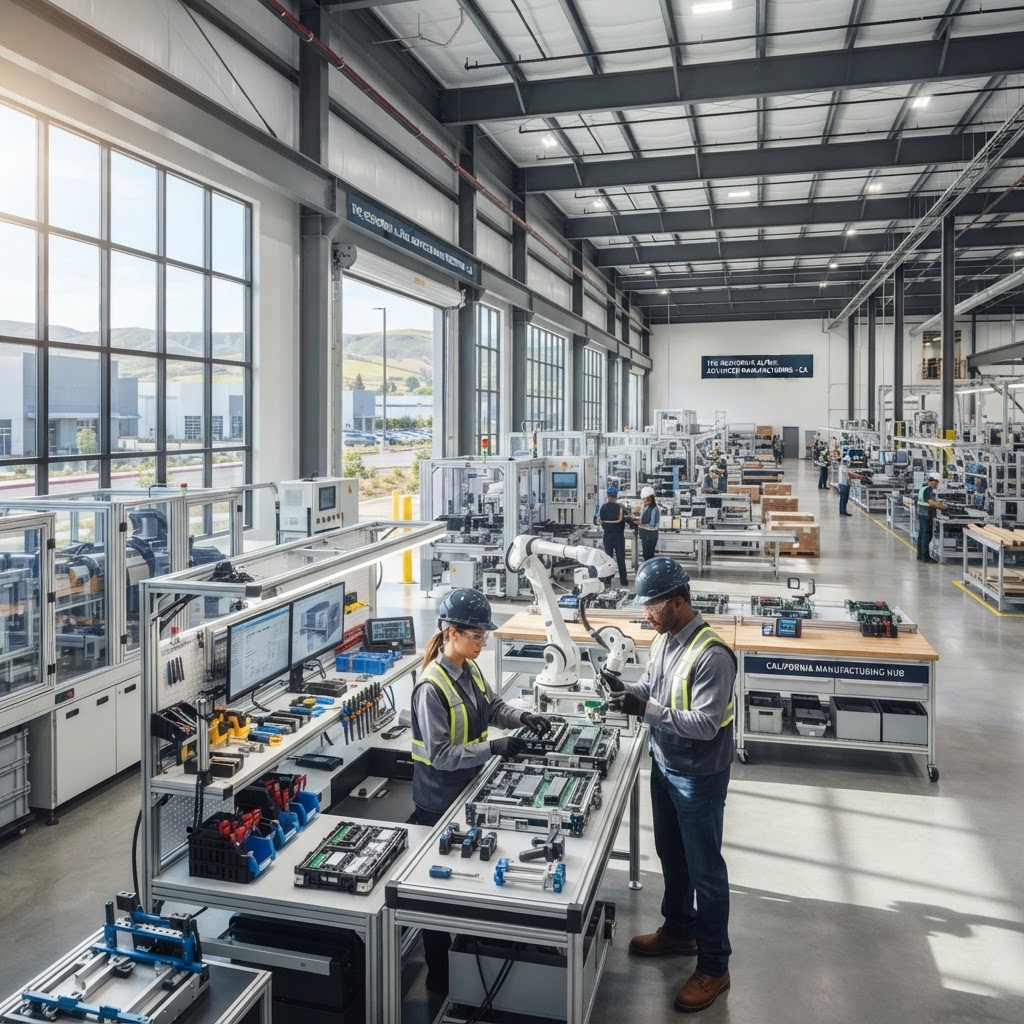
The Evolution of the California Industrial Core
As of July 2026, the California real estate narrative has shifted from the post-pandemic logistics boom to what economists are calling the "Reshoring Alpha." For the past decade, the Inland Empire and Central Valley served primarily as the nation's porch—a landing zone for imported goods. However, a combination of federal incentives, including the matured 2022 CHIPS and Science Act and subsequent 2024 Domestic Supply Chain initiatives, has fundamentally altered the highest and best use of industrial acreage in the Golden State.
Data from CBRE’s Q2 2026 report indicates a bifurcated industrial market. While traditional big-box logistics vacancies have crept up to 4.2%, properties equipped for advanced manufacturing—specifically those with high-load power capacities and specialized water cooling—maintain a record-low vacancy of 1.8%.
The Manufacturing Corridor: From Stockton to San Bernardino
The geography of California investment is being redrawn by the requirements of the "Clean-Tech" and "Bio-Foundry" sectors. According to the California Bureau of Labor Statistics, manufacturing employment in the state has grown by 6.4% year-over-year, outstripping the national average. This growth is concentrated in three primary hubs:
- The Northern Central Valley: Stockton and Modesto have emerged as satellite hubs for Bay Area biotech manufacturing, benefiting from lower land costs and proximity to UC Davis and UC Berkeley research pipelines.
- The Inland Empire East: As San Bernardino reaches density saturation, investors are moving toward the Coachella Valley, where land is being repurposed for solar-integrated battery assembly plants.
- The Otay Mesa Border Region: San Diego’s southern corridor is seeing a surge in "Co-Manufacturing" facilities that leverage the integrated supply chains of the US-Mexico-Canada Agreement (USMCA).
Infrastructure as Valuation: Power is the New Square Footage
In 2026, the valuation of industrial real estate is no longer solely dictated by ceiling height and dock doors. The primary value driver is Power Density. Industrial assets equipped with 4,000-plus amps of service and on-site microgrid capabilities are commanding a 22% lease premium over standard distribution centers. This reflects a broader trend where tenants are bringing automated assembly and 3D printing at scale directly into their warehousing footprints.
Furthermore, the California Energy Commission’s latest mandates have incentivized the retrofitting of Class B industrial assets. Investors who have integrated rooftop solar and Battery Energy Storage Systems (BESS) are seeing a significant "Green Premium" in appraisals, as institutional tenants prioritize Scope 3 emissions reductions in their 2026 corporate filings.
Practical Takeaways for Investors and Owners
The shift toward advanced manufacturing requires a different underwriting lens than traditional logistics. To capitalize on this trend, stakeholders should consider the following:
- Audit Power Capacity: Before acquisition, conduct deep-dive electrical audits. Properties with proximity to existing substations or those with grandfathered high-voltage permits are the high-alpha assets of this cycle.
- Focus on 'Flex-Manufacturing': Prioritize assets with 24- to 30-foot clear heights that can be easily partitioned. The 2026 tenant is more likely to require 50,000 square feet of high-spec space than 500,000 square feet of raw floor.
- The Zonal Play: Target jurisdictions that have streamlined the CEQA (California Environmental Quality Act) process for light manufacturing. Local municipalities in the Central Valley are increasingly offering fast-track permitting to attract high-paying technical jobs.
As the global supply chain continues to regionalize, California's industrial sector is proving to be more than just a transit point. It is becoming the nation's laboratory and factory floor, offering a resilient yield profile for those who can navigate the transition from storage to production.