The Evolution of the 'Work-Live-Make' Model
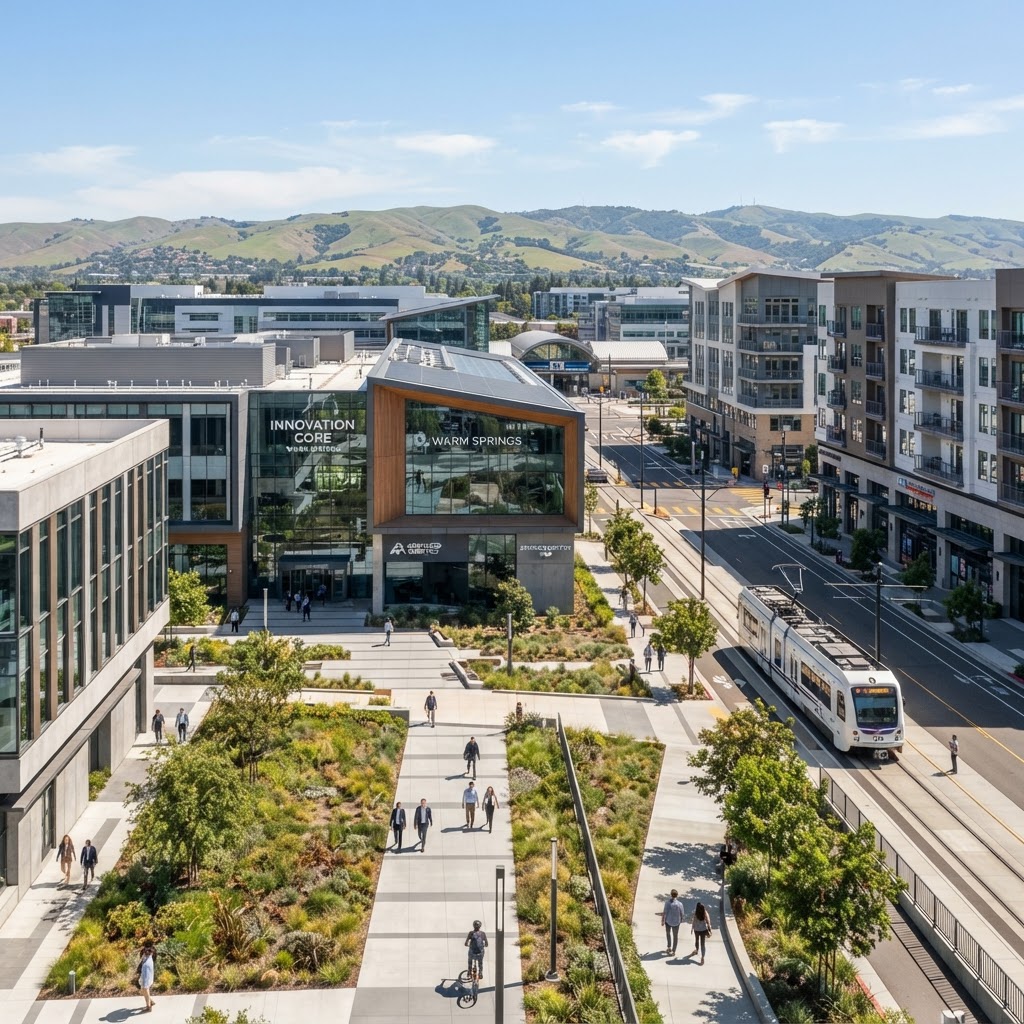
By July 2026, the Warm Springs Innovation District in South Fremont has officially shed its reputation as a collection of low-slung warehouses. Instead, it has emerged as the 'Hardware Core' of Silicon Valley. While much of the Bay Area spent the early 2020s navigating the office-to-residential transition, Warm Springs executed a master-planned metamorphosis, integrating over 4,000 new residential units within walking distance of the world’s most advanced manufacturing facilities.
Economic Anchors: Beyond the Tesla Gigafactory
The district’s growth is anchored by the Tesla Factory, which remains the largest manufacturing employer in California, but the 2026 landscape is far more diverse. The 'Innovation Triangle'—formed by the intersection of Interstates 680 and 880—now houses major hubs for Enovix (next-gen silicon batteries), Lam Research, and Western Digital. According to 2025 CBRE industrial reports, vacancy in the Warm Springs submarket remains below 2.8%, driven by a global surge in 'clean manufacturing.' This economic stability has created a uniquely resilient real estate market; unlike the software-heavy sectors of the Peninsula, Warm Springs benefits from a workforce that is largely tied to physical production facilities.
Transit-Oriented Urbanism and Infrastructure
The centerpiece of the neighborhood is the Warm Springs/South Fremont BART station, which now serves as a vital multi-modal hub connecting the East Bay to San Jose’s recently expanded transit lines. The 'Innovation Way' spine—a pedestrian and bike-friendly corridor—connects the station directly to major corporate campuses, significantly reducing the 'last-mile' friction that historically plagued South Fremont. For residents, this means a car-optional lifestyle that was previously unthinkable in this part of the Valley. The 2025 completion of the Fremont Innovation Bridge has further integrated the residential and industrial zones, allowing for a seamless flow between luxury housing and high-tech workspaces.
Community, Education, and Amenities
The neighborhood appeal is bolstered by the Fremont Unified School District, which remains a primary driver for property values. Schools like James Leitch Elementary and Warm Springs Elementary continue to rank in the top 10% of California public schools. Amenities have evolved to match the professional demographic; the Lila Bringhurst Community Park, a 4-acre urban oasis, now serves as the district's social center. Retail developments in the district have pivoted away from big-box stores toward high-end grocery anchors and 'maker-space' cafes that cater to the engineering community.
Practical Takeaways for Real Estate Stakeholders
- For Investors: High-density multi-family assets within a half-mile radius of the BART station are yielding a 15% rental premium over central Fremont. The 'sticky' nature of manufacturing jobs ensures lower turnover compared to pure tech-office hubs.
- For Buyers: Target newer LEED-certified townhomes on the district’s west side. These properties offer modern smart-home integrations that are standard for the 2026 market but rare in older Silicon Valley inventory.
- For Sellers: Demand remains at an all-time high for 3-plus bedroom units. According to MLS data from Q2 2026, the average days-on-market (DOM) for family-sized units in the Warm Springs catchment is just 11 days.