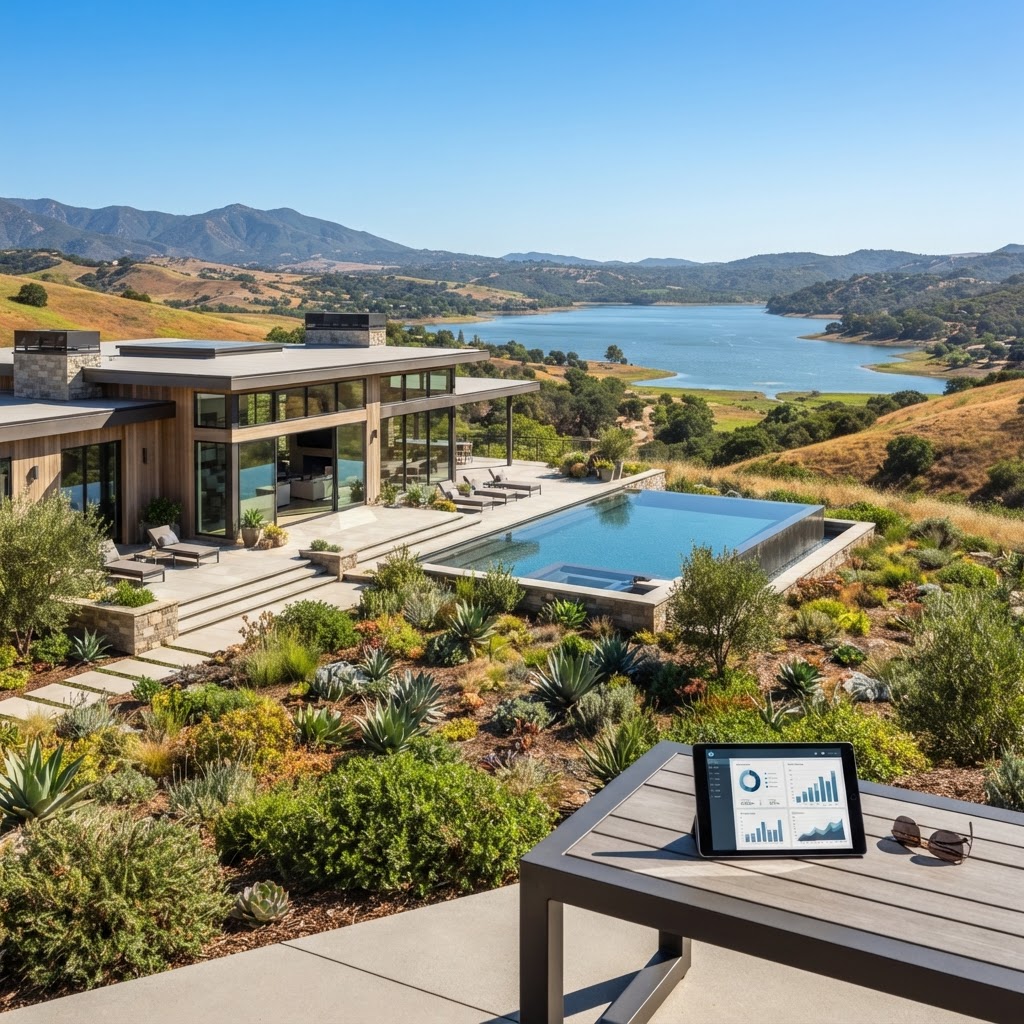
The Shift from Postcode to Pipeline
By mid-2026, the California real estate landscape has undergone a fundamental reassessment of value. While historical drivers like proximity to coastal hubs and school district ratings remain relevant, a new primary metric has emerged: the Water-Alpha Premium. As the Sustainable Groundwater Management Act (SGMA) enters its critical implementation phase, the market is aggressively repricing assets based on hydrological security rather than just square footage.
The SGMA Inflection Point
Data from the California Department of Water Resources (DWR) indicates that as of early 2026, over 60% of high-priority groundwater basins have moved into active restriction phases. This has created a bifurcated market. In regions like the Central Valley and portions of the Inland Empire, properties with senior water rights or those located within managed 'Safe-Yield' districts are commanding a 15% to 22% premium over neighboring parcels reliant on over-drafted aquifers. According to recent MLS data, the time-on-market for 'water-secure' agricultural and residential-fringe properties is 40% lower than the state average.
The New Due Diligence: Hydrological Audits
Institutional investors have pivoted their risk assessment models. The standard 'Phase I' environmental assessment is now frequently accompanied by a 'Hydrological Viability Report.' In 2026, the cost of securing supplemental water in 'Critically Overdrafted' basins has spiked to record highs, effectively functioning as a shadow tax on development. For developers, this means that a project’s internal rate of return (IRR) is now more sensitive to water-connection fees and long-term sustainability mandates than to traditional construction interest rates.
Regional Divergence: The Winners of 2026
We are witnessing a 'Hydrological Migration.' Capital is flowing toward municipalities with robust recycled water infrastructure and advanced desalination integration. Cities like San Diego and Santa Barbara, which invested heavily in diversified water portfolios over the last decade, are seeing a stabilization in commercial valuations. Conversely, exurban developments in the high desert that lack diverse sourcing are facing a 'liquidity lock,' where buyers are unable to secure traditional financing due to insurer concerns over long-term habitability.
Practical Takeaways for the 2026 Market
- For Investors: Prioritize assets within 'Adjudicated Basins.' These areas offer the highest level of legal certainty regarding water rights, acting as a hedge against future regulatory volatility.
- For Sellers: If your property features greywater recycling systems, drought-tolerant xeriscaping, or verified well-depth stability, these are no longer 'amenities'—they are core value drivers. Ensure these metrics are prominent in your disclosure packages.
- For Developers: Shift focus toward 'Water-Neutral' projects. Utilizing atmospheric water generation or closed-loop recycling systems can de-risk a project in the eyes of both lenders and municipal planning commissions.
Conclusion: The Liquid Gold Standard
In 2026, California real estate is no longer just about land; it is about the resources that sustain it. The 'Water-Alpha' represents a permanent shift in how we define prime real estate. As climate volatility persists, the most resilient portfolios will be those that view water not as a utility, but as the foundational collateral of the 21st-century California economy.