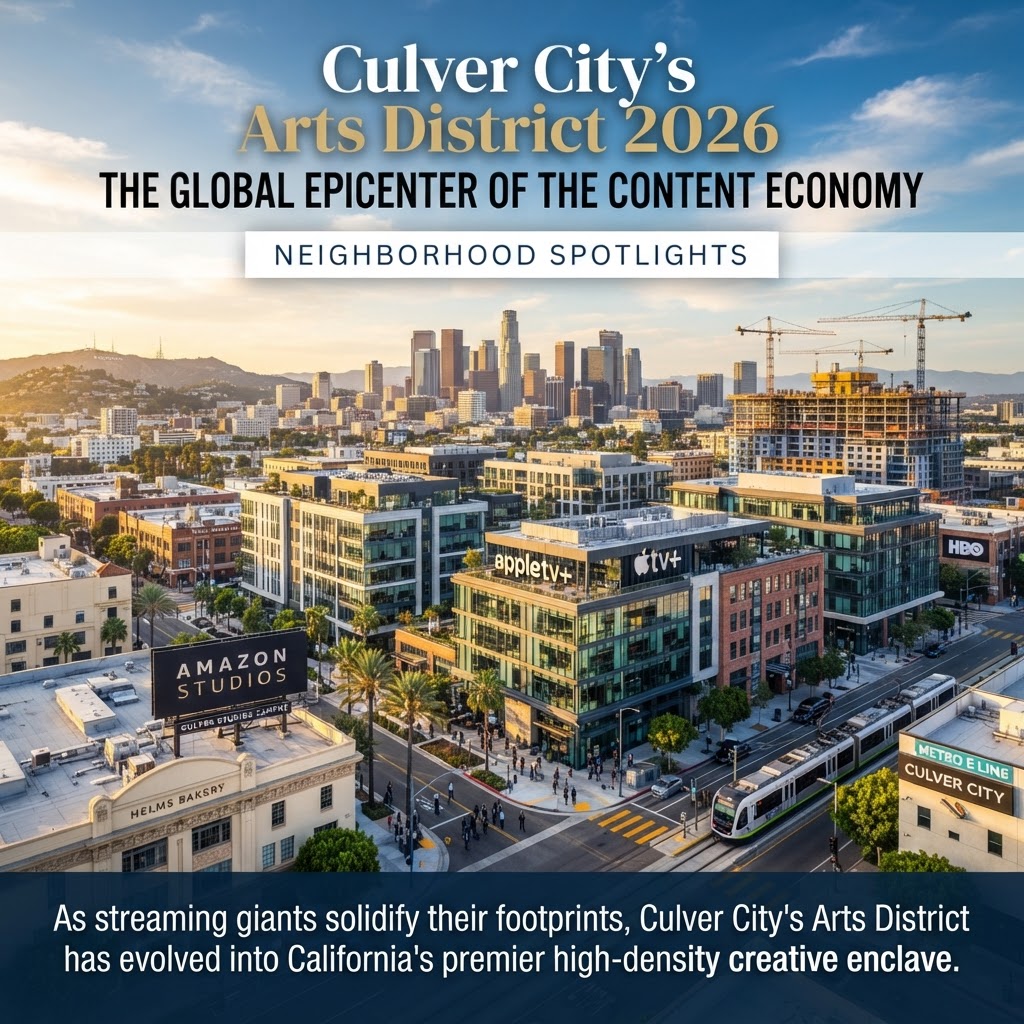
The 'Hollywood 2.0' Transformation
As of July 2026, the geographic center of the entertainment industry has decisively shifted west of the 101. While Hollywood remains the symbolic home of cinema, Culver City’s Arts District and the adjacent Hayden Tract have emerged as the functional headquarters of the global content economy. Driven by the massive campus expansions of Apple, Amazon Studios, and Warner Bros. Discovery, this neighborhood has transitioned from a sleepy industrial pocket into a hyper-dense, transit-oriented powerhouse.
The Multi-Generational Infrastructure Boom
The defining feature of the Arts District in 2026 is its seamless integration of 'Creative Office' space with high-end residential density. According to recent data from CBRE, the Culver City submarket maintains a 4.2% vacancy rate for Class A creative office space, significantly outperforming the broader Los Angeles average of 18.5%. This demand is fueled by the 'streaming wars' maturation, where production and post-production workflows are now permanently anchored in the city’s specialized soundstages and tech hubs.
Infrastructure has kept pace with this commercial growth. The Metro E Line (formerly the Expo Line) serves as the neighborhood's circulatory system, connecting the Arts District to Santa Monica and Downtown LA in under 30 minutes. The completion of the 'Culver Steps' expansion and the 2025 bike-lane initiative has turned the district into one of the most walkable 'park-once' environments in Southern California.
Real Estate Dynamics: Scarcity and Appreciation
The residential market in the Arts District is characterized by extreme inventory constraints and high-velocity sales. MLS data from Q2 2026 indicates the following:
- Median Sales Price: The median price for a single-family home in the immediate vicinity has reached $2.1 million, a 12% year-over-year increase.
- Condo Appreciation: Modern luxury condos and townhomes near Ivy Station are averaging $1,350 per square foot, driven by demand from high-earning tech and media professionals.
- Rental Yields: Proximity to the Apple and Amazon campuses has pushed one-bedroom rents to an average of $4,200, making it one of the highest-yielding submarkets for multi-family investors in the state.
Education and Community Amenities
A primary draw for executive-level buyers is the Culver City Unified School District (CCUSD). As of the 2026 academic year, CCUSD continues to outpace neighboring districts in STEM funding, thanks in part to local corporate partnerships. Linwood E. Howe Elementary, situated walking distance from the Arts District, remains a top-tier choice for families prioritizing bilingual immersion and arts-integrated curricula.
Lifestyle amenities have evolved to cater to the 'work-from-anywhere' elite. The district is now home to three Michelin-recognized dining concepts and the 'Platform' shopping complex, which serves as a prototype for modern experiential retail.
Practical Takeaways for Stakeholders
For Buyers and Families
Focus on the 'Inner Ring' of residential streets east of La Cienega. While prices are at record highs, the proximity to the CCUSD schools and the transit hub provides a 'valuation floor' that makes these properties highly resistant to market downturns.
For Investors
The opportunity lies in 'Adaptive Reuse 2.0.' With the city's updated zoning laws favoring mixed-use development, small-scale multi-family projects (4–8 units) that incorporate smart-home technology and EV-ready infrastructure are seeing the highest appraisal premiums.
For Sellers
Inventory remains at historic lows (less than 1.5 months of supply). Marketing strategies should emphasize the '15-minute city' aspect of the Arts District, targeting the influx of relocation buyers from Northern California and the East Coast who are following the tech-to-content migration.


